
Hudl Statsbomb’s Defensive Responsibility model separates the centre-back from the system, giving recruiters and analysts a cleaner read on J.League defenders.
Japan has mostly been known for producing high intensity, technical attacking talent. But in recent years a large influx of defenders have emerged as well. As Japanese players in these positions are increasingly moving to and staking their place in European leagues, it's worth asking how we evaluate these defenders.
Released just this summer, Hudl Statsbomb's Defensive Responsibility (DefR) model gives us a new way to approach it.
DefR is the inverse of the usual approaches to defensive metrics, where you are identifying and then assigning a value to a defender's action. Here instead we are looking at an attacker's action, identifying and assigning a value to that, and then working backwards. First by looking at where the action happened, the momentum of the attack and the shape of the defending team, then identifying which defender in which role would normally be expected to deal with it.
That gives us two readings: whether a defender made more or fewer defensive actions than were expected of them (DefR), and how much of the attacking value the opposition generated (On-Ball Value) was allowed through the space they were responsible for.
The 100 Year Vision League was a time for experimentation and strengthening squad cohesion all across Japan. We can use DefR to look at some of the best defenders from the competition and see which player’s performances might be worth monitoring during the 2026/27 season proper.
Mapping J.League Centre-Backs
Let's begin by firstly looking at the overall landscape of centre-backs in the 100 Year Vision League. We'll filter it down to those that played over 900 minutes to focus our analysis on regular starters. This gives us a pool of 54 centre-backs at the J1 level.
As explained in the main DefR article, we can divide the data points sitting along the two axes of Responsibility-Weighted OBV Conceded per 90 and Defensive Actions Above Expectation per 90 to produce four specific quadrants.
Used together, these two metrics tell us not just how proactive a defender is, but also how much attacking value a player allows through the area they marshal, giving us a more complete picture of defensive output than had been previously possible with just event data.
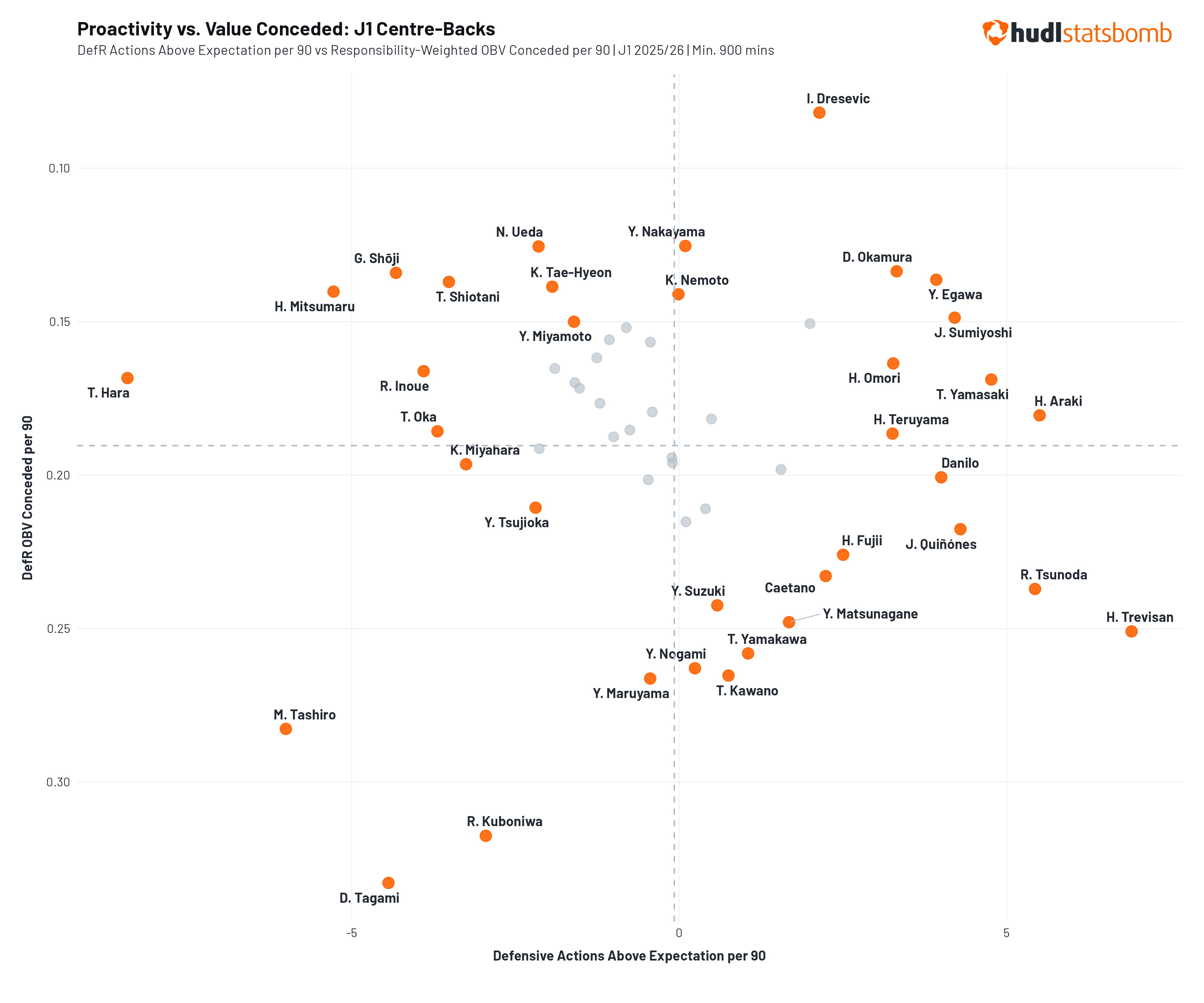
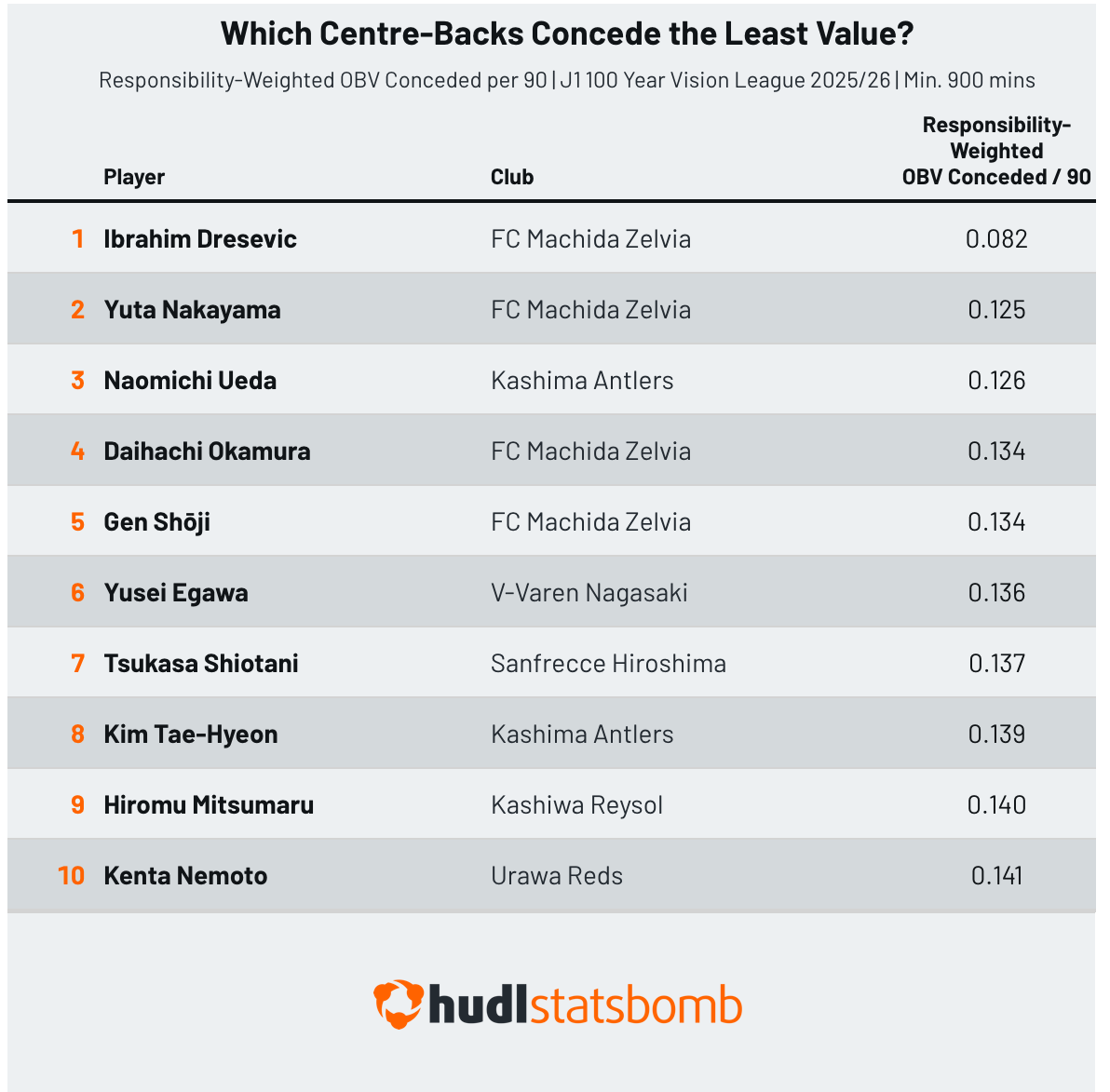
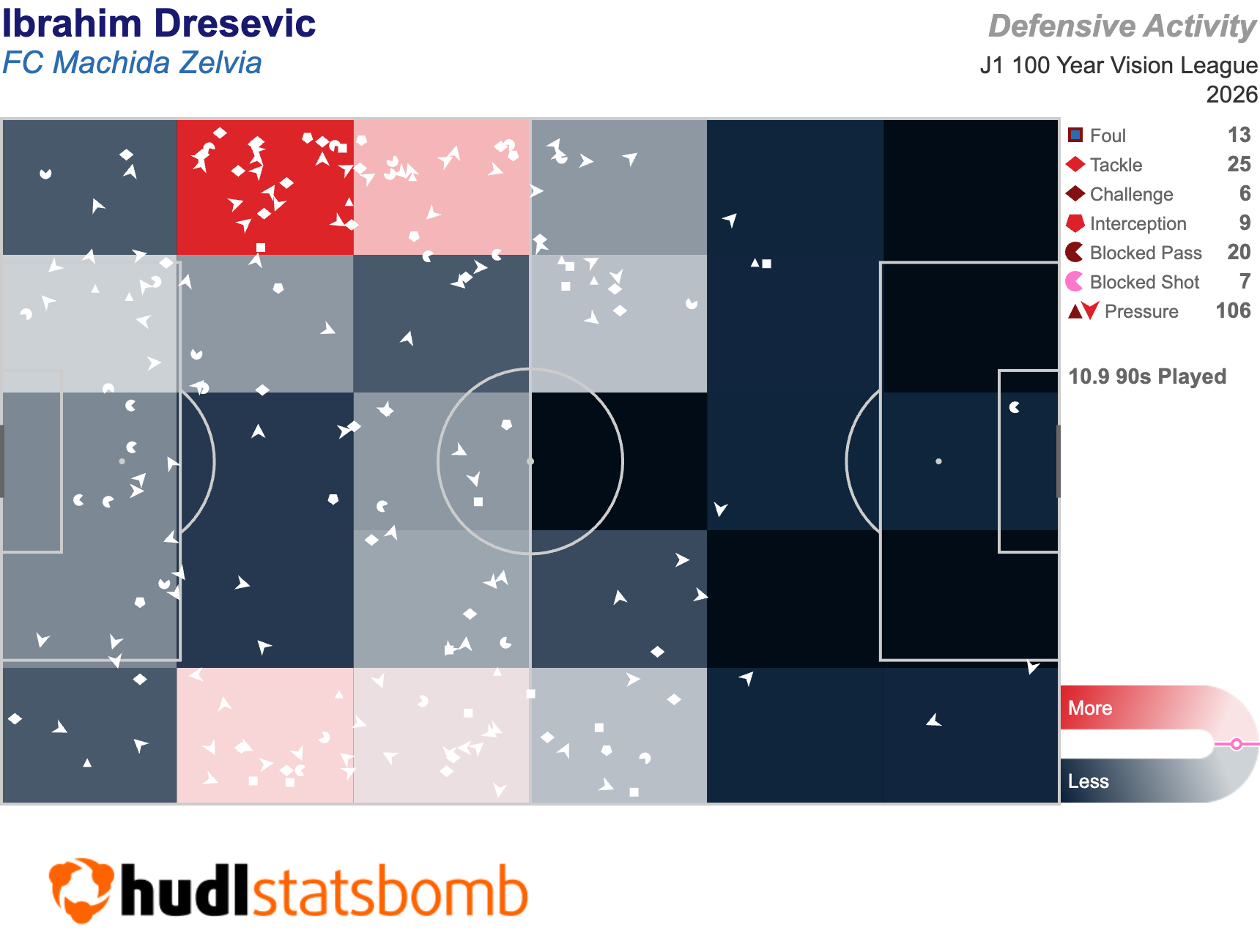
Ibrahim Dresevic was a particular standout. The Kosovo international has been at Machida since 2024 and operates as the left-sided wide centre-back in a defensive line of three. During the 100 Year Vision League he was very good at protecting the space vacated by his left wing back ahead of him, proactively stopping counterattacks before they fully developed, while also making key shot blocks inside his own box.
Dresevic didn’t play regularly in 2026 but when you look at the fact that his teammates also make up the top ranks by this new metric it shows that competition is fierce and that Machida’s system facilitates whichever player comes in to seamlessly slot in without much of a drop off.
On the other hand, perhaps, it may provide some evidence that he should in fact be playing more. Of course, outside of the data one might also need to consider various tactical reasons such as the chemistry between any combination of centre-backs along with their wing back partners.
An intriguing entrant in the quadrant here was Yusei Egawa who was promoted with V-Varen Nagasaki in 2026. He impressed with his very front-footed approach to defending as he came first among the pool of centre-backs in aggressive actions, tackles and interceptions, and pressures while also coming second in counter-pressures and blocks per shot faced.
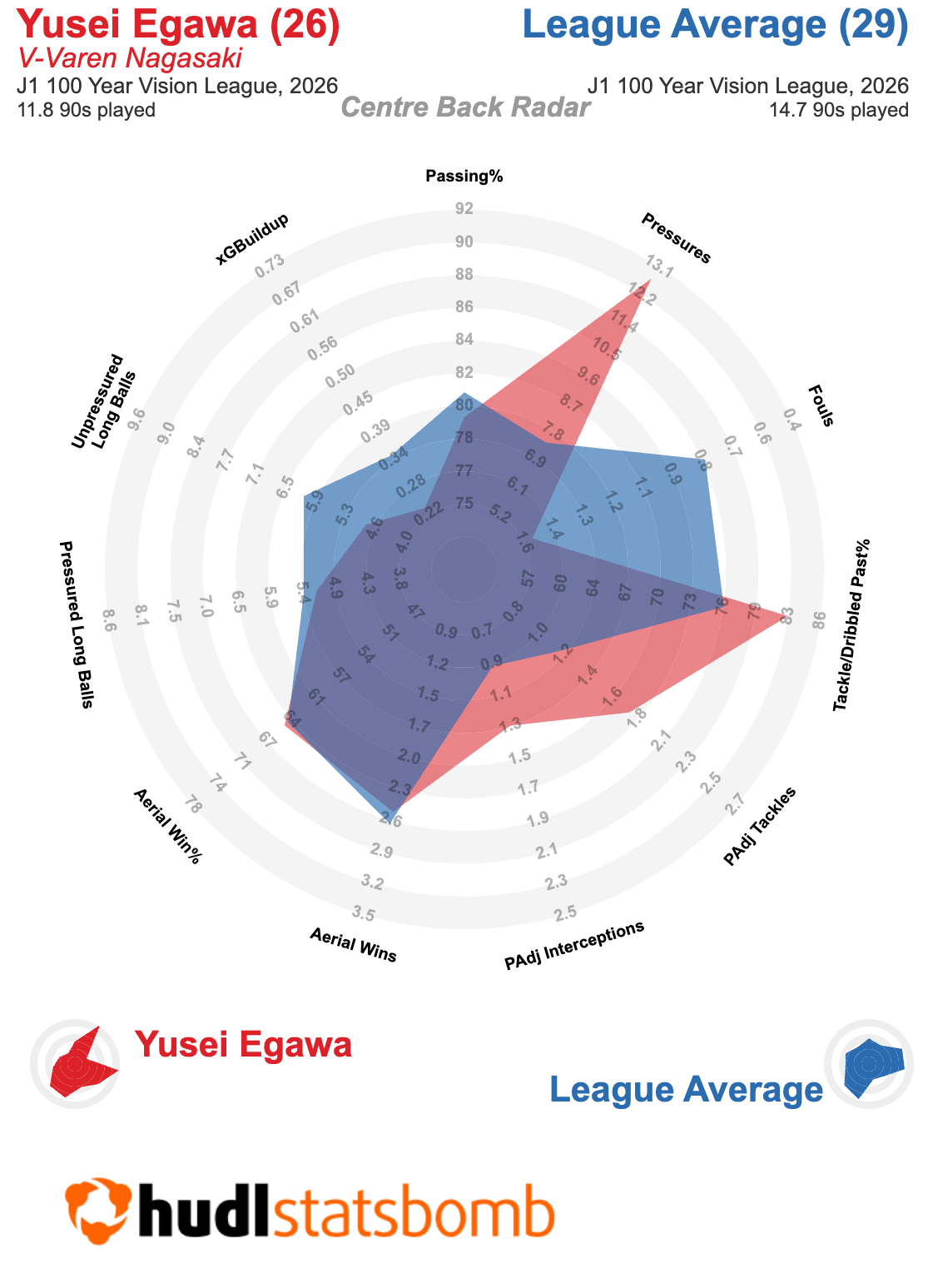
Hiroshi Omori also caught the eye when watching Fagiano Okayama this past season. Just one year ago he was playing in J3 but performed admirably despite the steep playing level change. Both Egawa and Omori show the talent lurking in the second and third tier, ready to be unearthed by smart scouting.
Bottom Right Quadrant: Busy Isn't Always Better
The players that show up here feature the likes of Jeison Quinones and Ryotaro Tsunoda (Yokohama F. Marinos' pairing), along with Kawasaki Frontale's young Yuto Matsunagane and Kyoto Sanga's Henrique Trevisan.
This quadrant is typified by those that are very aggressive due to team and/or individual style, but are consistently getting caught out and conceding a lot of value through their defensive actions. Of course, this may not necessarily be an issue with the individuals per se, but it might be due to them trying to fill gaps left by other teammates in front of them, suggesting more of a team tactical issue than personnel.
Some individual defensive stats that are common among centre-backs here are typified by Ryotaro Tsunoda, who was second in aggressive actions, but 49th out of 54 in terms of dribbled past, and 31st in tackle/dribbled past %. Similarly Haruya Fujii was 3rd in aggressive actions and 31st for dribbled past, although with a more respectable 18th rank in tackle/dribbled past %.
The 21 year old Yuto Matsunagane featured prominently for Kawasaki Frontale at centre-back in the 100 Year Vision League despite having spent time on loan at J3 the past few years and with his professional experience played mostly at full back instead.
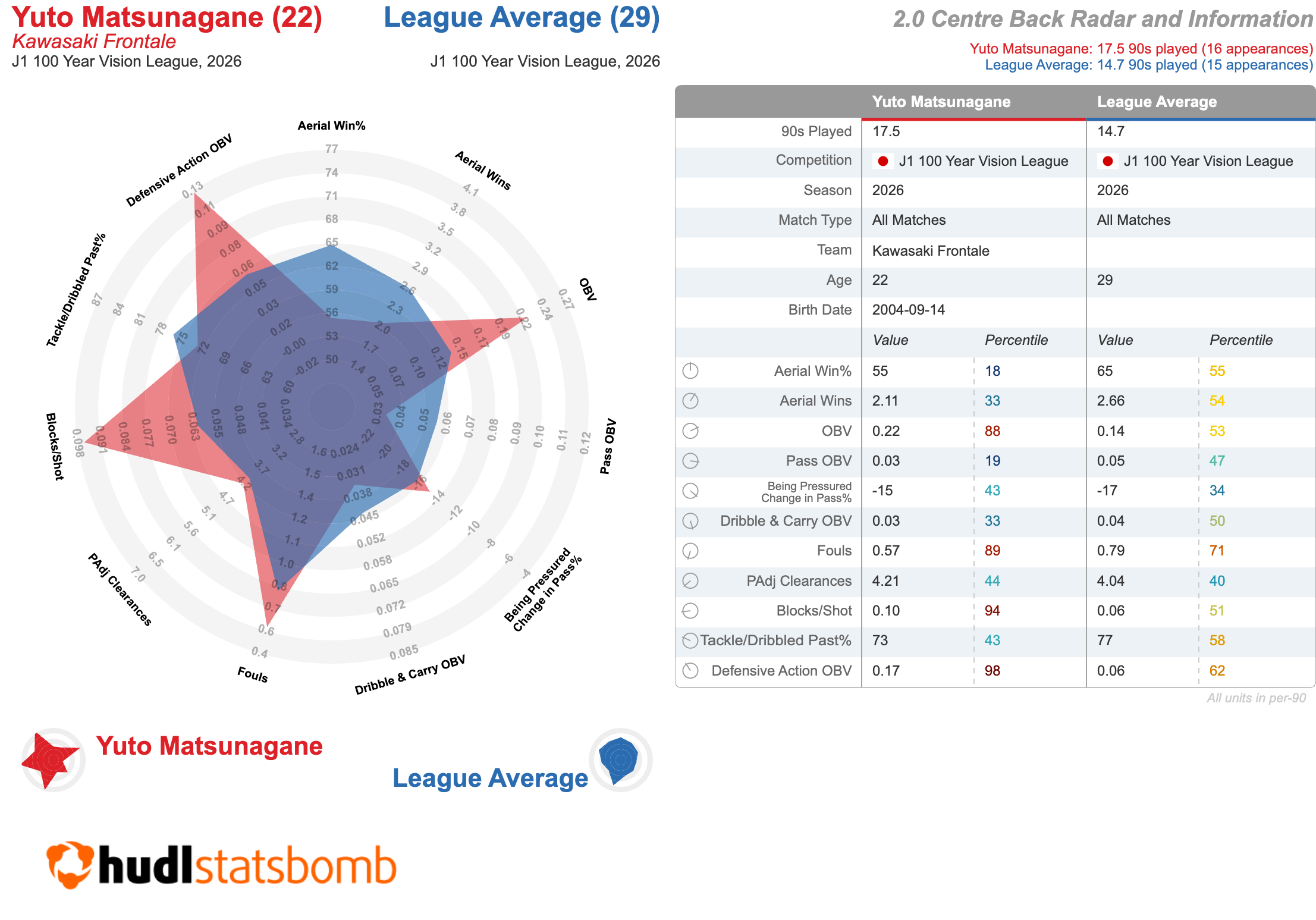
Across the half-season his decision-making looked like the part of his game still adjusting to J1. He was often willing to step out when the responsibility wasn't his, and once the duel was lost, the space behind him became the easiest place on the pitch to attack.
He is an interesting player to note here because in terms of pure defensive action OBV per 90 he ranks extremely highly due to his penchant for making some highly valuable last-ditch blocks in the box. Clearly, the defensive responsibility metric gives us a more nuanced view of the player. Perhaps this “baptism of fire” could be the springboard for improved performances in the 2026/27 season.
Top Left Quadrant: Reading the Game Rather Than Chasing It
Players like Tsukasa Shiotani, Naomichi Ueda, and Gen Shoji, with their veteran profile and foreign league and/or national team experience, are a good archetype of defender in this quadrant. These three all use their ample experience to read the game very well and only intervene when absolutely necessary.
Kashima Antlers stalwart Naomichi Ueda is actually the centre-back in our pool that is ranked dead last in aggressive actions and also 51st of 54 in tackles and interceptions. However, given how he is third in fouls per 90, eighth in blocks per shot faced, and fourth in aerial win percentage, one can understand he is effective in the rare times he does engage. As we can see in his heatmap, nearly all of his defensive actions come inside the box.
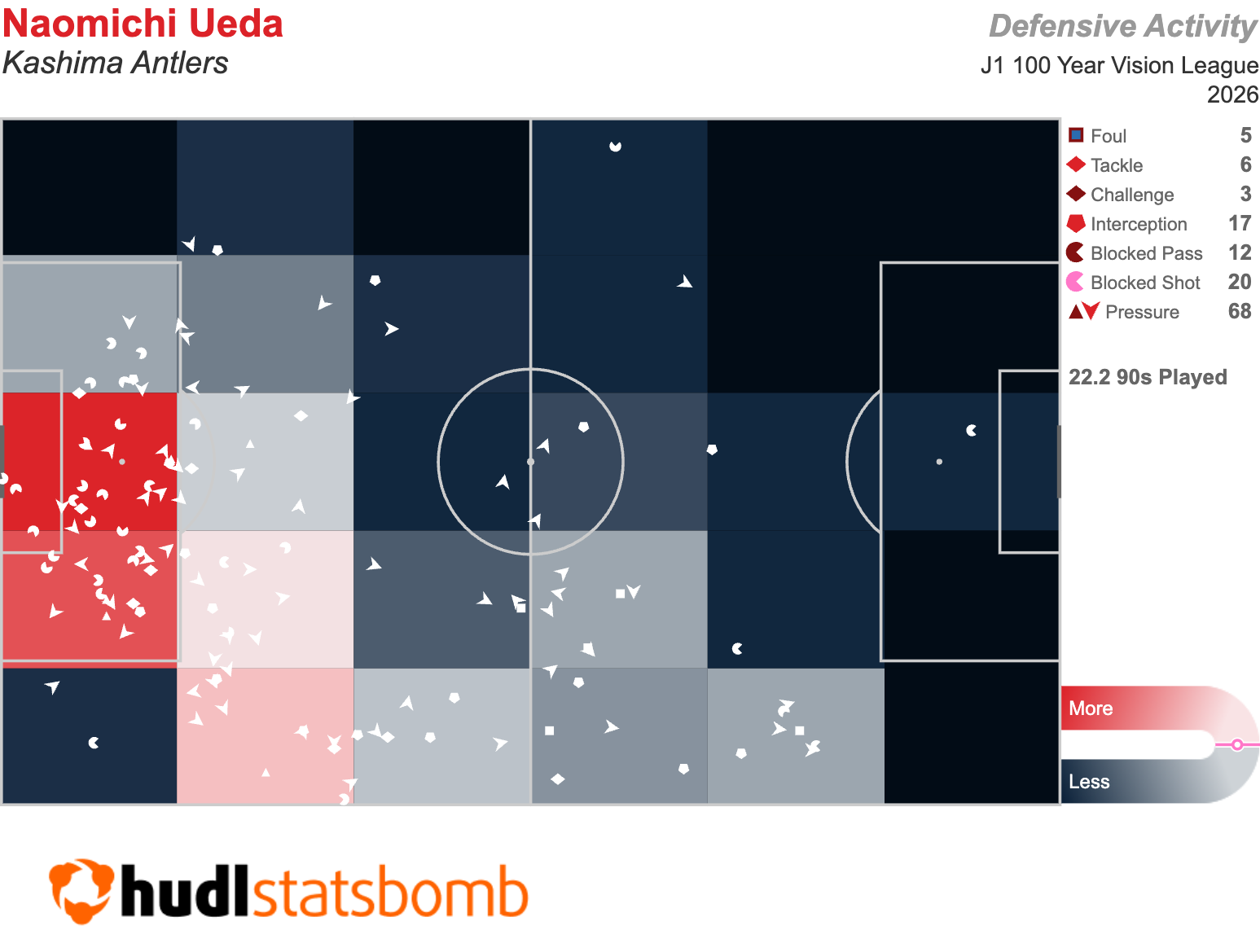
Kim Tae-Hyeon, Ueda's centre-back partner, being in this quadrant provides some evidence that their presence might be more about Kashima Antlers' defensive system rather than being about the proclivities of these two particular individuals in isolation. In that regard it shouldn’t be a surprise that Kashima Antlers as a team recorded the second lowest aggressive actions and pressures in the league in 2026.
The younger players in this quadrant like Yuta Miyamoto, Teppei Oka, and Kim Tae-Hyeon might be players to keep an eye on to see if their careers extend fruitfully into their 30s given their patient and eagle-eyed defending style.
Bottom Left Quadrant: Deep, Passive and Exposed
This is the quadrant that might raise some flags about the defenders present. Players in the bottom left such as Masaya Tashiro, Daichi Tagami, Yuma Tsujioka, and Ryota Kuboniwa are both very passive while also conceding a lot of value from their opponents’ attacks.
An extreme example is Fagiano Okayama's Daichi Tagami, who actually ranks in the 99th percentile for Defensive Action OBV through a lot of last ditch shot blocking but is overall an extremely passive defender sitting deep inside his own box. Of course, given that he usually plays in the centre of a back three partly explains this but nevertheless the fact that he is in the lowly 7th percentile for tackle/dribbled past % hints at why he is in this quadrant.
Masaya Tashiro's defensive actions are also mostly inside his own box and unsurprisingly he is ranked 53rd out of 54 in terms of pressures. Of course this isn't necessarily a bad thing by itself. As we saw in the previous section where Kim Tae-Hyeon and Naomichi Ueda were ranked similarly and Tashiro’s task is providing cover as the centre of Avispa Fukuoka's back three. However, sitting 54th out of 54 centre-backs in tackles and interceptions, 47th in recoveries, 51st in blocks per shot faced, and 44th in aerial wins does not paint a good picture for any defender.
For as much as the target is being painted on the backs of these defenders, one will also need to carefully consider the team’s defending structure in front of them, especially the centre midfielders, to get a fuller, more nuanced picture of their performance.


Conclusion: From Quadrants to Shortlists
The clearest lesson from plotting a whole league is how legible a team's defensive instructions become. Look at how tightly Machida Zelvia, Kashima Antlers and FC Tokyo's centre-backs group together, and then at Fagiano Okayama, whose two defenders sit at opposite ends of the axis. Where a squad clusters, you are largely reading a system; where it splits, you are reading individuals. That is the practical starting point for anyone using DefR - establish the cluster before you judge the player, because a defender's position here is a joint product of their instincts and their instructions.
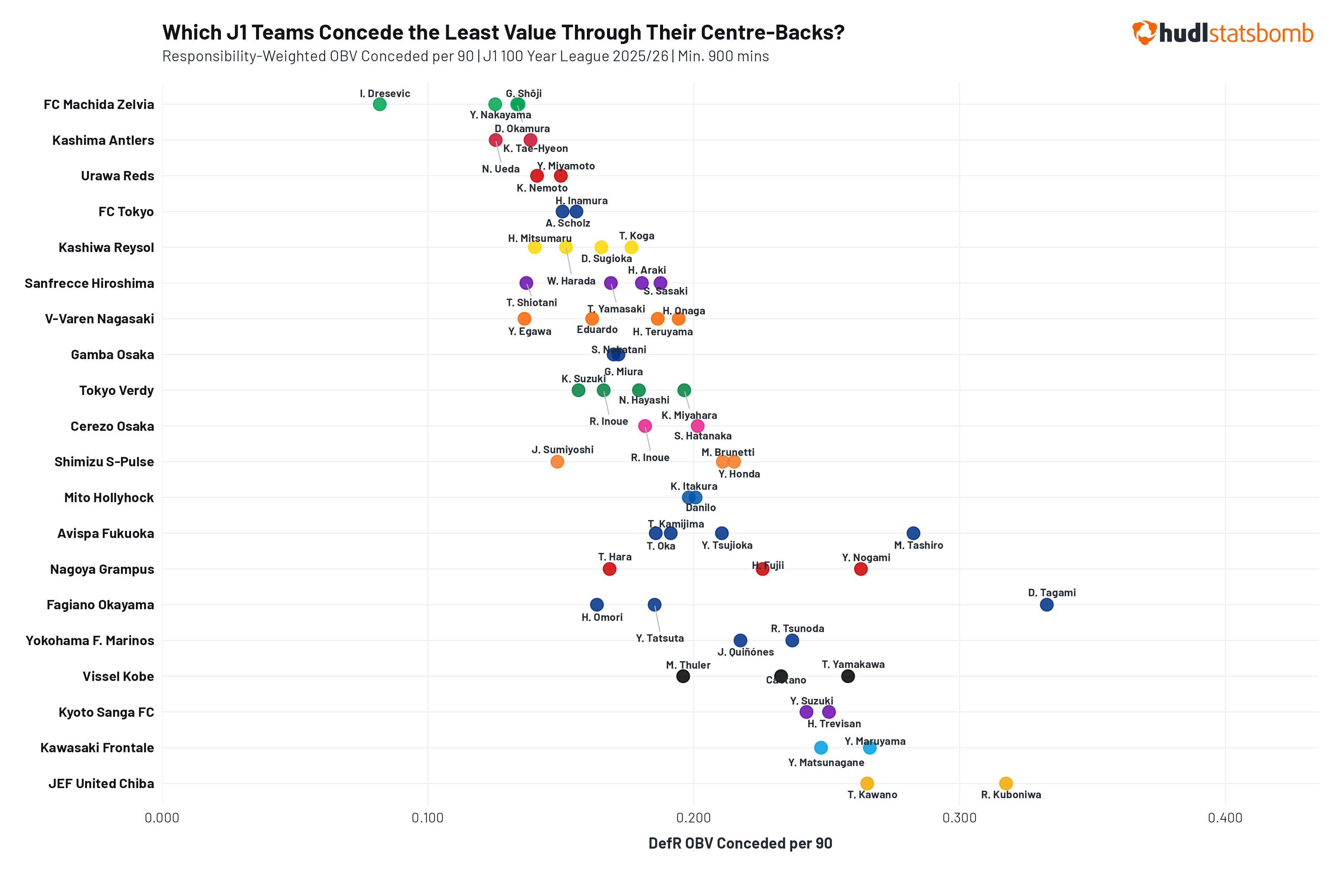
For performance analysts the value of DefR runs in both directions. On your own side, it’s a check on whether responsibility is landing where the structure intends, and whether the players carrying the most of it are the ones equipped to. On the opposition, it points to which defender is being asked to cover the most ground and which one is conceding value through their zone - a weak link you can plan to attack, or a midfield failing to protect their backline.
For recruitment, that changes the question from "who is the best defender here?" to "who defends the way we defend?" A front-footed centre-back who suppresses value in a back three, like Dresevic, is not automatically the same asset in a deep block. The players worth the most attention are the ones whose profile doesn't match their team's cluster - the outliers within a system, and the ones arriving from a lower division and holding up, as Yusei Egawa and Hiroshi Omori did this season. Those are the profiles that clear a J1 shortlist before the European market gets to them.