Scouting Japan’s next European exports? We identify three J1 prospects ready for the step up — so your recruitment team can prioritize the right targets faster.
As part of the J.League’s shift to a fall-spring calendar from the 2026-2027 season, a special bridging tournament was needed to smooth the transition. Enter the J1 100 Year Vision League.
The one-off tournament also provided J.Leaguers with a last chance to make their case for national team selection this summer in the United States. While only three domestic-based players eventually made the cut, the 100 Year Vision League nevertheless provided an excellent scouting opportunity for forward-thinking clubs looking for talented young players.
We pick out three such prospects and - using Hudl Statsbomb advanced data - we analyze these potential future Samurai Blue stars.
All the data is correct up to the last matchday of the league phase of the 100 Year Vision League.
Ryunosuke Sato (19, FC Tokyo, Attacking Midfielder)
Ryunosuke Sato is the latest player from FC Tokyo's noteworthy academy production line. A Japan youth national team regular, where he won continental titles and appeared at the U-17 and U-20 World Cups, it was only in 2025 that the 19-year-old got a taste of regular top flight action on loan at Fagiano Okayama – albeit at an unfamiliar wing back position.
This experience made him a more well-rounded player and, after a successful 2025 in which he also won his first full national team cap in June, he returned to FC Tokyo in 2026.
The most important aspect of Sato's play is his technical qualities on the ball. Due to his small size, he uses his agility to his advantage, twisting and turning away from pressure in tight spaces to face forward to pass.
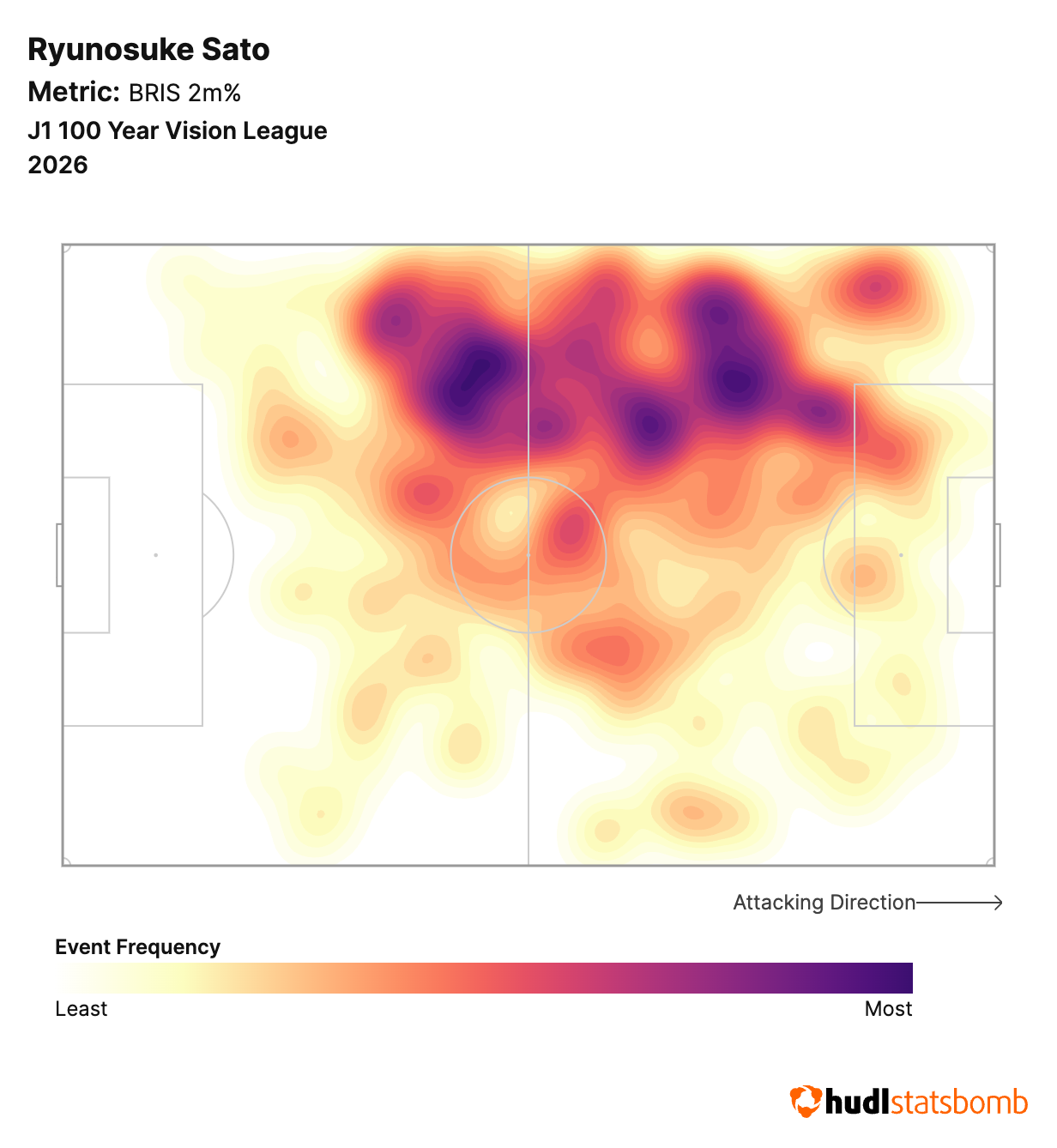
Despite often playing out wide for club and country, he is much more of a playmaker rather than an outright winger, especially as he prefers to receive ball-to-feet rather than run into large spaces.
Satos's ball receipts within 2m of space
Standing at 1.71m, the question has always been whether he can handle the physicality at higher levels of play.
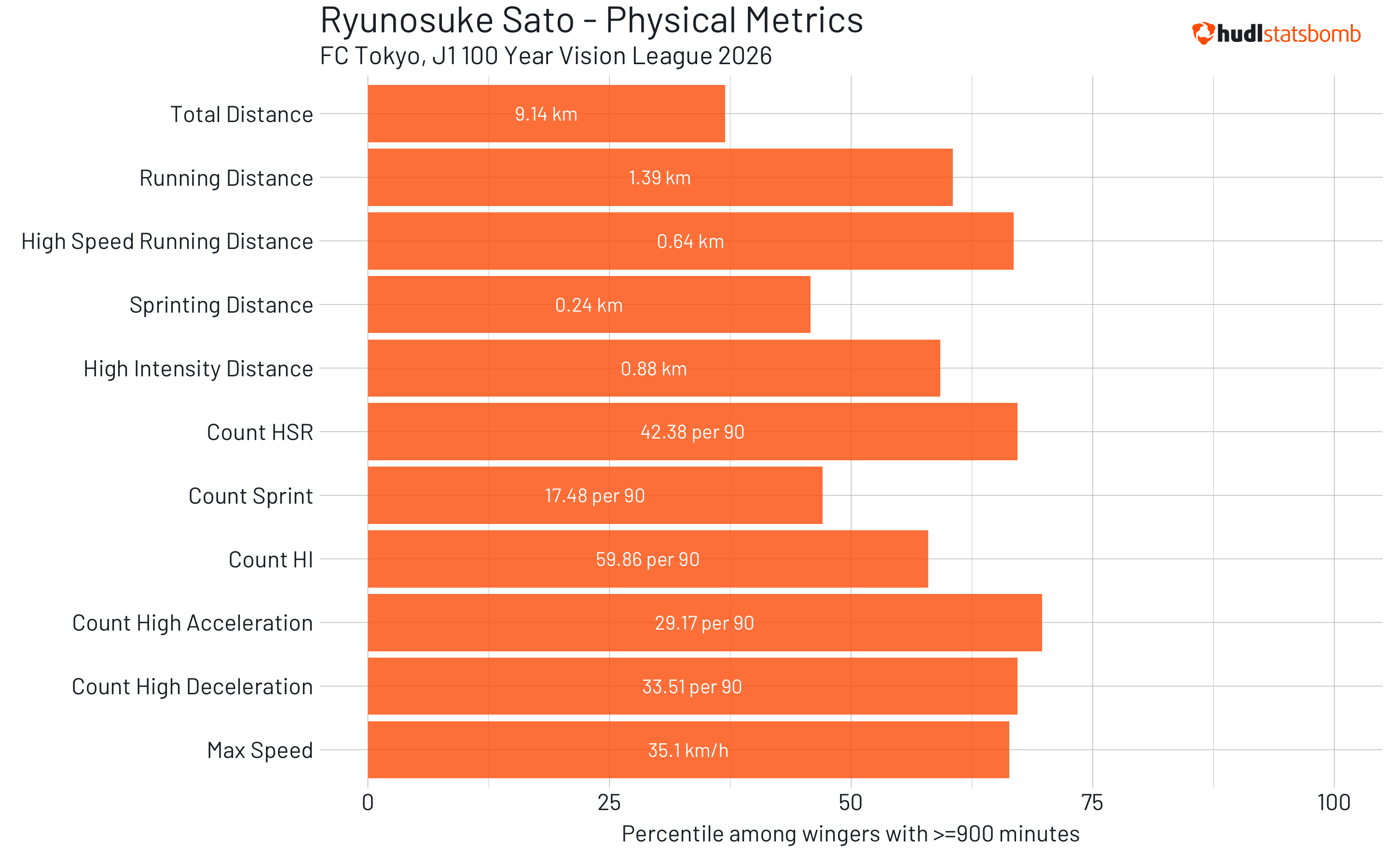
Watching footage both at Okayama and with FC Tokyo, Sato has consistently exhibited enormous physical output in terms of his running intensity on-and-off the ball – at least at the J.League level – all while maintaining his great technical qualities. He expends a lot of effort in pressing and loose ball recoveries but, due to a lack of top-end speed and explosiveness, he is better suited to a playmaker role than an out-and-out winger.
The physical data supports this too, as seen below when comparing Sato to all wingers in the Top 5 European leagues. We can see that, while there’s a solid foundation from his J.League performances, Sato will need a bit of time to adapt to a European league physical standard.
Understanding the context in which Sato plays is important for recruiters considering how he would fit into their team style.
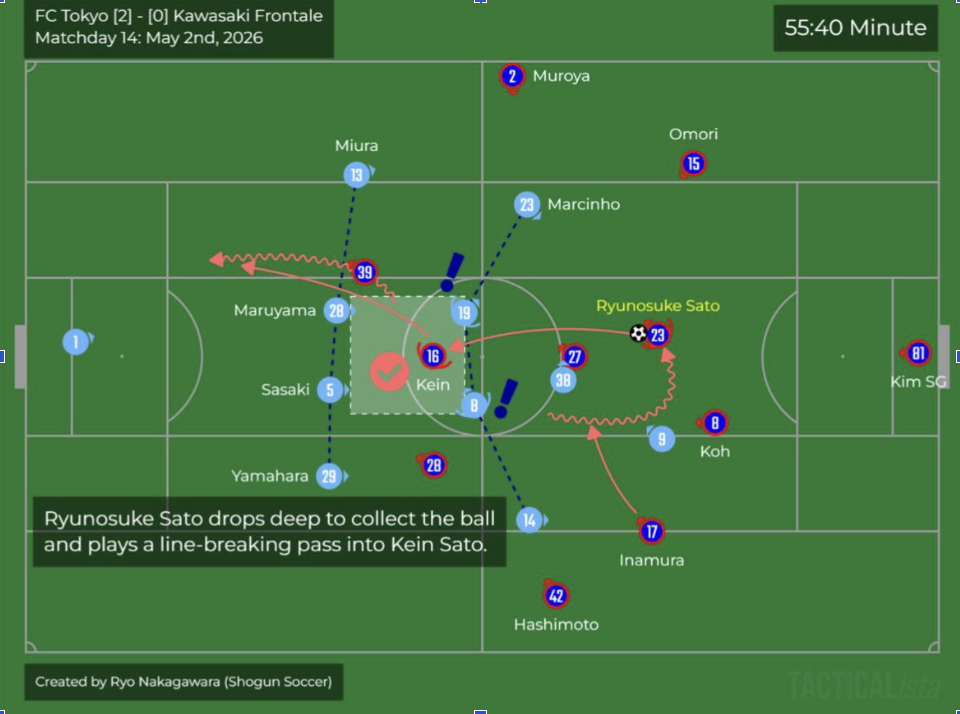
In FC Tokyo's 4-4-2 / 4-2-3-1, Sato will drop deep to act as the third midfielder to settle possession against the opponent's high press and set the tempo. In Tokyo's build-up patterns, one of the double pivot will occasionally split the center backs which then gives Sato more room to find spaces between the lines in the middle third.
This movement invites pressure inside which can then open up the full backs or wide midfielders on the outside when he lays off the ball or when he is able to turn forward himself to play the pass - as per the example below.
Build up to FC Tokyo's second goal against Kawasaki Frontale on May 2nd.
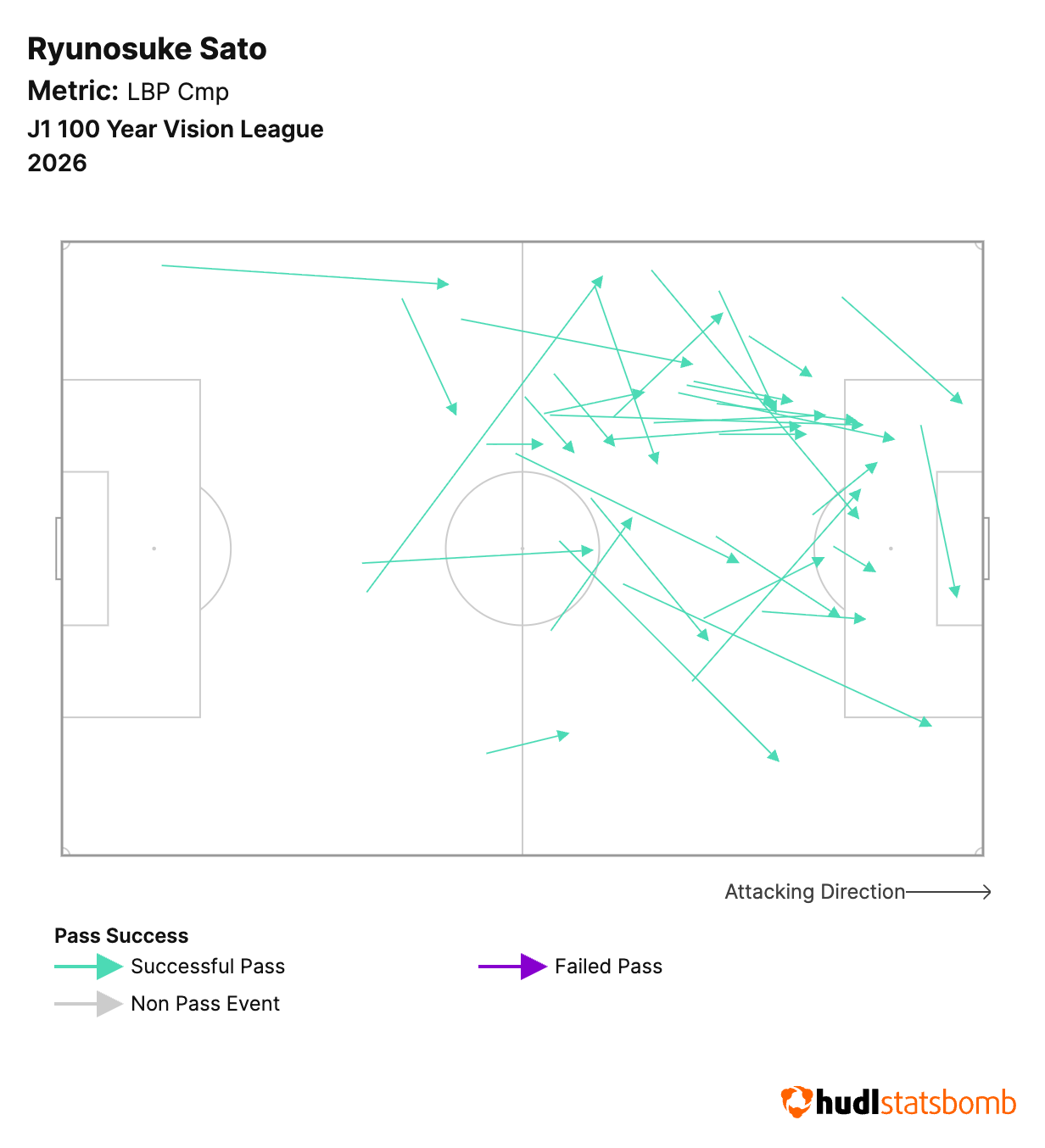
Further forward, he prefers operating in the left half-space and has great vision for through-balls and line-breaking passes.
Sato's completed line-breaking passes this season
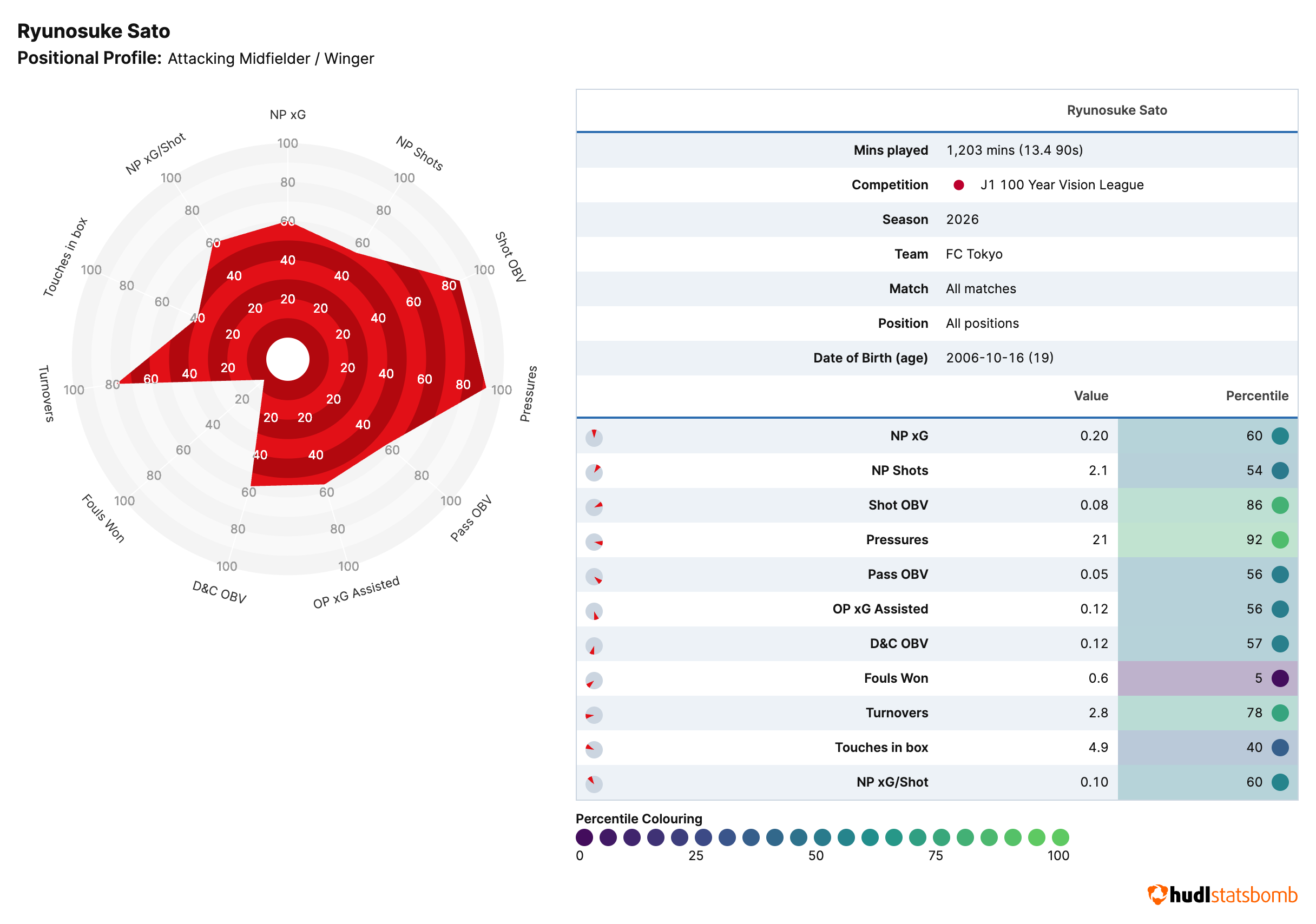
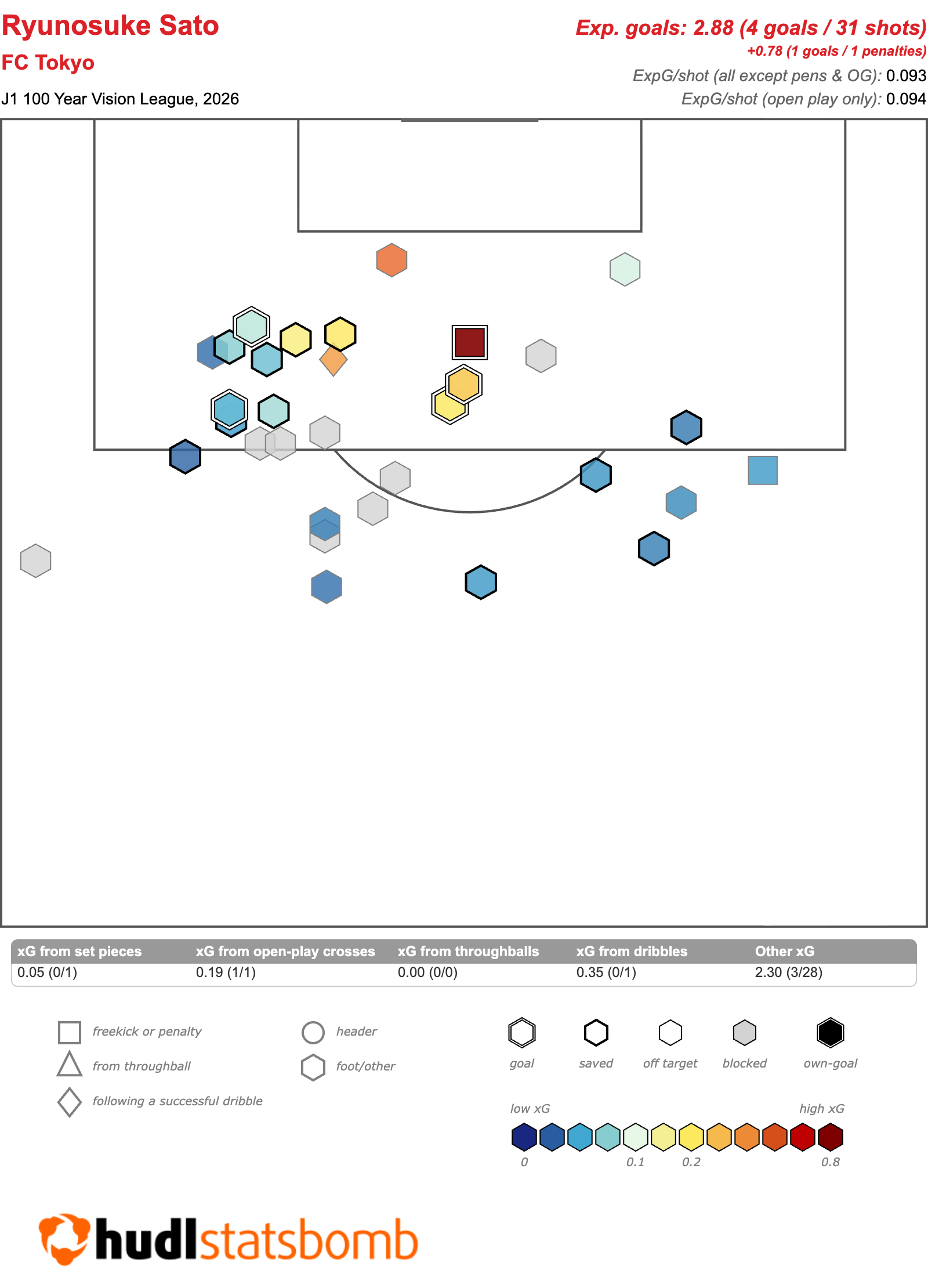
Regarding his end-product, Sato finished the half-season with 4 goals (plus 1 penalty) from 2.72 non-penalty xG. His ball-striking can be inconsistent; however, he uses his side-foot well to curl into the corners when cutting inside from the left.
As seen in the shot map below, most of his shots are clustered in the left half-space side edge of the box, amounting to xG of middling quality. A bonus is that he is a great penalty kick tacker as seen in the various shoot-outs in the league and the youth national teams.
Set pieces have become an increasingly important weapon in modern football – and are another feather to Sato’s bow.
Despite FC Tokyo struggling to score from dead ball scenarios, he is among the highest percentiles for set-piece xA, and is third in set piece xG assisted among attacking midfielders and wingers with at least 800 minutes.
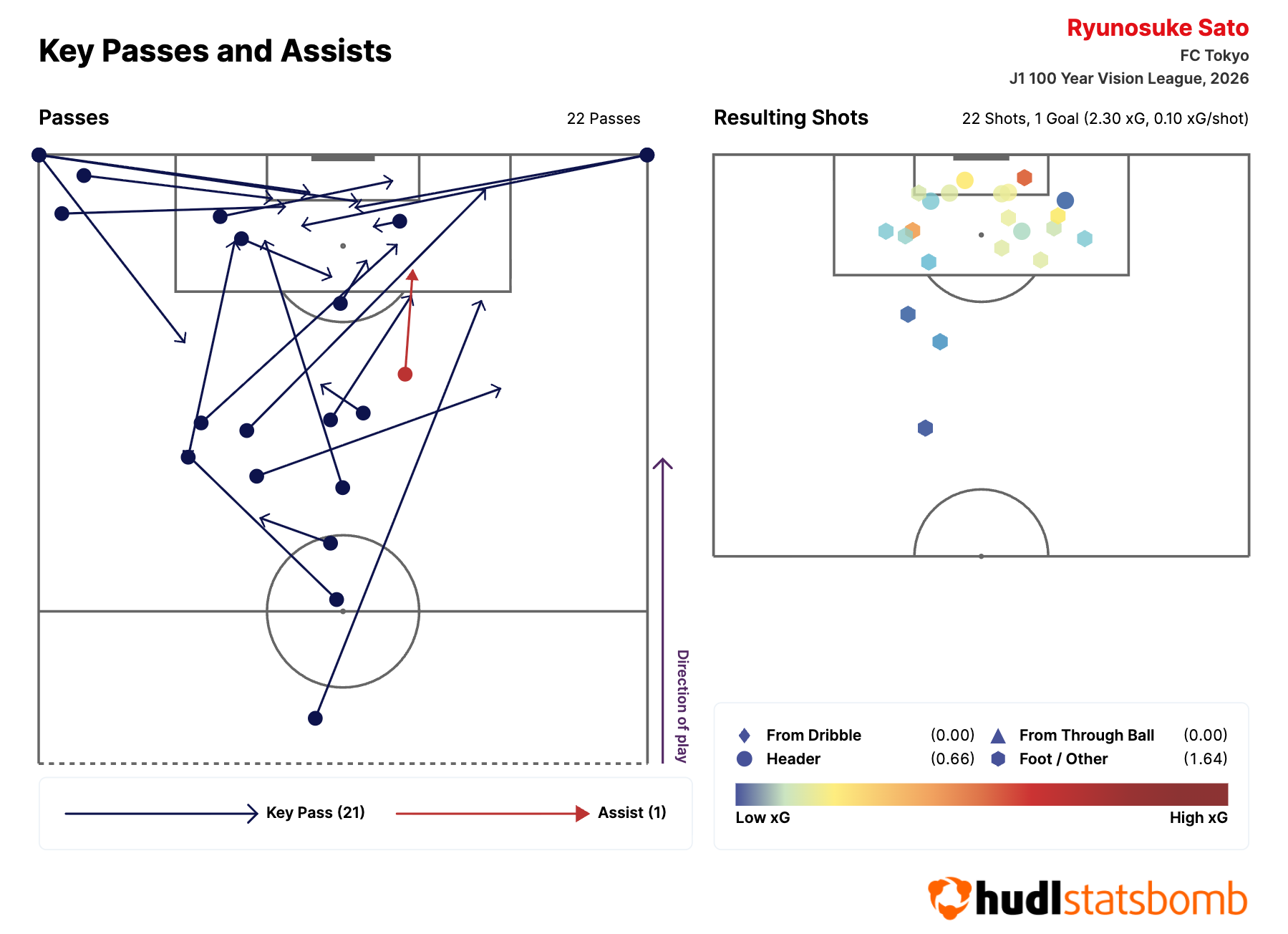
Overall with 0.97 open-play key passes per 90 and 0.04 open-play xG Assisted per 90, he may lack in absolute numbers for assists and direct chance creation for an attacking midfielder, but given how deep he drops he can be involved in possession sequences that lead to chances in various ways.
With the profile of a technical yet hard-working number 10, his skillset would be suited to a number of European leagues – albeit perhaps one that would not be such a jump in physicality and intensity.
Nelson Ishiwatari (20, Cerezo Osaka, Central Midfielder)
Cerezo Osaka have been an exciting J.League team to watch since Arthur Papas took over in 2025 and Nelson Ishiwatari is one of their more interesting young prospects.
It would be easy to put his performances on loan spell at J2 side Iwaki FC last year down to his unique physicality advantages at that level. Nevertheless, over the past few months, he’s demonstrated that these strengths have carried over to the first division.
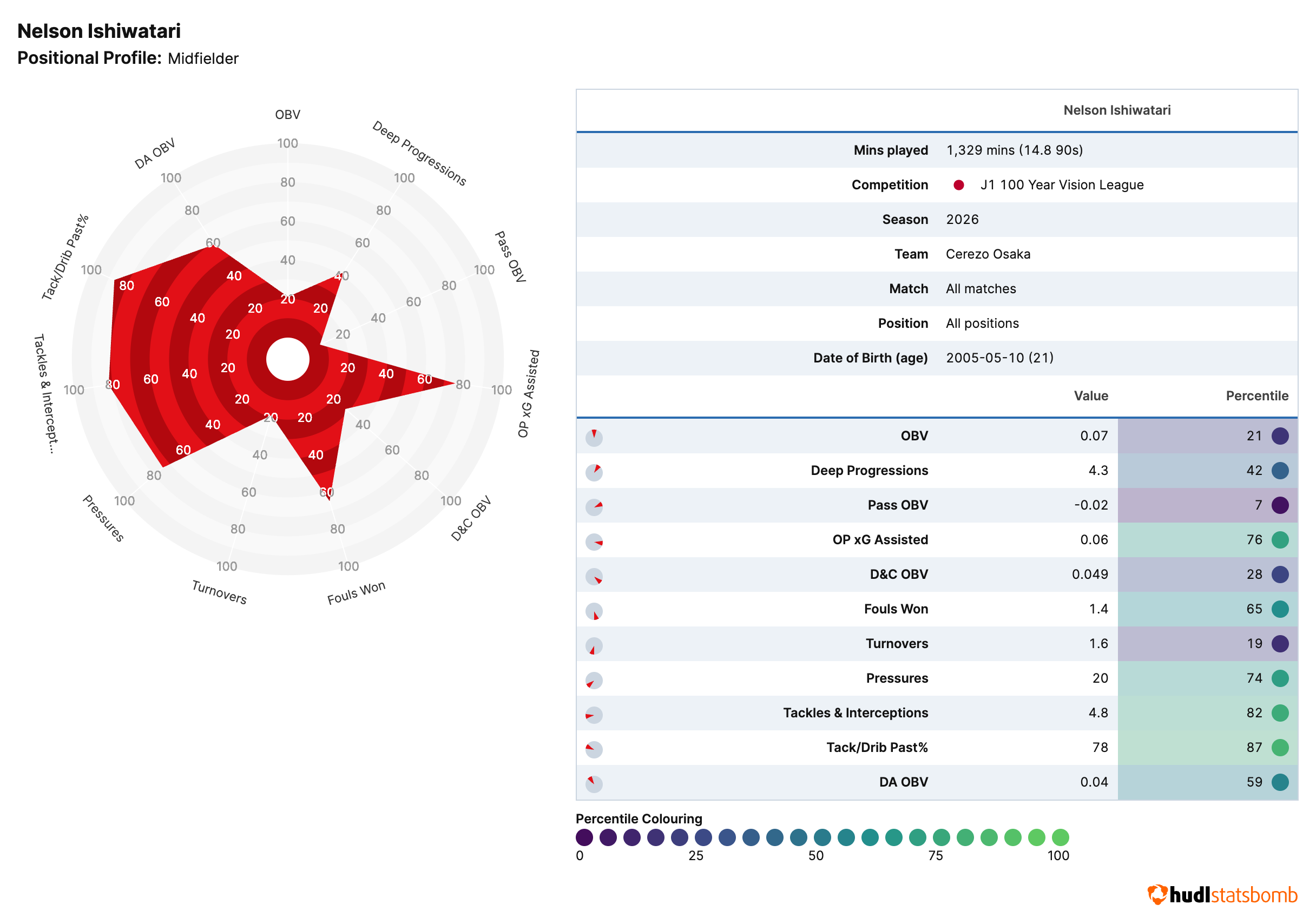
Ishiwatari's strengths lie in his endurance and mobility from which he can then use his long legs to tackle or intercept the ball. He can be quite imposing, as seen by his 78% tackle/dribbled past%, which is close to the 90th percentile across all central midfielders in the league.
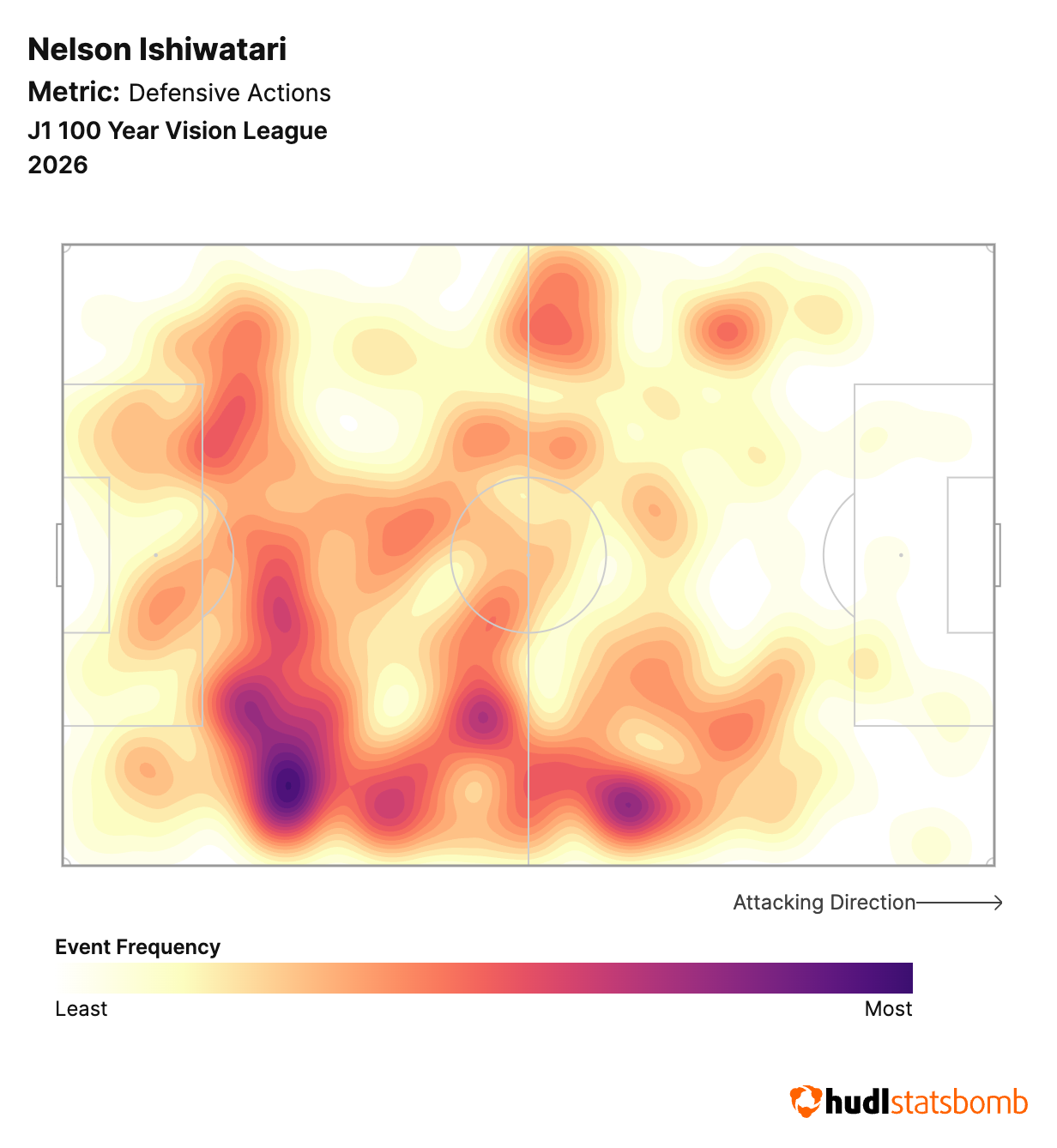
Compared to all J1 100 Year Vision League central midfielders who have played at least 900 minutes, Ishiwatari ranks highly in aggressive actions, pressures, counter-pressures, and tackles & interceptions – which quickly paints a picture about his role on the team.
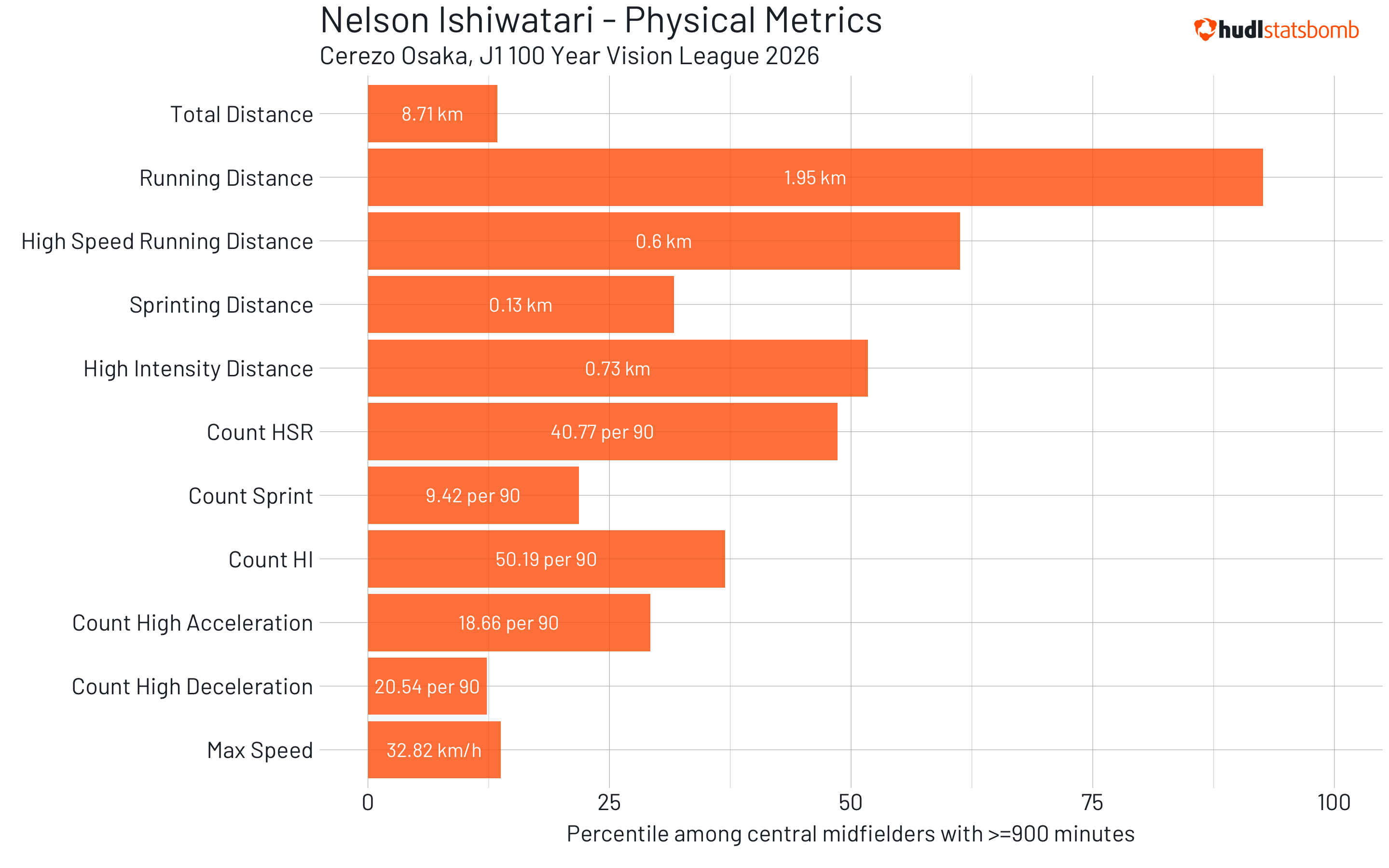
Looking at Hudl’s physical data we can see just how active Ishiwatari is. In terms of pure running distance he is in the top percentiles, not only in the J.League but compared to other central midfielders in the top 5 European leagues.
However, there is a relative dearth of sprints and other high intensity actions compared to what his positional profile might suggest. Incorporating more intense running and sprints into his game has been an area that Ishiwatari himself has mentioned that he can improve upon so that is something to keep an eye on in the future.
For all his defensive abilities, Ishiwatari is still raw and elements of his game need refining. Due to his aggressive style of play he concedes a lot of fouls (2.71 per 90) and his first touch and ball control needs improving (1.6 turnovers per 90 is in the 19th percentile among midfielders).
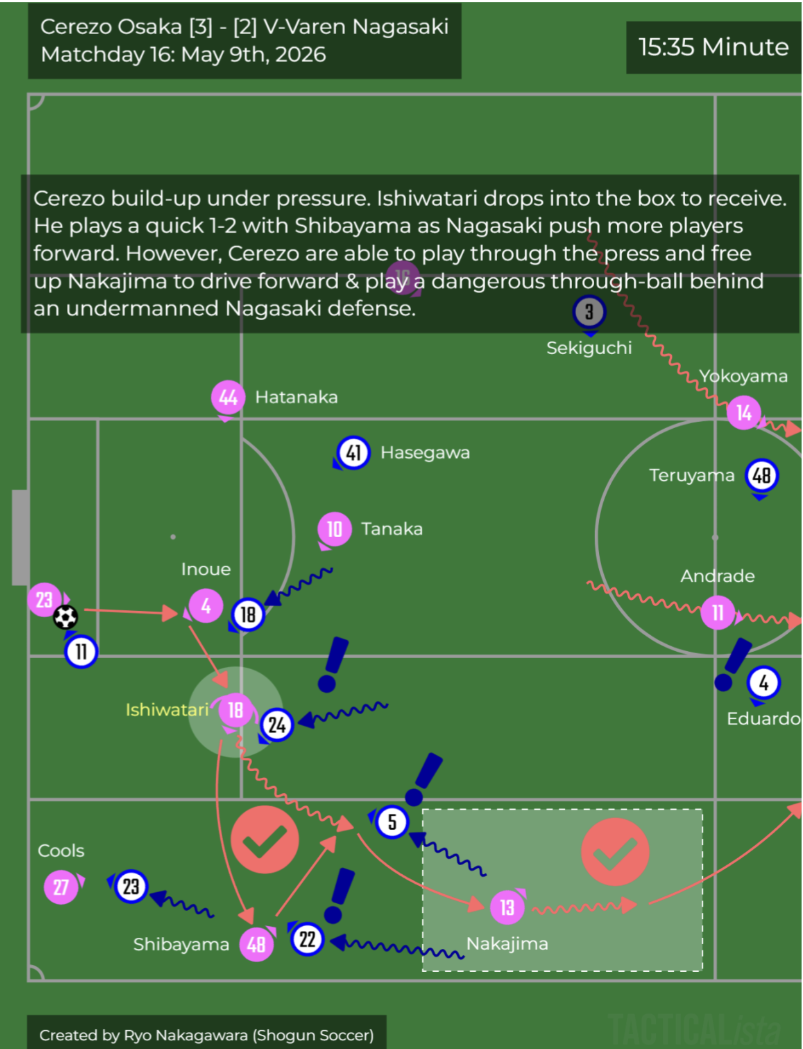
On the ball it’s a mixed bag. In the build-up phase, Ishiwatari uses his mobility quite well by popping up into various zones centrally and out wide to combine in short exchanges.
Once the ball is progressed further forward, he makes plenty of underlaps in support to hit the pockets in/around the box, but he does need to start producing more once he receives the ball there.
Despite his supporting runs, his actual deep completion numbers as well as his On-Ball Value (OBV) in passing, dribbles, and carries are all in the very low percentiles compared to other midfielders.
On the bright side, there still are occasional moments of progressive and creative passing (like his assist vs. Kyoto Sanga) and, as part of a Cerezo Osaka team that is attractive on the eye, he should have ample time to hone that part of his game.
Unlike the other two players in this list, Yumeki Yokoyama is a player that came through the local club and then high school football scene — highlighting the diverse pathways one can take to become a professional footballer in Japan.
The most compelling aspect about Yokoyama is how his ball carrying has held up to the step-up to the J1 league after joining from J2 side FC Imabari this past winter.
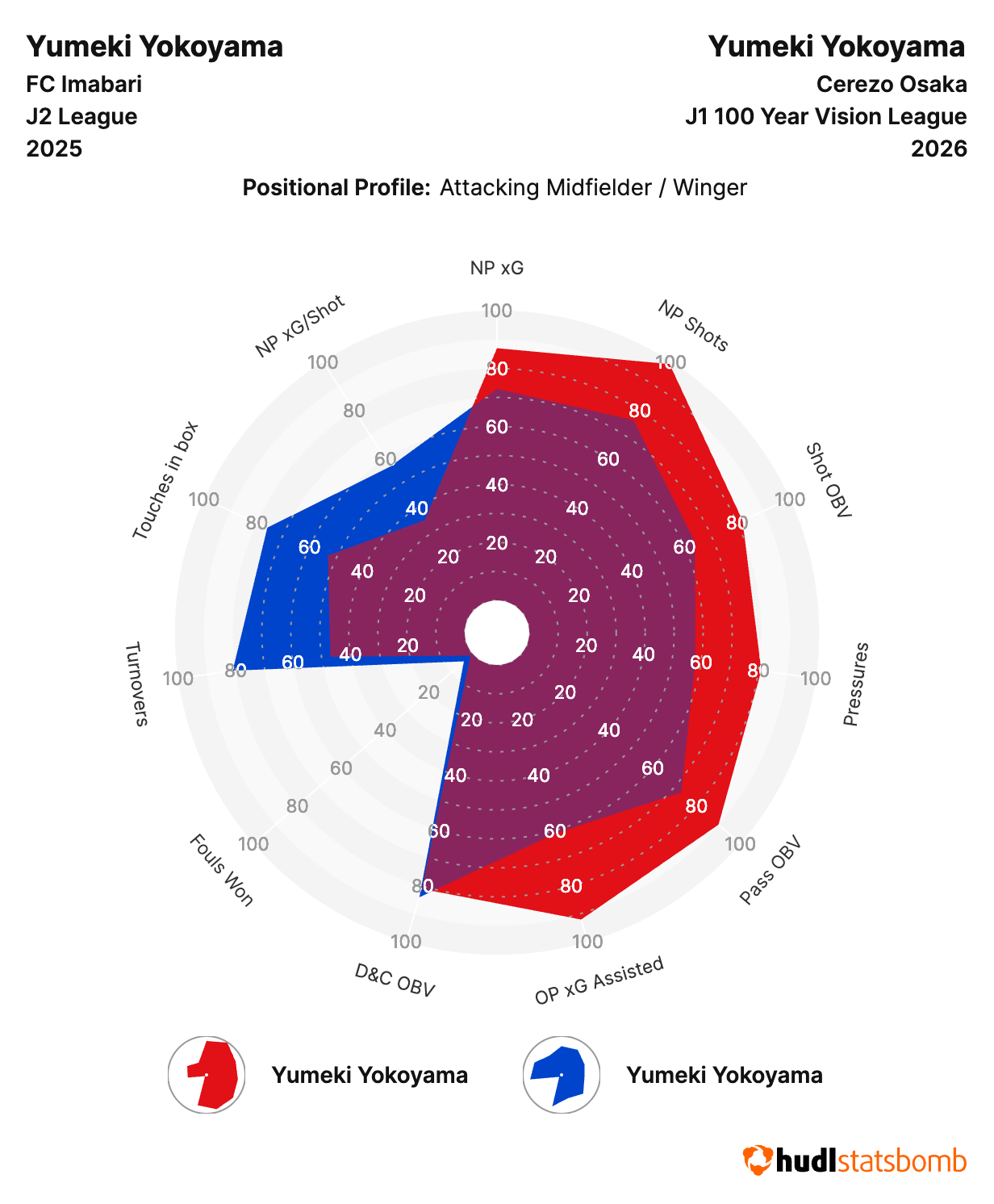
Primarily looking at his OBV, understandably there has been a slight drop in his Pass and Shot OBV, as you would expect in a higher level division. But his Dribbles and Carry OBV has remained one of the top percentiles of the league.
What is interesting is that Yokoyama is far more secure on the ball with less turnovers and is getting more touches in the box. Of course, he now has higher quality teammates around him, but there is clear personal development as well.
Watching footage of Yokoyama, something you notice is that even if the initial dribble attempt fails or he's in an unfavorable situation, Yokoyama simply resets by going back to his teammates and then re-position to try again – always showing for the ball and staying positive.
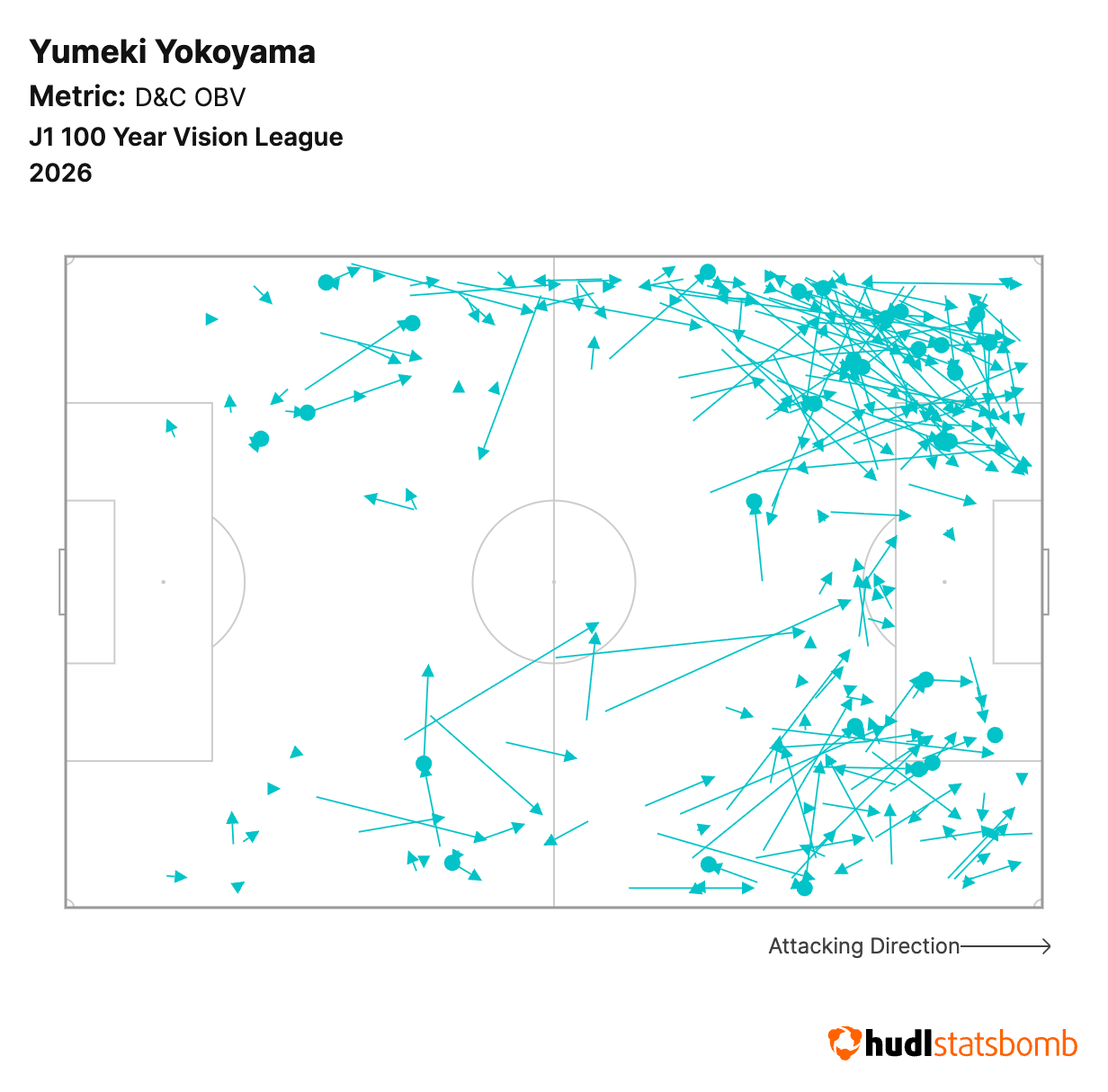
As his Dribble & Carry OBV (D&C OBV) shows, dribbling is Yokoyama’s biggest weapon, able to both go down the line to play with his left foot or cut inside to play with his right foot for both crossing or shooting opportunities. This breadth of choice gives defenders trouble as it’s not so simple to just show him to one side or force him on one particular foot.
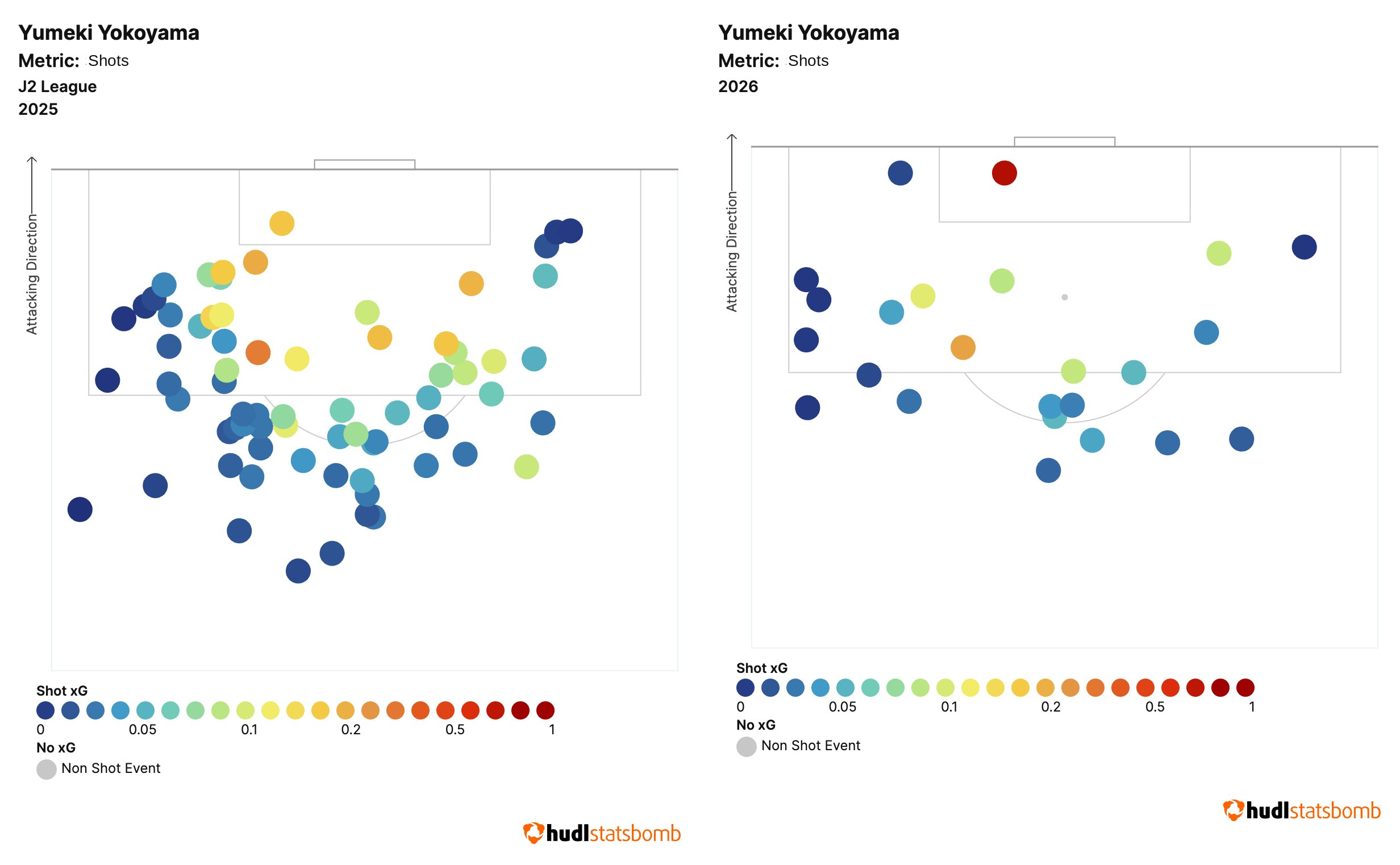
Throughout his time in J2, his biggest issue was consistently getting good shots and his final third impact in general was quite variable. That continued in J1 with Cerezo Osaka in the beginning but, in the past month or so, it's slightly improved.
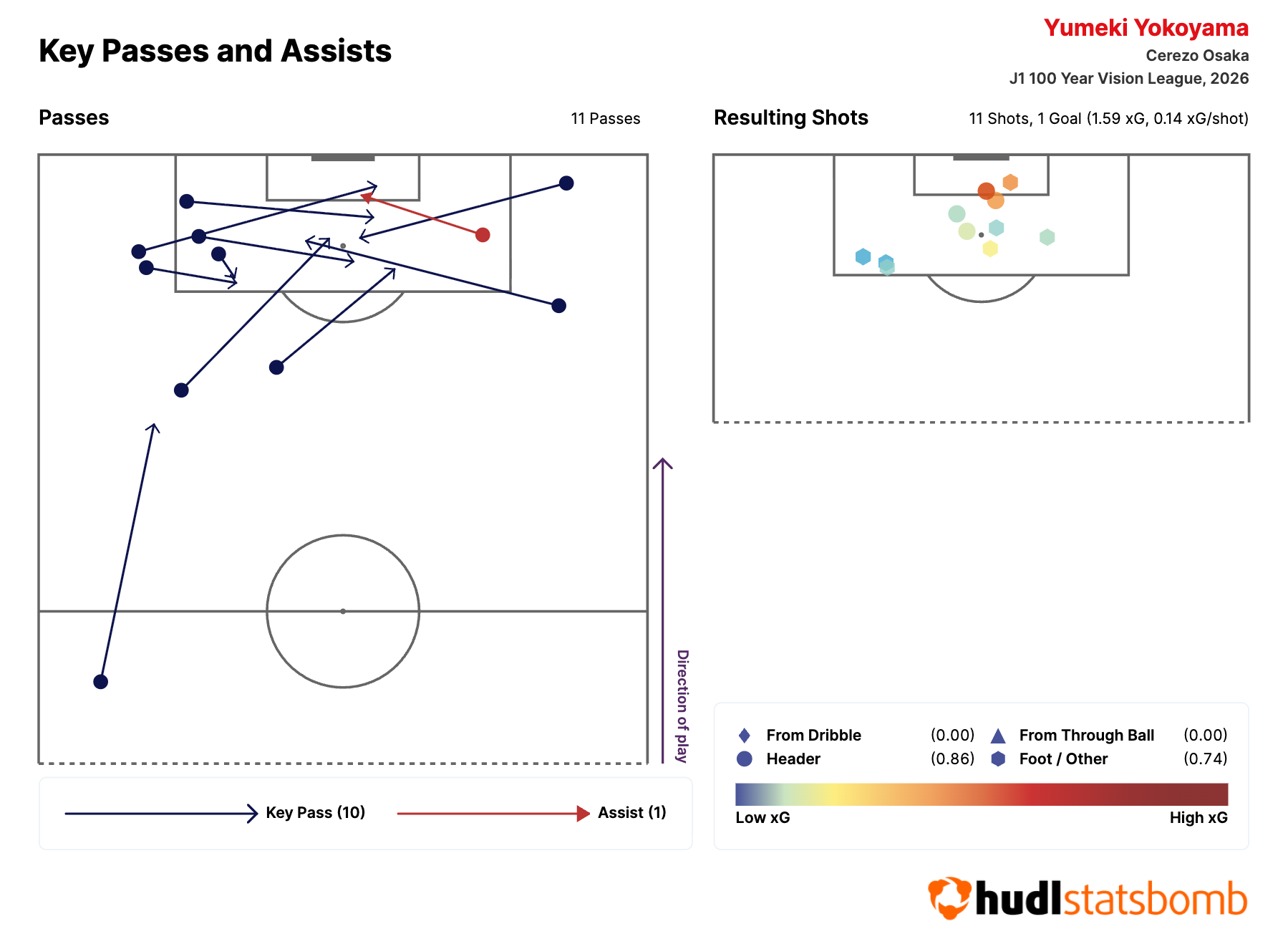
Yokoyama is a player who fires off a lot of crosses – the fifth most crosses into the box among his positional peers. This accounts for 60% of his passes into the box. However, for all this effort and reasonably positive OBV values, Yokoyama maintains a rather low cross completion, and his key passes and xG Assisted numbers are quite low. If he can improve on this final product, he would be an elite-level proposition.
While he has mainly played as a winger across the club and national team level, he also showed some versatility playing as a second striker at FC Imabari. Another challenge for Yokoyama earlier in the season was that Cerezo already had an established left winger so he was forced to play on the right for several appearances. Since then, he has won his spot in his preferred position.
In the past year, Yokoyama has shown considerable growth and resilience in different contexts, especially with his track record of consistently being able to step up to a higher level (going from J3, J2, to J1). The time for Yumeki Yokoyama to make a step up to a European league should come probably within the next year given his form in the 100 Year Vision League.
As these three players demonstrate the J.League continues to provide intriguing profiles that fit the modern game and tactical meta. This summer should be another big market for Japanese players heading to Europe.
Learn how Hudl Statsbomb’s industry-leading data can power your analysis and recruitment.