

With the new Serie A season around the corner, we look at what DefR tells us about defensive output in the top flight of Italian football.
Active is not the same as effective, though. A striker can chase the opposition's build-up all afternoon and never win the ball; a centre-back can win eight duels out of ten and still have lost the two that mattered. That is what Responsibility-Weighted On-Ball Value (OBV) Conceded is for. It takes OBV - the value every action adds to or subtracts from a team's chance of scoring or conceding - and weighs it against DefR. A high figure means opponents were creating danger from the zone that player was responsible for.
Put the two together and a coach can see where the defensive system creaks under pressure, which areas of the pitch were porous, and who was not doing their share.
Team Analysis: Do Serie A's Aggressive Teams Defend Better?
Some practical examples, then, using the 2025/26 Serie A season as the testing ground - partly to show how the metric works, partly to get some fresh insight into teams and players ahead of next season.
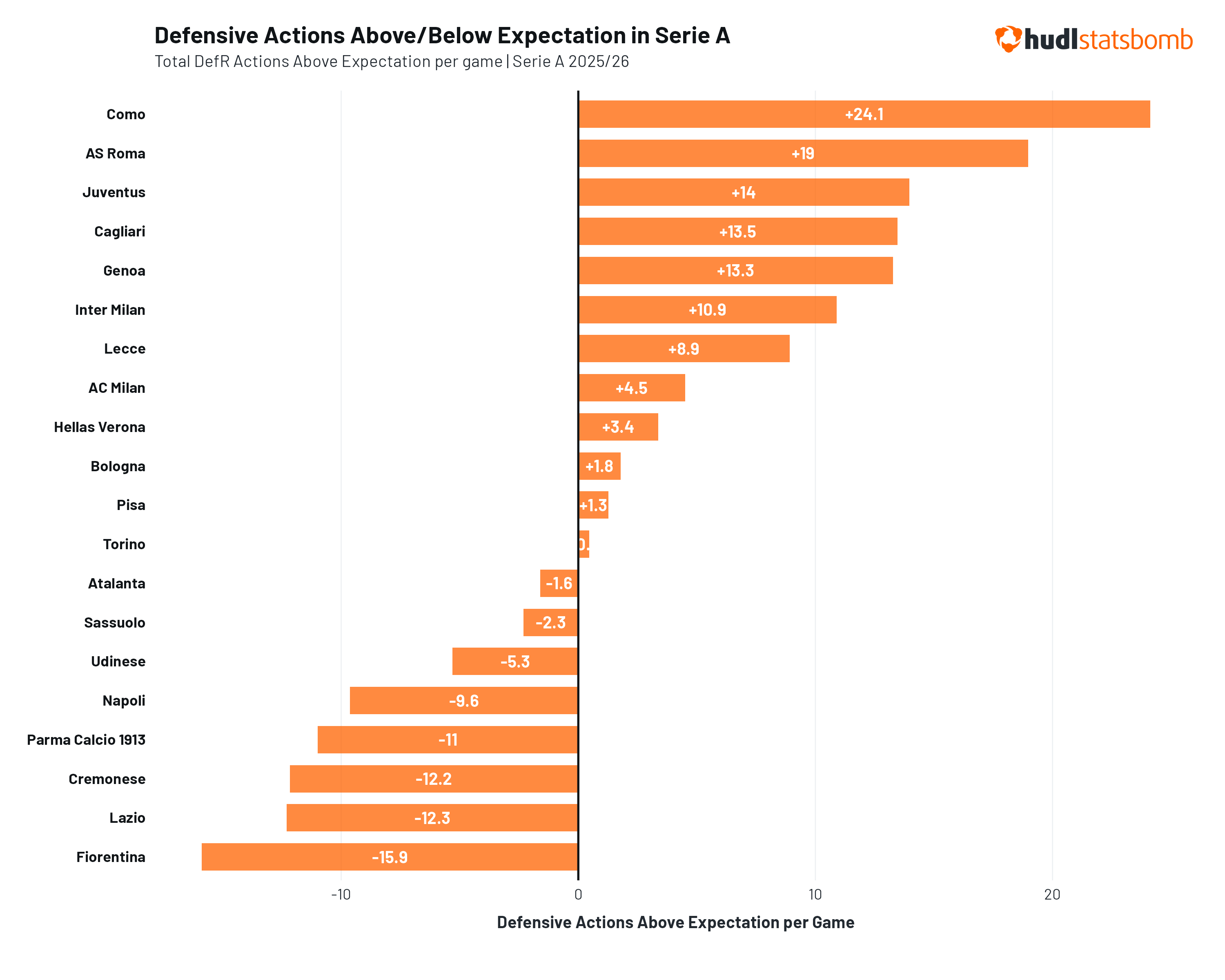
Looking at the graphic below, Como stand out for their efficiency (+24.1 DefR), followed by Roma (+19), Juventus (+14) and the surprising Cagliari (+13.5) and Genoa (+13.3) - the last two finishing ahead of champions Inter (+10.9).
Setting DefR against PPDA tells us something about style. Several of those sides pair a high DefR with a low PPDA, a sign of high pressing intent: Como (8.02), Roma (9.10), Inter (9.76) and Juventus (10.74). All four were hyper-aggressive last season, pressing high - and, more interestingly, the four most aggressive teams in the league were also the four who conceded fewest. Not bad for a league that is always talked about as being so reactive.
Cagliari are the exception that proves the point: a high DefR alongside a below-average PPDA (15.12, second-worst in the league). This suggests that although they did not press hard up the pitch, they still defended aggressively from a deeper block once teams reached their half.
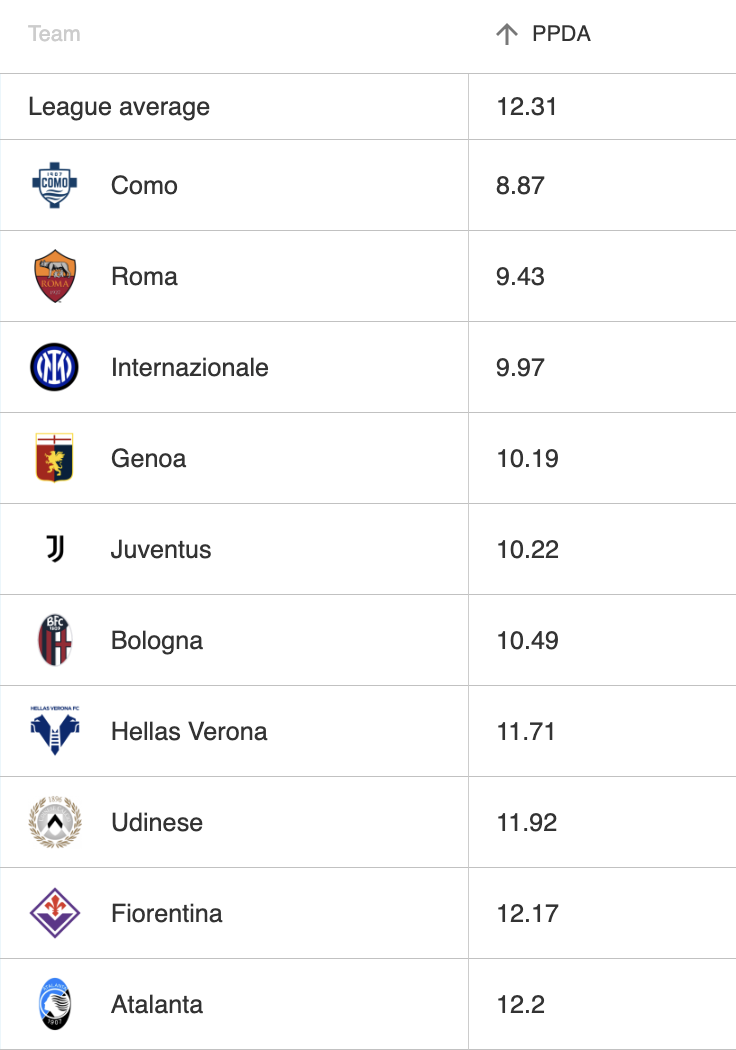
At the bottom of the graphic are the teams with a negative DefR, and the worst figure of all belongs to Fiorentina (-15.9). The Viola also sit close to the league average for PPDA (12.30). Together, those two numbers describe a side that has not defended aggressively.
Player Analysis: The Defensive Effectiveness of Forwards
The same idea works at individual level, and it is most revealing when applied to forwards - a crucial question for any side that treats high pressing as its main line of defence.
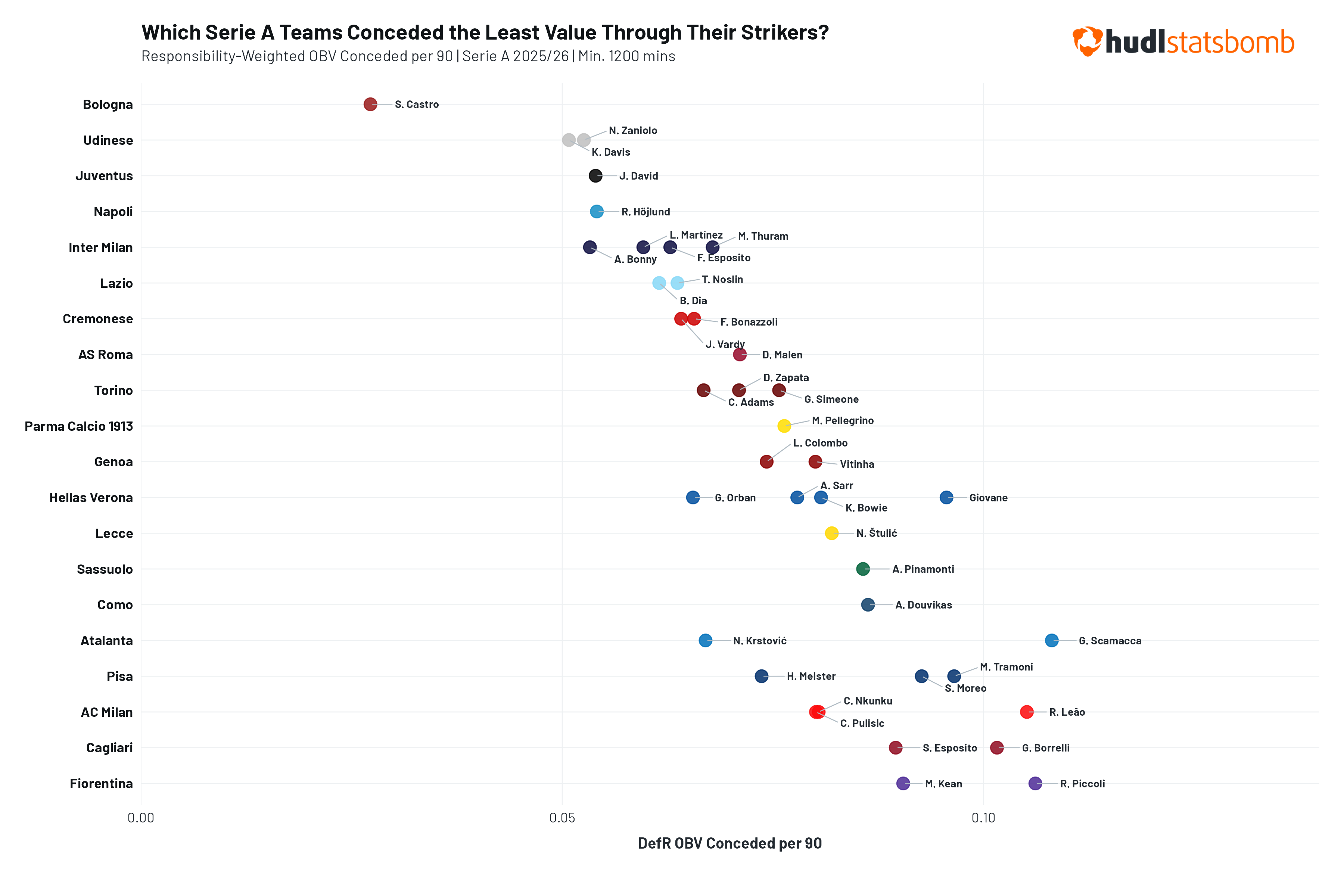
Take Santiago Castro for example. The Bologna forward's DefR OBV came in below 0.05, the only Serie A forward to manage it; everyone else in the front line was above that mark. Closest to him, just above 0.05, are Nicolò Zaniolo and Keinan Davis: would you have expected two Udinese players among the forwards who work best out of possession? At the other end sit Gianluca Scamacca, Rafa Leão and Roberto Piccoli, all well beyond 0.10.
Plotting Defensive Actions Above Expectation against Responsibility-Weighted OBV Conceded across the Big 5 European leagues spreads last season's forwards across four quadrants: aggressive and effective (top right); effective without doing much (top left); busy but not effective (bottom right); and those that are neither busy nor effective (bottom left).
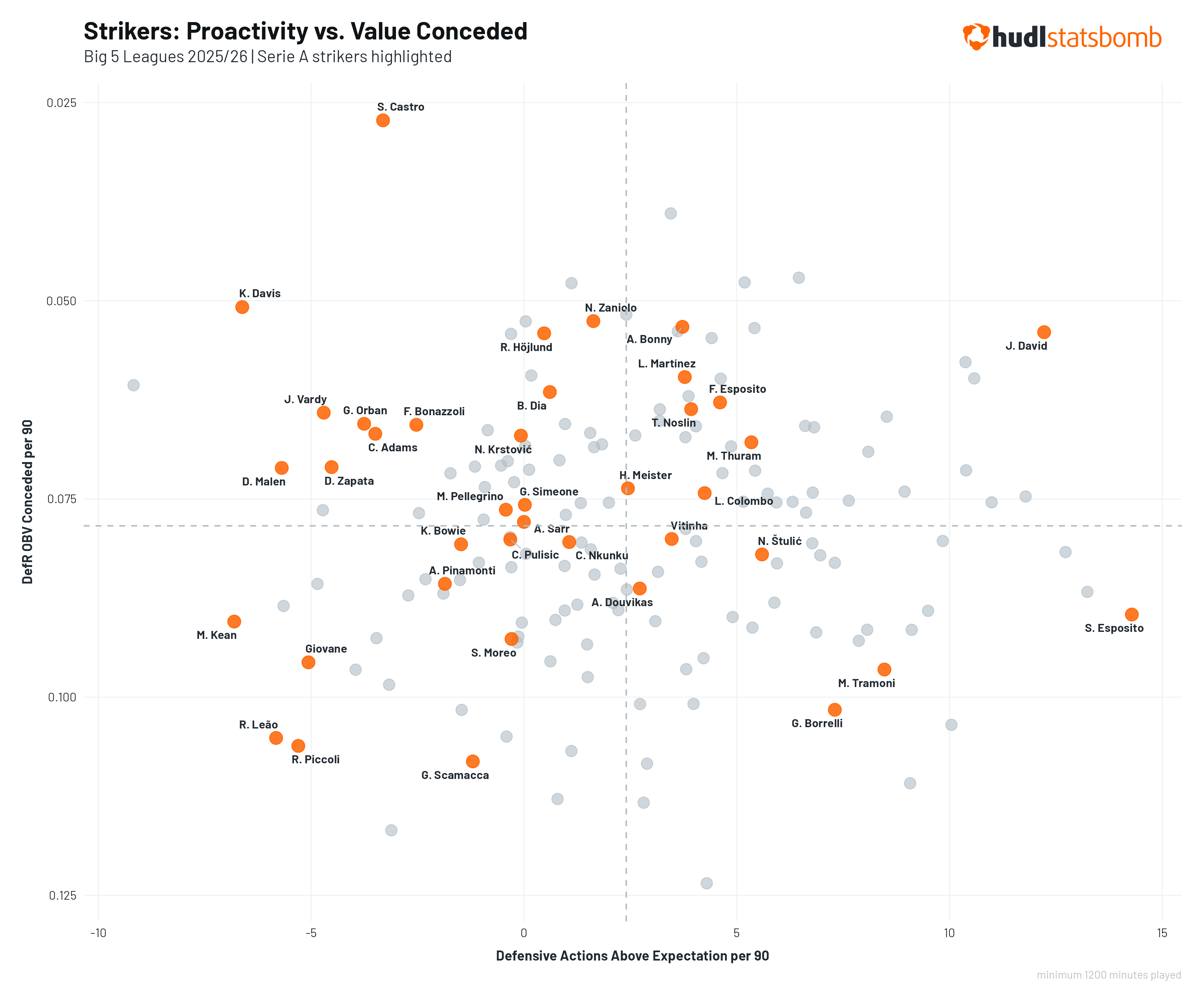
Castro turns up again among the forwards who concede little in their zone despite relatively few interventions. That suggests he was particularly good at funnelling opposition build-up away from his own area and limiting progressions in behind him - and it helps explain why Gian Piero Gasperini wanted to bring the Argentine to Roma.
Top right is Juventus's Jonathan David, effective and busy with it: he conceded little while recording more defensive actions than expected. Bottom right is Sebastiano Esposito, alongside other forwards who win plenty of duels without actually stopping opponents progressing through their zones.
Bottom left - conceding a lot while doing little - we find Leão and Moise Kean, which should not be a surprise. Beyond their own habits, both played for teams that were not aggressive. Fiorentina we have covered already; Milan posted a fairly high PPDA (13.67) and a DefR only just above average (+4.5), the profile of a side defending mostly from a mid or low block, and not defending especially well.
Player Analysis: The Defensive Effectiveness of Centre-backs
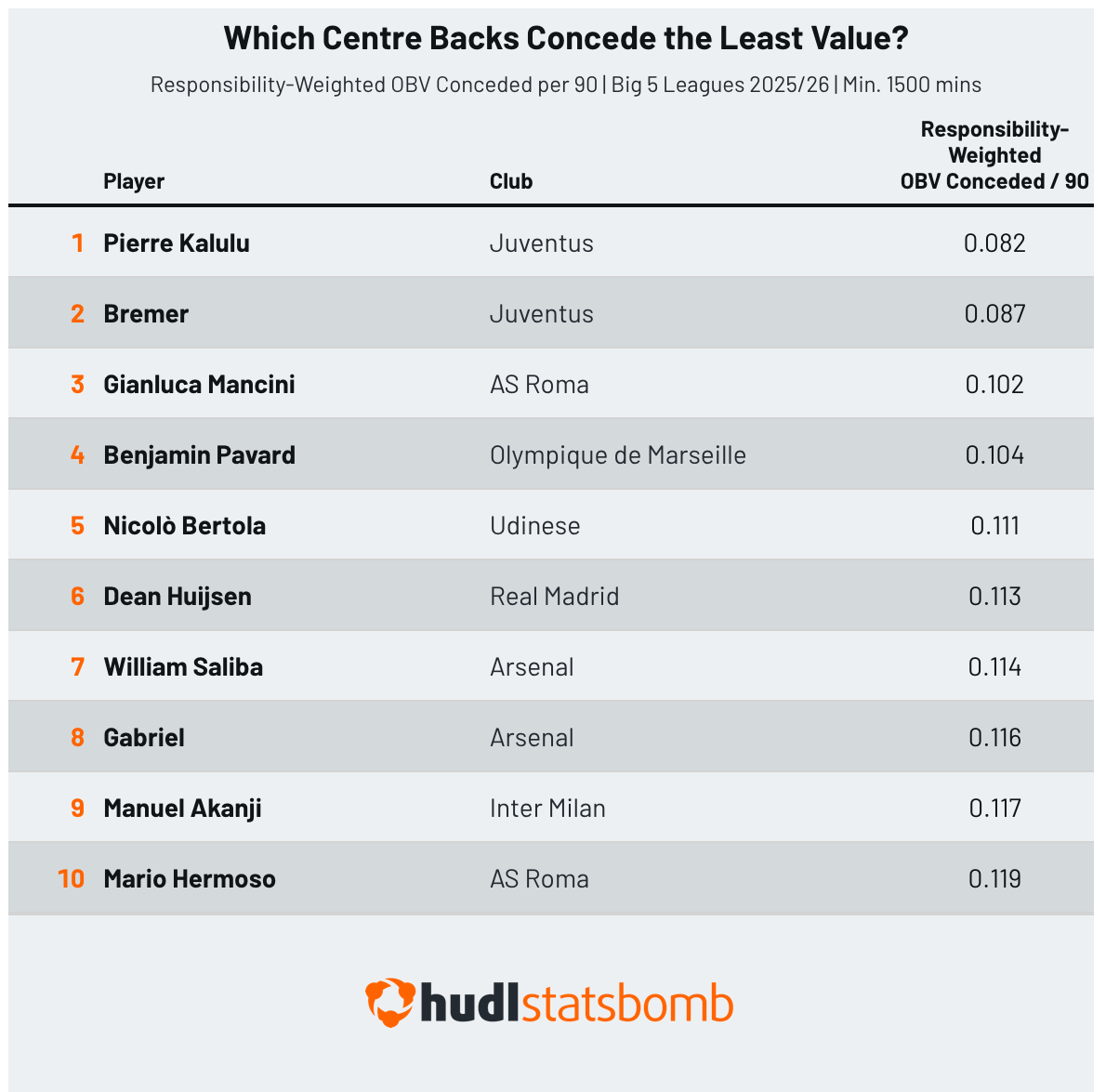
Centre-backs are harder to judge, because raw volume depends so heavily on the team around them. Defenders at Como or Inter, who spend long spells in possession, simply get fewer chances to intervene. Combining Defensive Actions Above Expectation with Responsibility-Weighted OBV Conceded gets around that - and across Europe's top five leagues in 2025-26, the list of centre-backs conceding least per 90 in their own zone is dominated by Serie A.
Pierre Kalulu (Juventus) leads it at 0.082, ahead of team-mate Bremer (0.087) and Roma's Gianluca Mancini (0.102). Six of the top ten are Serie A defenders — a fair indication of the profile the league currently rewards: aggressive, built to break up play, and well suited to the man-marking that still dominates Italian football.
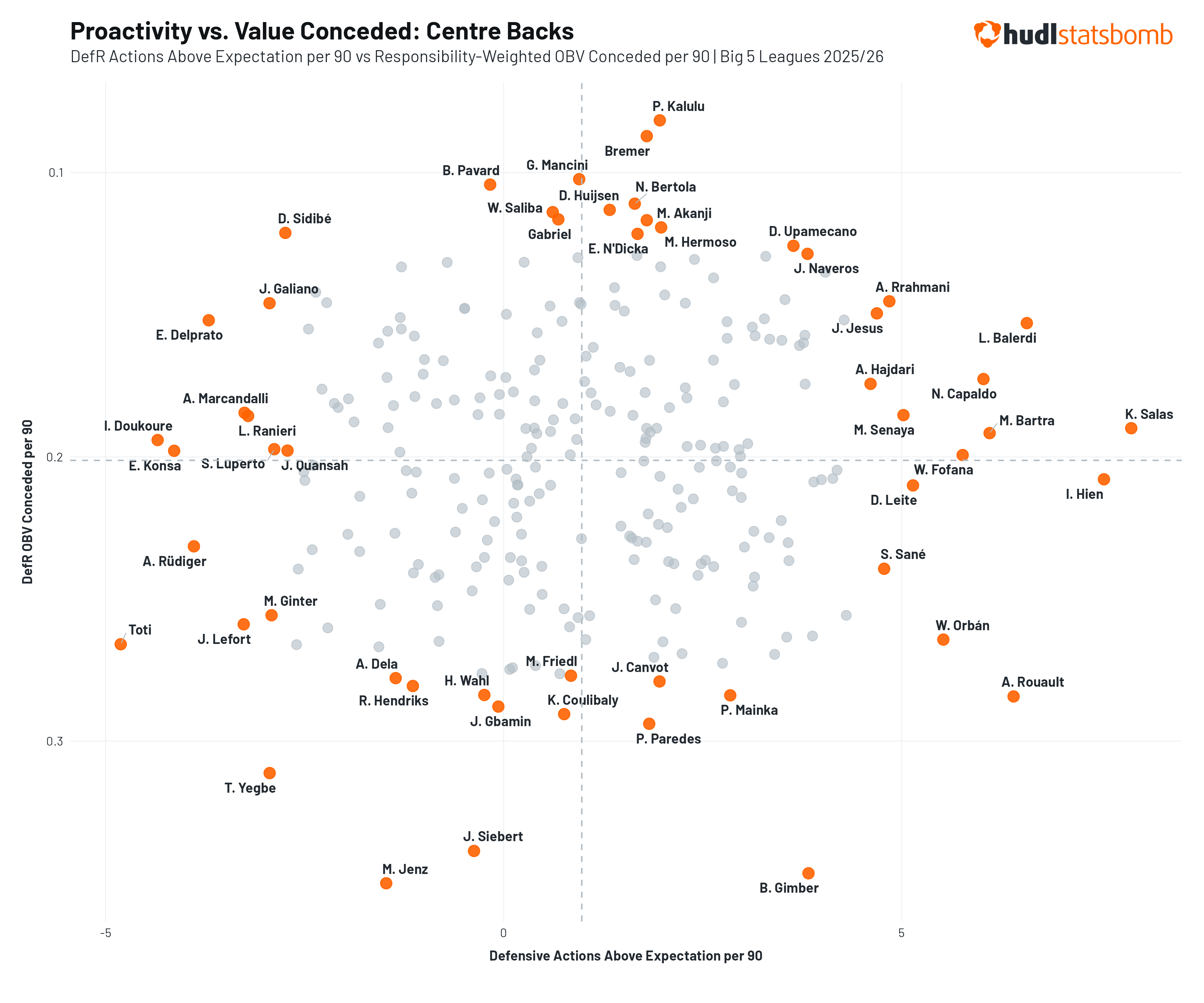
Plot the two metrics against each other and the top-right quadrant - defenders above average both for proactivity and for suppressing opposition value - is where the story is. Bayern Munich’s Dayot Upamecano is the archetype in Europe, but what stands out is how many Serie A defenders are packed in alongside him: players who spend much of the game stepping forward to break the line, and who therefore get through an enormous number of defensive actions.
Paradoxically, that is partly a product of how Serie A teams attack. So many are direct and vertical, leaning on a forward with his back to goal to move the ball upfield, that matches become a succession of defender-versus-forward duels. And because the league defends man-to-man, those duels break out all over the pitch rather than along a single defensive line. The chart sums it up neatly.
Elsewhere on it, Isak Hien (Atalanta) shows the risk that comes with all that aggression: plenty of interventions, but space opening up behind him for opponents to use. At the other extreme is the quieter, more effective profile - Enrico Delprato (Parma) made 3.7 fewer defensive actions than expected per 90 yet conceded only 0.15 OBV per 90, holding his position instead of stepping out and giving opponents almost nothing in his zone. Alessandro Marcandalli and Luca Ranieri land close by.
With DefR now available in both men's and women's football, scouts can finally compare defenders fairly across very different contexts - those at teams who dominate the ball and those at teams who spend their afternoons in a low block. It is a significant step forward, and it sheds light on a corner of the game that has been dark for a long time.