
We chart the history of shifting transfer trends in the AFC Champions League and look at what the future holds.
Asian club football, once a relatively parochial affair, has become something altogether more cosmopolitan in recent years. The club competitions on the continent (which now comprises the AFC Champions League Elite, the AFC Champions League Two, and the AFC Challenge League) haven’t just raised the stakes for what happens on the pitch – they have quietly redrawn the recruitment map for clubs, players, and agents from Tokyo to Tehran.

Local Before Global: The Early Days
Go back a couple of decades, and the average Asian club side looked quite different. There were the local stalwarts—often players who had never set foot outside their province, never mind their country.
When the AFC Champions League was born in 2003, replacing the old Asian Club Championship, in many countries around Asia, most foreigners tended to be Brazilian and they were usually strikers with a few creative midfielders thrown in. There was still a mystique around that nationality, with the Selecão having just won their fifth World Cup in 2002 and there was still a feeling that having a Brazilian forward was the way forward and a short-cut to success.
Living in Korea, almost every K-League team had at least one. It was amazing to see the turnover. Some were big successes, some were OK, some just weren’t suited to a physical league with a very different culture on and off the pitch, and many just came and went without making any mark and any memories. But the churn continued as clubs worked with the same agents over and over again.
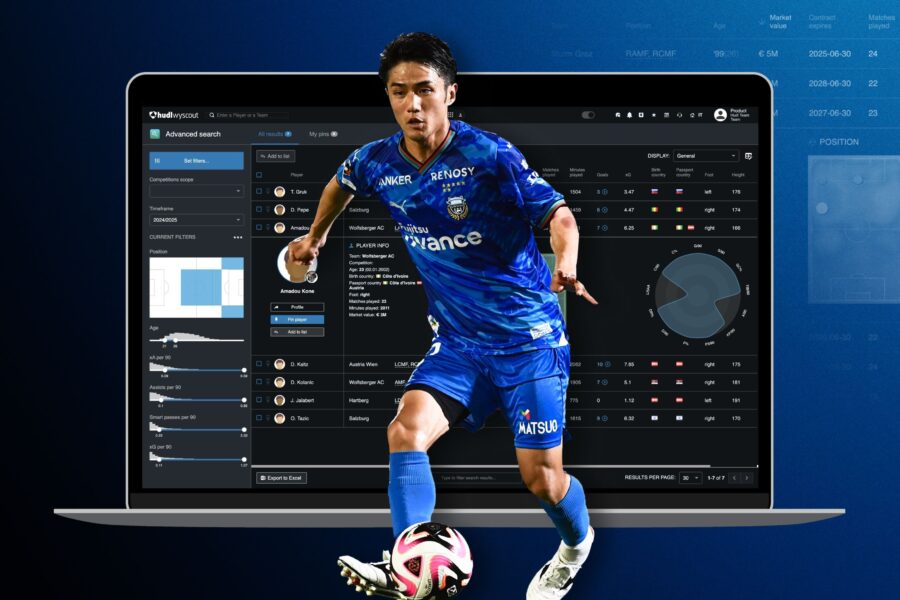
At the time there was little scouting, given the time and cost restraints of travel. There were no journeys from East Asia to South America to check out talent in person, and limited means of video analysis – a very different situation to today’s scouting landscape with Hudl Wyscout, which covers over 600 competitions worldwide.

The Champions League Arrives
The old Asian Club Championship was a low-key affair, played in centralised groups with the knockout stage in one country. The Champions League arrived in the early 2000s, draped in promises of reform, television contracts, and prestige. It wasn’t just a new name. The tournament was longer, more professional, and—most crucially—worth more money. There were more games and more interaction with teams from other countries and other regions.
But it was not just about that. More and more games against teams from across Asia opened eyes to the recruitment of other clubs and leagues. At that time, teams in Japan and South Korea for example, could largely compete financially with those in the gulf but Middle Eastern recruitment was a little more varied than those in the east.
The now-legendary Al-Ittihad team of 2004 and 2005 showed the way, and not just because the Jeddah side remains the only one in the Champions League’s history to successfully defend the title.
Under coach Anghel Iordanescu, there was an interesting mix of foreign players. There was, of course, a Brazilian playmaker, Tcheco, under-rated and one of the stars of the competition, but there was Mohammed Kallon from Sierra Leone in attack. There was also Cameroon star Joseph Desire-Job, on loan from Middlesbrough.
The Asian Quota
The revamped Champions League helped bring a wider vision to clubs from elsewhere. For example, Seongnam Ilhwa Chuma won the 2010 title with a talented Colombian Mauricio Molina and physical Serbian striker Dzenan Radoncic.
As always, the teams that had success had also found the right balance between local talent and imports. In some ways, this was made easier by the ‘3 plus 1’ rule in place which limited the number of foreigners that could be signed to four, so there was not a huge amount of choice. Three of those could come from anywhere but if you wanted a fourth then he must come from a fellow member nation of the Asian Football Confederation.
Returning to the aforementioned Seongnam, they had Sasa Ognenovski. The Australian centre-back was not just physically strong but effective in both boxes and a real leader. He was so impressive that he was named as the Asian Player of the Year in 2010, unheard of for an Australian and unusual for a defender.
Before long, Australian defenders started to pop up in Japan and in West Asia – cheap, professional and hard-working, suddenly Australians had a new destination and did not just need to look to Europe.

Japan, too, saw marquee faces. It was no coincidence that Vissel Kobe’s signing of Andres Iniesta (and David Villa shortly after) happened at a time the club sought continental success. Indeed, Kobe’s stated goal was to be number one in Asia. Iniesta may have been past his Barcelona peak, but he changed the game off the pitch as much as on it.
The J.League’s robust youth competitions produced players who leapt from Urawa or Kashima to Bundesliga and then, sometimes, back to the ACL as returning heroes. Similarly, Korean clubs, intent on safeguarding local development, set up more advanced scouting, technical, and academic programs.
More games mean deeper squads. The top tier tournament now has eight group games, up from six two years ago. This being Asia, there is a lot of travel and a lot of demands. Clubs now think in terms of depth charts, loan armies, and strategic signings. There are players who may not start every week domestically but are invaluable for navigating the group stage or stepping up for a knockout round in daunting away conditions.

Southeast Asia Joins the Race
If the eastern and western powerhouses moved first, Southeast Asia is trying to catch up. Buriram United in Thailand turned to Brazil for attacking flair. Johor Darul Ta’zim in Malaysia became a destination for Argentine midfielders and Singaporean full-backs alike. These two teams found that they could win the title at home without too much trouble, and then focused on trying to have success in Asia.
They have looked to more and more foreign players, Johor have gone for Spanish players in a big way. While Buriram’s squad is more mixed with Austrians, Brazilians, Germans, Serbians, Koreans, Filipinos, Indonesians, Australians, Montenegrins –it is a real mix. The Asian Champions League has come a long way, and so have the clubs.
Surge of Saudi Arabia and Relaxing of Regulations
Now there are no limits on foreign players in the Champions League and the clubs with deep pockets can shop anywhere. At the moment, most of them are in Saudi Arabia, who are buying top talent from the big leagues of Europe and aren’t looking so much to the rest of Asia.
Despite the eye-catching spending of Saudi clubs, there has also been a shift towards snapping up some of the best young South American talent. Instead of waiting for them to go to Europe and paying a premium - such as Marcos Leonardo from Benfica or Jhon Duran from Aston Villa - they are going direct to source and are proving to be an increasingly popular first step abroad.
The likes of highly-rated teenagers Gabriel Carvalho and Wesley Gassova would have traditionally moved to Europe and were considerable coups for the Saudi Pro League, while the quick profit made on Equi Fernandez – sold by Al-Qadsiah to Bayer Leverkusen for €25 million just a year after joining from Boca Juniors – could be the blueprint going forward.


Ready to transform your recruitment process? Find out more about how to use Hudl Wyscout for your scouting, recruitment, and talent evaluation workflows here.