

Serie A’s lowest-scoring season in six years is no accident. The long ball is back — and it’s being used with more tactical intent than you might think.
Football evolves in cycles of action and reaction. The success of any given tactical tool eventually produces demand for its antidote. Tactics are plastic — they adapt to the demands that each historical moment places in front of teams. What is certain is that nothing is truly invented: the game is always the same, and the solutions to its challenges are found within the grammar of its own possibilities.
The widespread use of man-marking defensive systems has pushed teams in possession to move their positions around more — rotations, positional switches, off-ball movement out of zone. All of it designed to generate space where none exists. The effectiveness of the high press has, in turn, refined and accelerated the development of build-up-from-the-back strategies, which look to exploit the space left behind the pressing lines.
These ideas share a common underlying logic: trying to take advantage of the opposition's aggression by accepting a degree of risk. But what happens when a high press and aggressive man-marking collides with caution — when the response to an out-of-possession risk is not a corresponding in-possession risk?
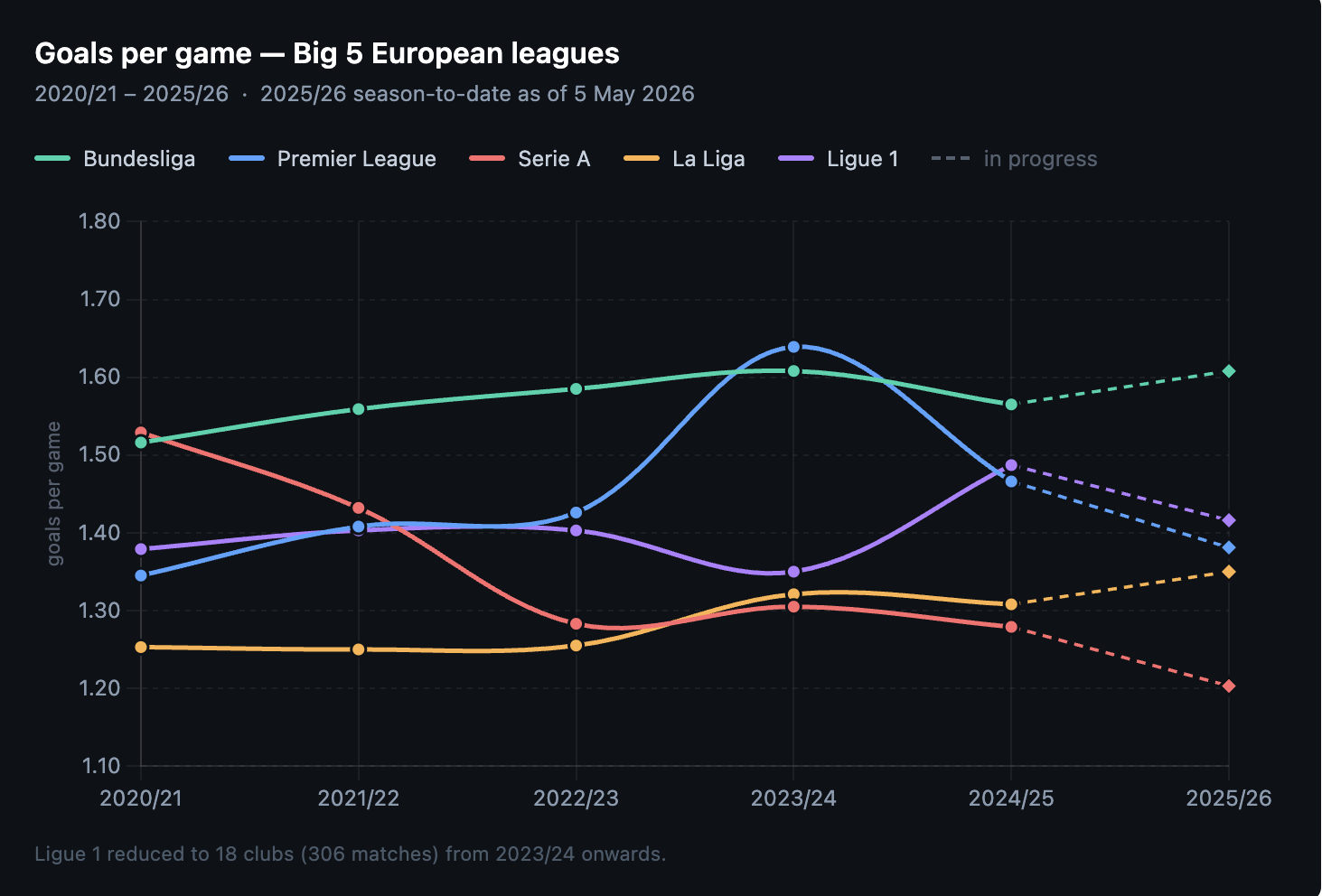
In Serie A this season, we are witnessing one of the most cautious campaigns in recent years. The goals-scored data tells the story: the lowest tally in the last six seasons, and the lowest across Europe's five major leagues.
That caution is reflected in how teams approach possession, too. In Serie A, teams frequently do not try to play through the first line of pressure. Instead, they adopt a more direct approach into the strikers. A tool that seemed to have disappeared from the modern game, a relic of a more rudimentary, less scientific era, appears to be back in fashion: the long ball.
Faced with teams that press high and man-to-man, many Serie A sides prefer not to take risks, avoiding complex combinations under pressure and instead going direct to forwards with their backs to goal, who engage in duels with defenders.
Some distinctions are worth making. This does not happen in every match or with every team. As we explored in a previous article, each Serie A side chooses to concede a different kind of space — closer to their own goal, or closer to the opponent's. Against teams that sit in a mid-block, defend zonally and focus on covering passing lines, the long ball is an ineffective and largely useless tool. Against teams that go man-for-man and compress forward space, however, it becomes a low-risk means of disrupting the opposition's structure and creating chaotic — but potentially dangerous — situations.
Serie A is the top European league in which the fewest passes are completed. That is partly a product of lower intensity in possession, but also of the frequency with which teams bypass midfield entirely, producing shorter passing sequences to advance up the pitch.
The clubs launching the most long balls in Serie A are Pisa, Cremonese, Torino and Lecce. This is not, however, an approach exclusive to lower-table teams with physical, direct styles of play.
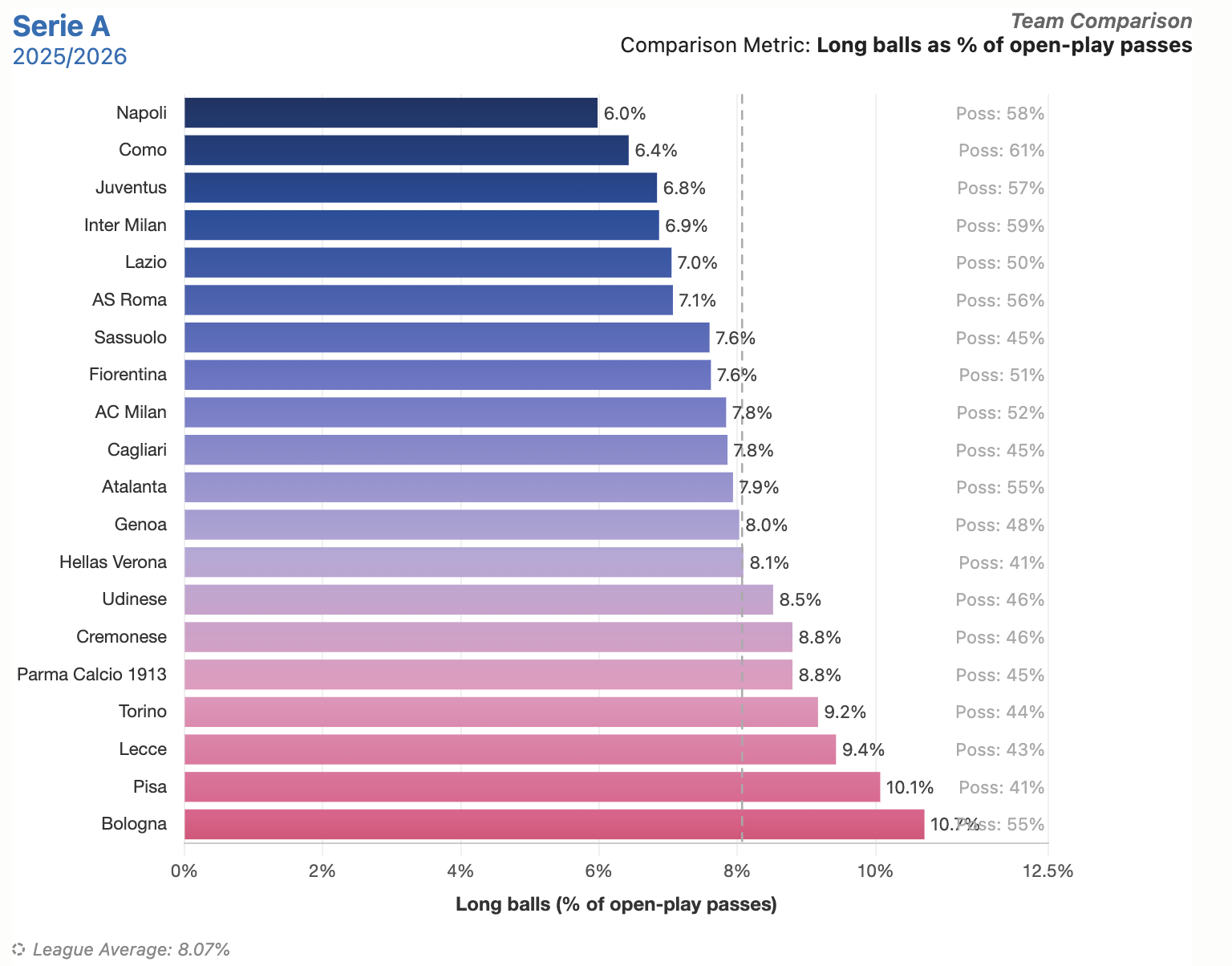
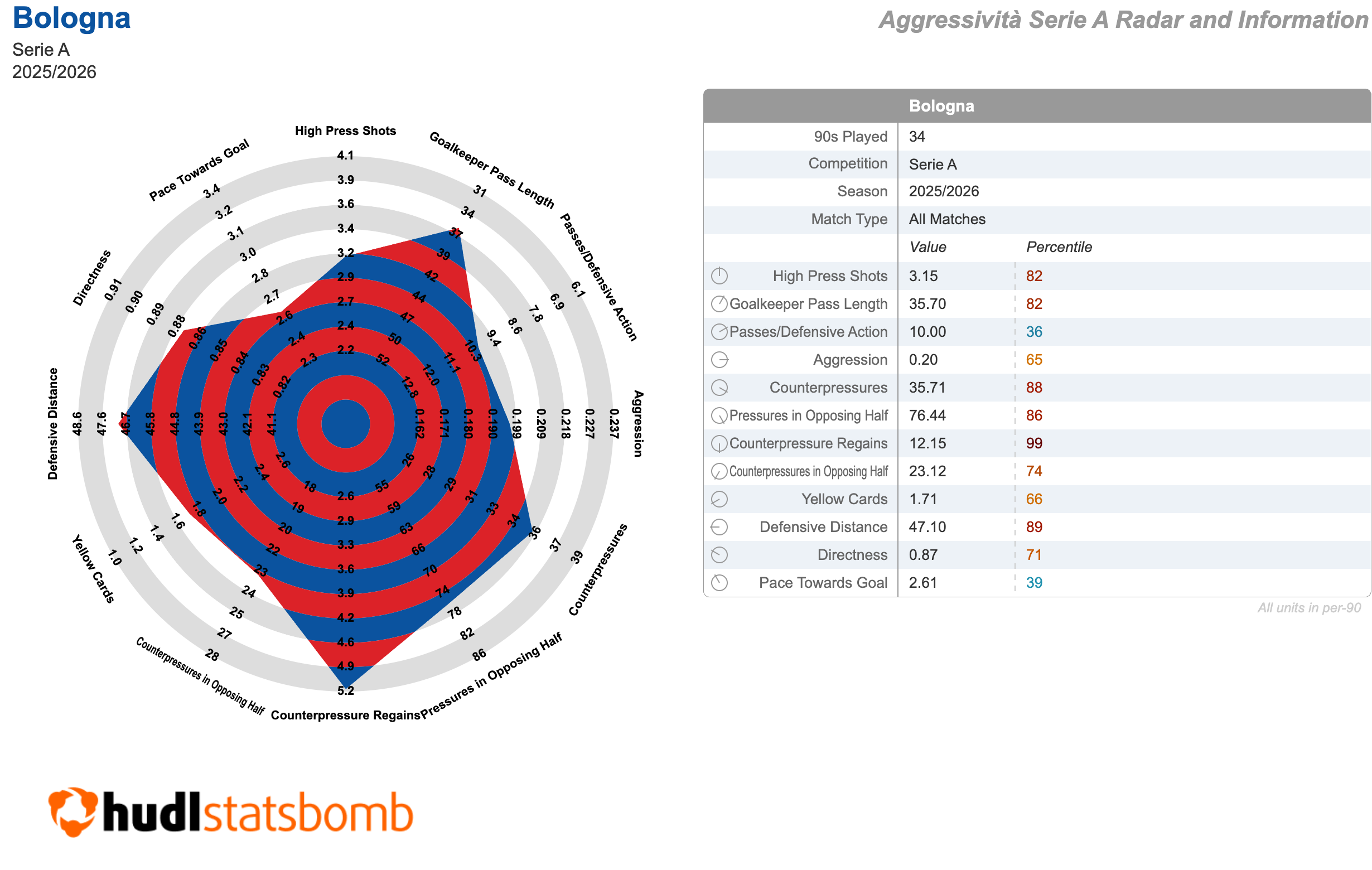
An interesting outlier is Bologna – in the upper reaches of the table and simultaneously one of the most frequent long-ball sides in Europe. That is partly a product of the efficiency and aggression of their pressing, and partly of certain limitations in their ability to progress the ball on the ground. The result is matches defined by long balls, man-to-man pressing and duels across the full pitch — a style that perhaps brings to mind English football of a few years ago.
More than half the clubs in Serie A 2025/26 are associated with a physical, aggressive style of play that looks to win the ball back at various heights of the pitch. It is a style that tends to go hand in hand with the long ball as a means of escaping the opposition's press — and as a platform to contest the second ball.
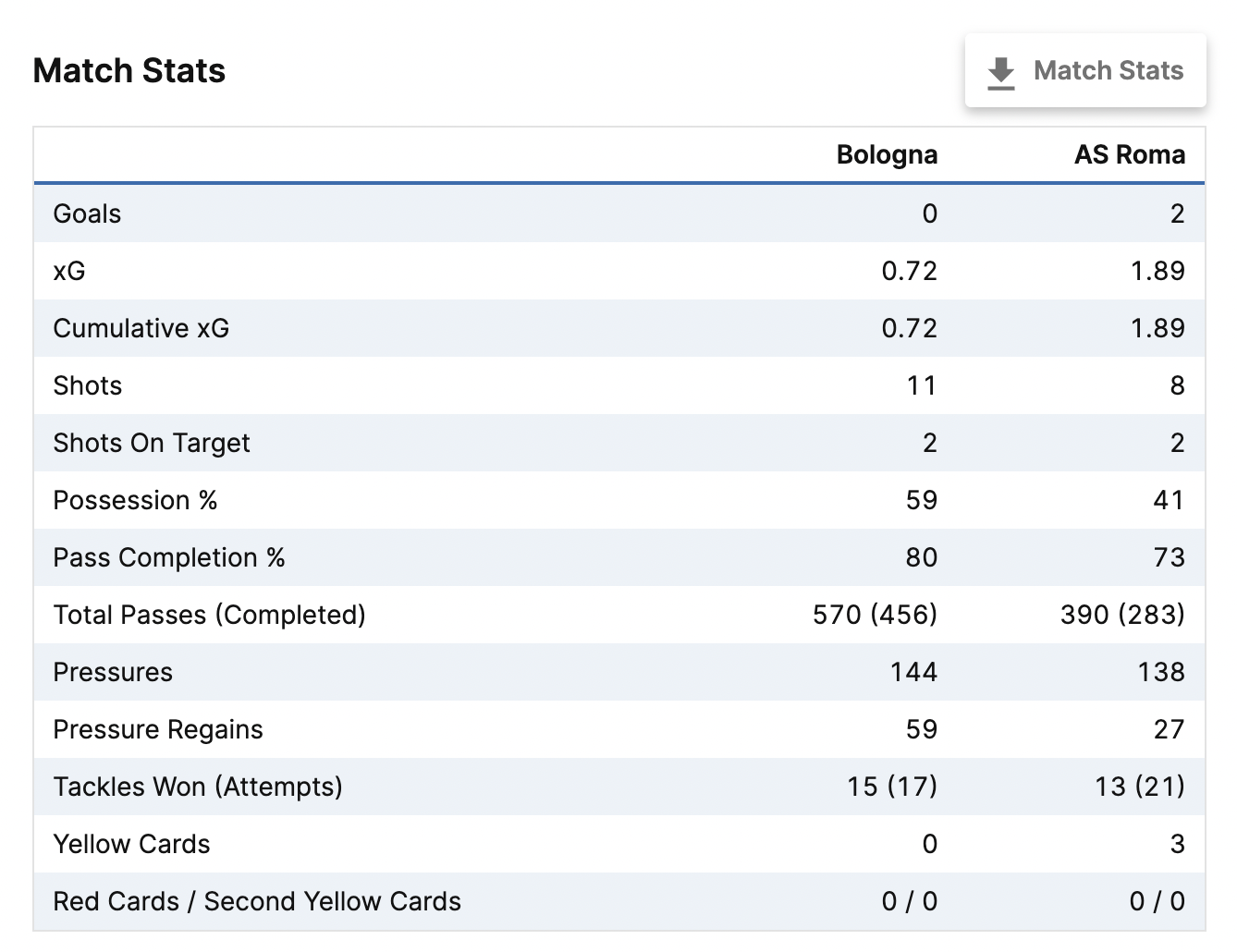
A case in point, during the most recent Bologna vs Roma league fixture at the Stadio Dall'Ara, neither side managed to exceed 80% passing accuracy.
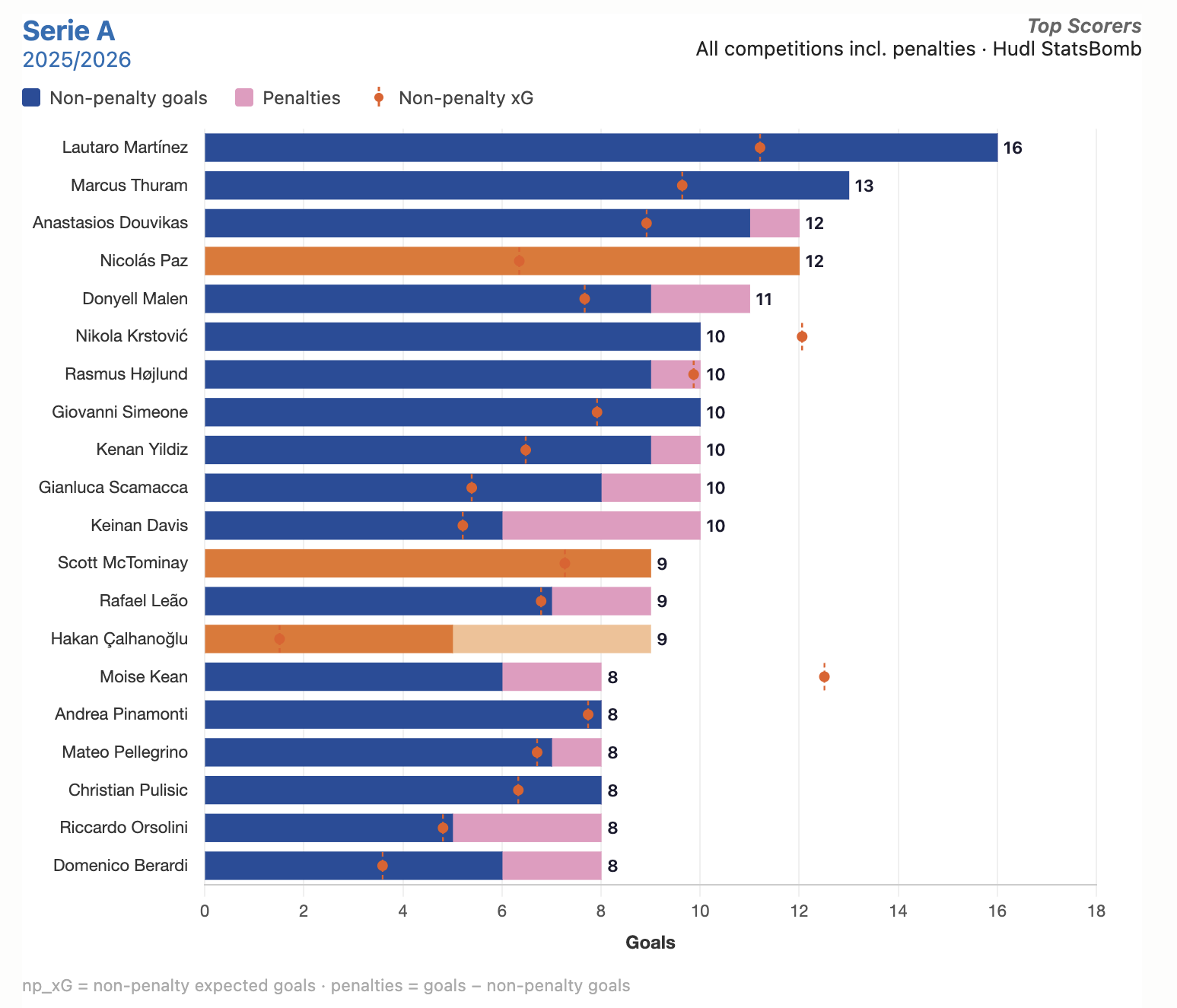
In Serie A, attackers are used primarily to carry the team up the pitch, push defensive lines deeper, and win individual battles. It is often the midfielders who do the finishing. Strikers like Keinan Davis, one of the revelations of the season, are more effective in physical battles with defenders than in front of goal.
The two best young forwards in the league also share the capacity to duel with their backs to goal as their primary weapon: Santiago Castro at Bologna and Francesco Pio Esposito at Inter.
While Esposito has played a more limited role this season — entering games in specific situations — Castro performs a fundamental tactical function in Vincenzo Italiano's Bologna side. Italiano is a manager who has always made heavy use of the long ball, deploying it as the launching pad for a high-pressing recovery.
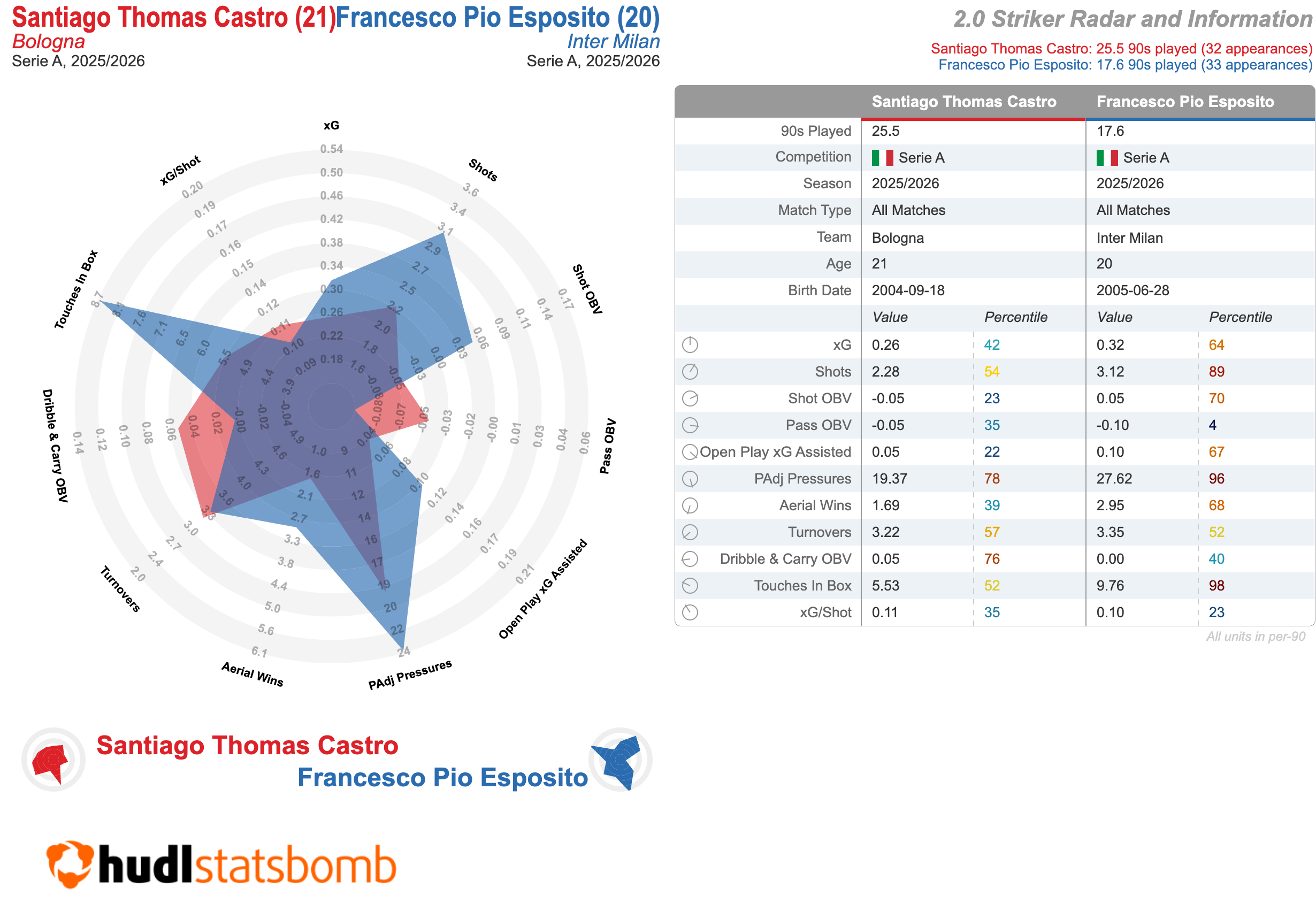
The Bologna case is interesting because their strategies are not fully captured by the headline numbers. Bologna look to play driven, penetrating passes into their strikers, prioritising the forwards' reactivity over their aerial ability. Castro, after all, stands 1.82m tall, and his aerial duel numbers are not particularly remarkable. In fact, the constant use of the long ball arguably highlights the limitations in that part of his game: he wins 1.69 aerial wins per 90 minutes, and his success rate of 36% is below average for his position.
Where Castro does excel is in his work before the ball arrives — battling opponents to create contact, allowing the ball to run or bounce before laying it off to Bologna's wide players. Jonathan Rowe in particular regularly positions himself just off the central striker, showing a sharp instinct and quick reactions in collecting his teammate's knockdowns before running in behind.
In short, what matters for Bologna is creating chaos on second balls and winning them back. Their data profile reflects the effectiveness of that aggressive defensive phase.
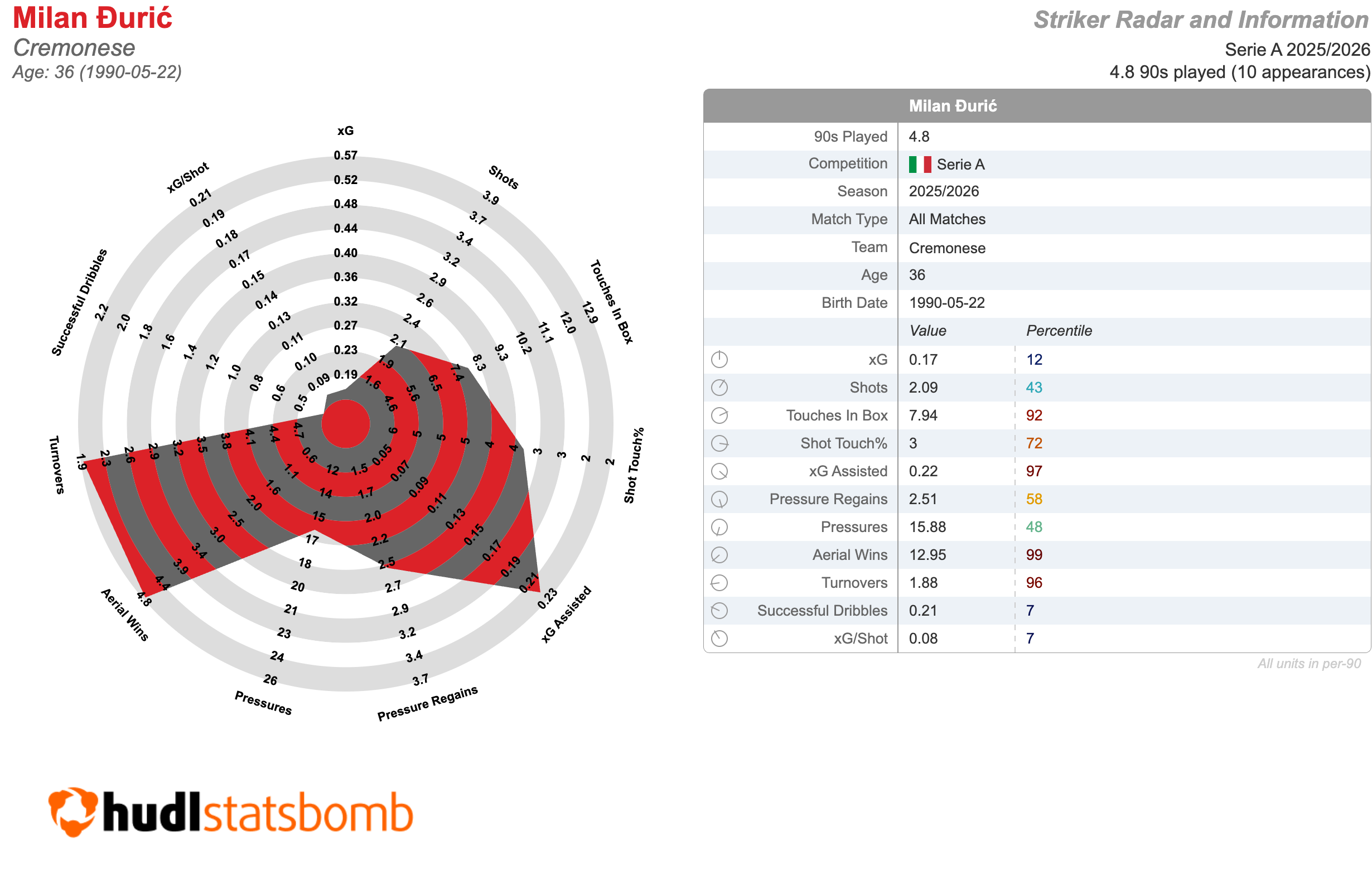
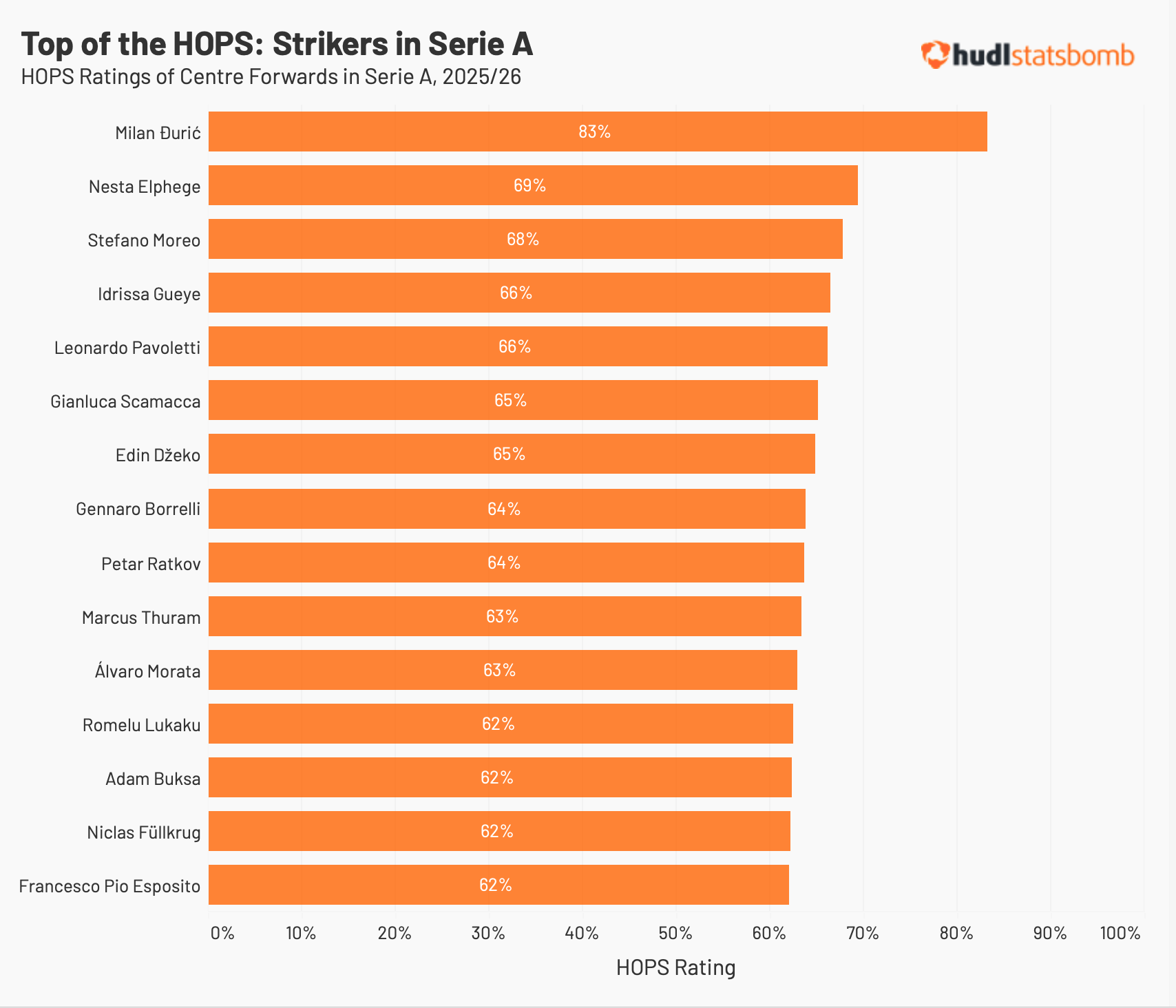
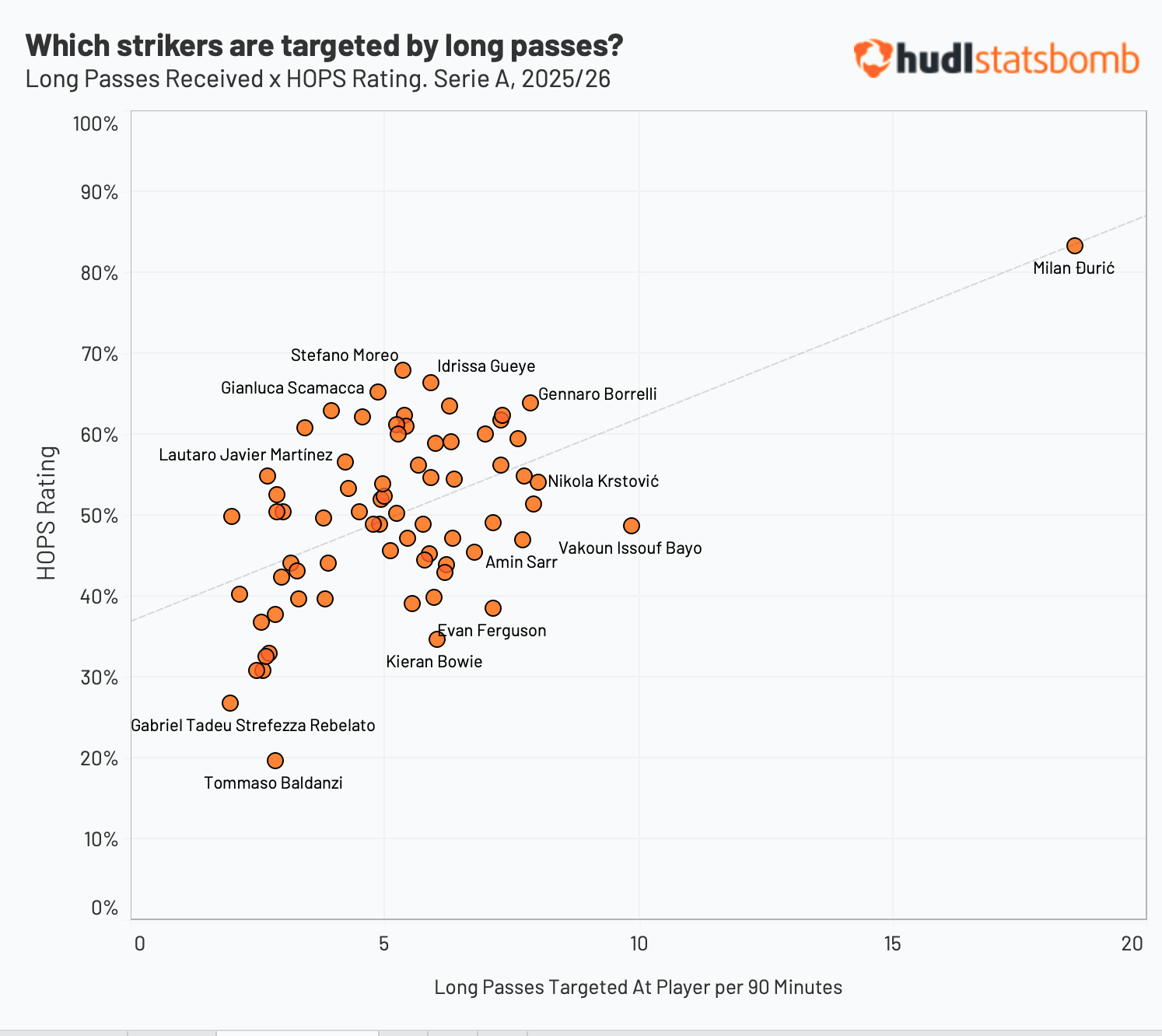
Diving deeper with HOPS – which has recently been updated with a range of new metrics – we can see what it tells us about how the aerial dominance of strikers influences how often teams look to quickly progress the ball up the pitch to them. Once again Đurić is operating on a different level and goes some way to explaining Cremonense’s penchant for playing long balls.
In the finishing phase, too, Serie A shows a preference for aerial play. Inter are the highest-scoring headed-goal side in Europe this season, with 19. Lautaro, Esposito and Thuram have between them scored 11 headers. Much of that stems from the quality of Federico Dimarco's left foot — he has registered 16 assists this season, a Serie A all-time record — but Inter's forward line as a whole are specialists in this area. It is a combination that Christian Chivu has leaned into, thinning out the central channels and emphasising the wide relationships, to maximise both Dimarco's crossing and his forwards' heading ability.
In an era of scientific rationalisation of the game, the art of the aerial duel seemed close to extinction. In football, though, nothing is truly invented — and nothing is truly lost forever. Within a league that has embraced low-risk strategies as Serie A has this season, the long ball and the physical forward battle have become tools for bypassing man-marking press systems. A way to profit from high defensive lines by simplifying the build-up and minimising risk in possession. It is a percentage strategy: you do not need to win many duels, only the right ones — to carve out a chance and catch defences unprepared.