Norwegian Youth: Laying the Foundations for Sustainable Success

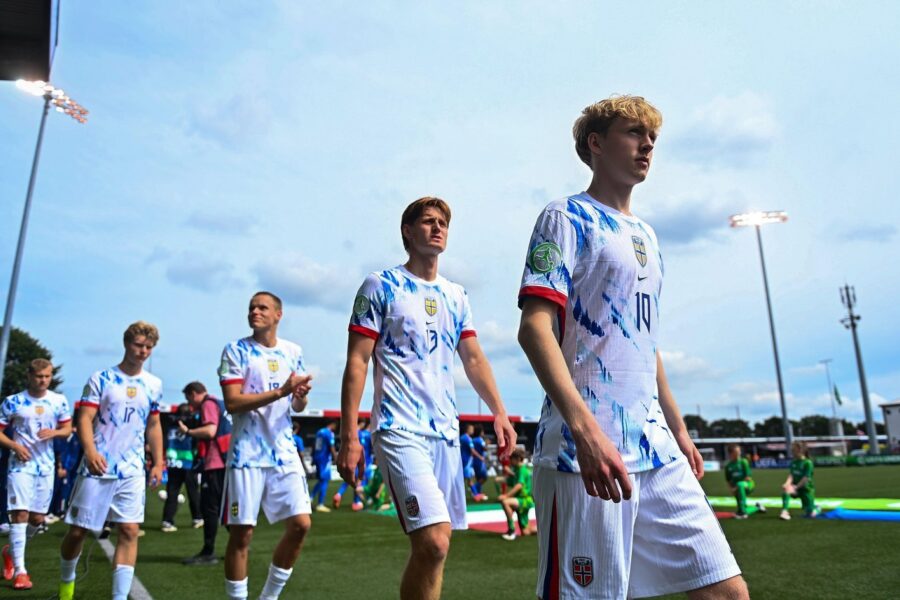
In this article, we analyze Norway’s current U20 squad, highlight standout performers, and explore the country’s youth development.
The Norwegian men’s national team are enjoying a successful World Cup 2026 qualifying campaign – with the chances of a first tournament appearance since 1998 looking promising. Their ‘golden generation’ of talent looks to finally be achieving its potential and some might say the first signs of their emergence could be traced back as far as the 2019 FIFA U20 World Cup.
In that competition, players such as Erling Haaland, Leo Ostigard, Jens Petter Hauge, Hakon Evjen and Kristian Thorstvedt stood out, with Haaland famously scoring 9 goals in a 12-0 rout of Honduras.
The Norway U20 team failed to qualify for the 2023 U20 World Cup but they came back with a bang in the most recent edition, reaching the quarter finals and pushing a strong France side very close.
While player development should be prioritised over results, the performances of this latest crop suggest the current senior team isn’t a one off and that there is a depth of talent in Norwegian youth football that could potentially bring a sustained run of success for the national team.

Impressive showings at the U20 World Cup - one of over 190 competitions featured in the Wyscout Youth Pack - are not only an indicator of the health of a nation’s talent pipeline, but also a timely reminder of the importance of scouting elite youth tournaments when identifying the stars of tomorrow.
In this article, we will use Hudl Wyscout to analyze Norway’s U20 squad and highlight standout performers, to gain insights into the talent being developed in the country’s youth system.
Continuity of Coaching
Norway tasked Björn Johansen to be in charge of the U20 team. The former Fredrikstad manager has been working within the Norwegian national youth system since early 2023 at U17, U16, and U15 level, so his knowledge of the available players made his appointment a sensible one.
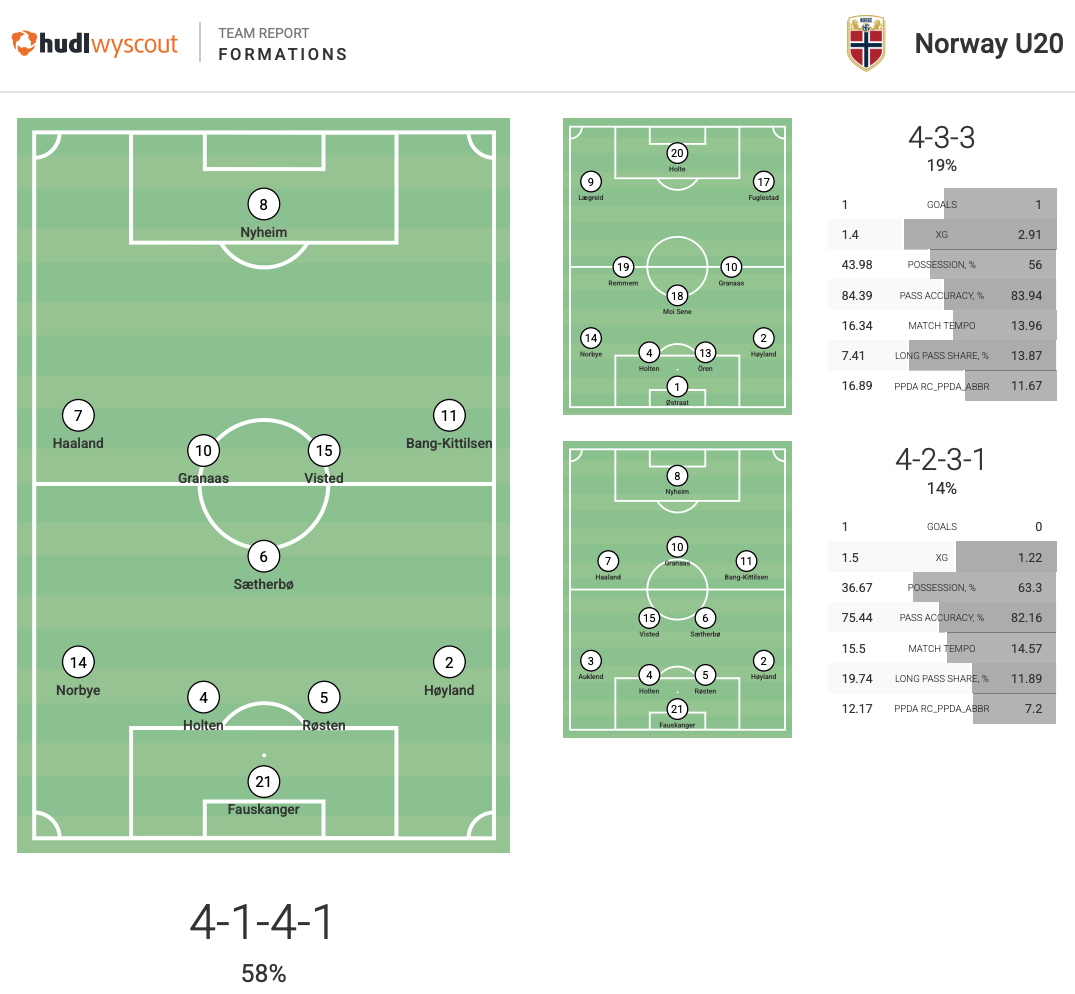
Watching the tournament footage, Johansen did not over complicate his tactics and predominantly used a 4-1-4-1 formation at the tournament, occasionally switching to a 4-3-3. This is in line with the senior national team, perhaps suggesting there is a directive to use similar tactics across all levels to ease transition between age groups.
Building on Solid Foundations
Johansen generally used low possession and counter-attacking tactics throughout the tournament. Norway had as little as 32% of the ball against Colombia U20s and the most they had possession wise was 44% against Saudi Arabia and France respectively. Only New Caledonia averaged less possession at the U20 World Cup compared to Norway’s 39.1% mark.
This was a team built on a solid foundation; hard to break down whilst offering a threat on the break with their pacey wingers. They didn’t seek to win the ball back high up the pitch, as demonstrated by their PPDA numbers and average formation line of 38.3 metres.
As a result, Johansen has a brilliant defensive record in charge of Norway U20s. Including the friendlies leading up to the tournament throughout the year, the team conceded just 5 goals in 9 games and have generally been very secure. Their games have typically been very low scoring with 8 out of 9 ending with under 2.5 goals.
The manager has perhaps correctly identified some of the key strengths of the side with strong defenders who can soak up pressure and fast, direct attackers who are suited to their counter-attacking tactic. At the U20 World Cup they only averaged 0.10 xGA per shot against which ranked in the top ten.
With current trends in football shifting to a more direct, physical style of play, scouts will no doubt turn their attention to players capable of executing this approach – potentially good news for Norwegian players who thrived in Johansen’s system.

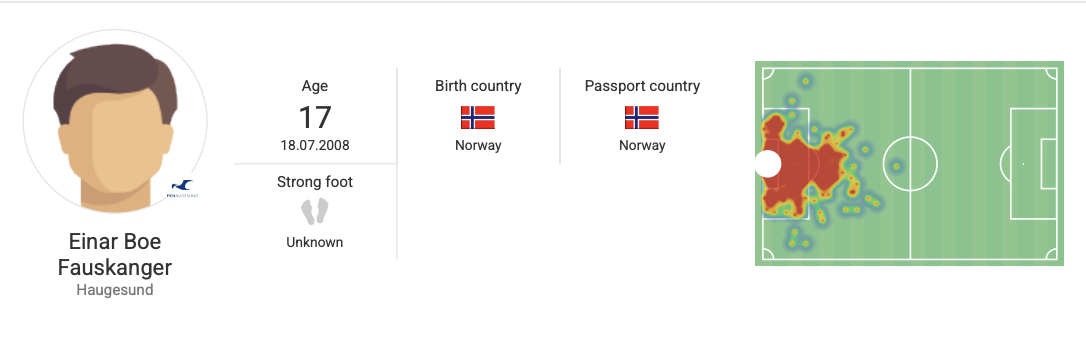
The one snag is his age. At 17, he is very very young in goalkeeping terms, but has already shown remarkable maturity when given his opportunities on the field. He plays for Eliteserien side Haugesund and already has 10 senior appearances for the team, having made his debut in December 2024 at the age of just 16 years and 5 months.

Watching clips of Fauskanger on Wyscout, he displays some weaknesses in the crossing department and dealing with set pieces. This can be an issue for young keepers simply due to the physical aspect. The expectation is that he will grow out more and increase his strength in time.
Fauskanger has only conceded 29 goals from an xGC of 28.32 in the last calendar year. This suggests he is doing his job just fine and has strong handling and reflexes. In a recent Eliteserien match for Haugesund vs Valerenga, he demonstrated a top class save, arguably one of the best of the season in the league.
If Fauskanger develops physically as expected, in a few years time Norway could have a top quality stopper for the foreseeable future.


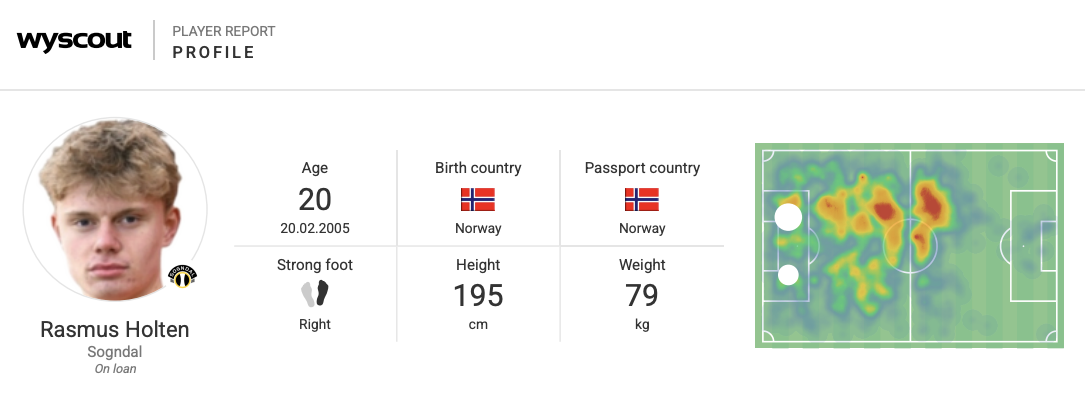
Holten is a strong physical specimen for his age and tall at 1.95m. Watching footage of him, he was excellent with defensive duels inside his own third, especially aerially - seeming to win the majority of the actions he was involved in. He also proved a cool head in the opponent’s box, with two well-taken penalties, making him Norway U20’s joint-top scorer.
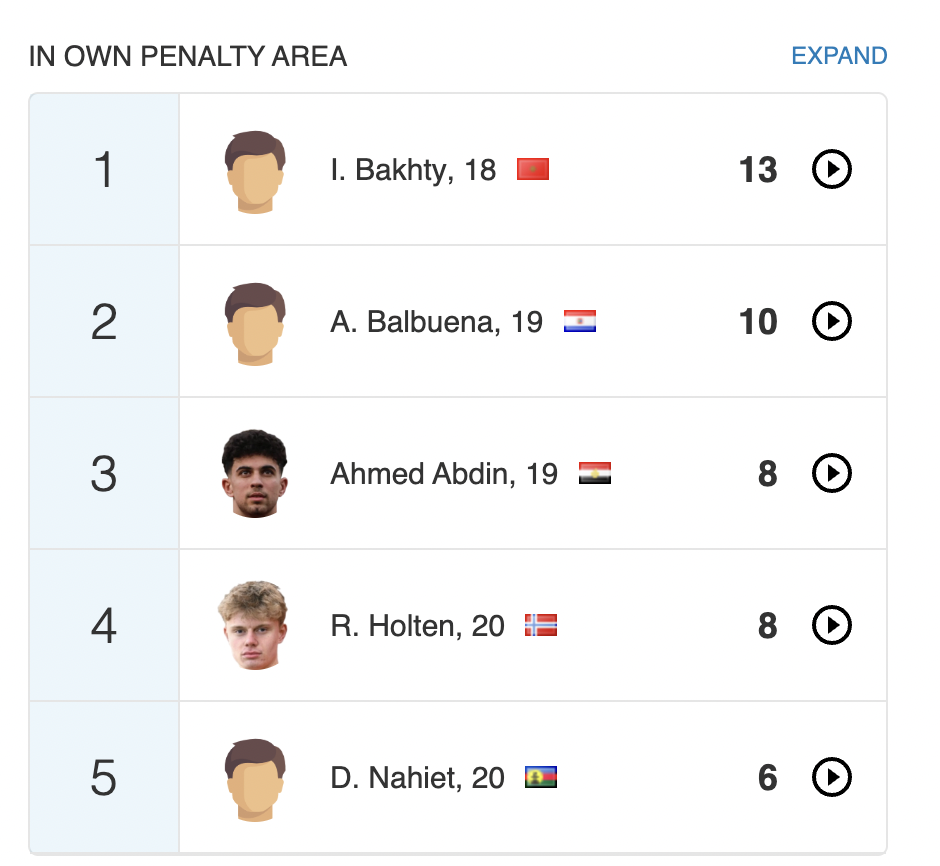
Holten came through in the city of Bergen on the West coast of Norway and was involved in the Brann youth system since he was just 16. He has 12 career Eliteserien appearances and 8 in the Norwegian Cup. Brann have recently loaned him out to second tier side Sogndal to try and develop his game, but he looks a great long term prospect for both club and country.
Sondre Granaas: The Midfield Dynamo
The young Molde starlet played 481 minutes at the U20 World Cup, which was the second most for any player at the tournament for Norway. He is clearly trusted by the manager and there is an argument to say he was the best player in the entire squad.
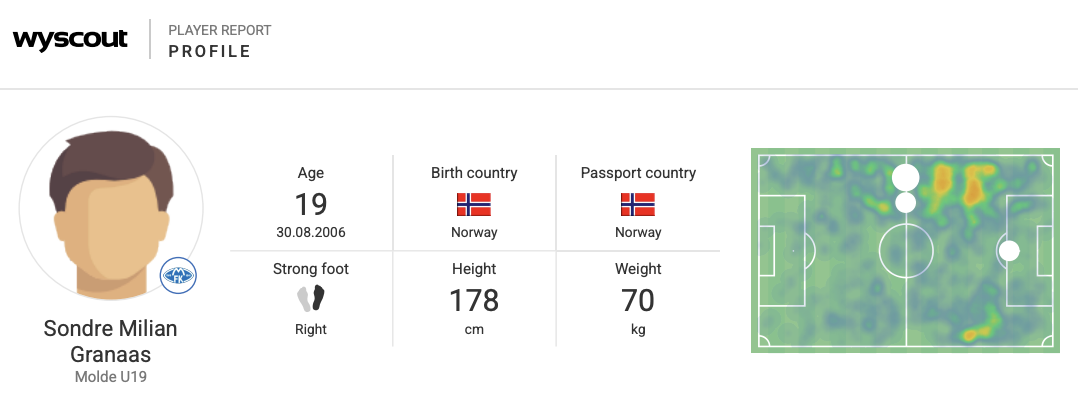
Granaas was bought by Molde from 2nd tier side Mjondalen in January 2024 for nearly £1 million and at the time it felt like too much. He turned 19 this summer and he already has 106 senior appearances for his respective clubs, with 41 of those either at Eliteserien or UEFA Conference League level for Molde - showing that their investment is already looking like a savvy piece of business.
He is best described as a modern day mezzala or supportive central midfielder. Despite not being the tallest of players, one of his main strengths is his sheer physical engine. Granaas has a very high work rate, great pressing ability and stamina, and can be a very effective midfield destructor.
But if you watch footage of him, you’ll see he’s also dangerous on the ball due to his carrying ability. His best categories in the last calendar year have been with offensive duels and defensive duels, in addition to progressive runs and progressive passes.
Overall, Granaas is a great all-round midfielder who can add plenty to both the offensive and defensive game and will no doubt draw more attention from abroad after his exploits at the U20 World Cup.


Converting Promise Into Reality
The Norwegian ‘golden generation’ is just entering its window for potential greatness, so it’s really important that the next wave of young prospects are able to back it up. The nation knows it needs a continual conveyor belt of talent but, thankfully, the infrastructure now seems in place.
On an episode of the Nordic Football Podcast this year, Shaun Constable – the head coach at Flint Football and previous manager of Moss, Sandefjord, and Brommapojkarna – gave some insights into why there has been an improvement. Constable credits the more widespread introduction of 4G pitches as to why there has been such a great technical improvement amongst players. He also revealed that the Norwegian FA has been basing their model on the ‘Spanish Blueprint’ in producing players.
Constable recognised that there has been a lack of defensive talent which could hold back the current national team. There has not been enough physicality and toughness and also the lack of quality keepers. He gave a great insight into some refereeing problems, which for a certain time discouraged more physical play. However, in his role as a head coach within the Norwegian football period he says that clubs are ‘trying’ to learn their lessons and produce the types of talent required.

This current U20 generation certainly are at their best defensively which is a very encouraging sign for the senior national team. The video footage, combined with underlying metrics and performances, clearly point towards a set of players who could definitely develop and fill the holes that are required in future years.
With club teams such as Bodø/Glimt, Brann and Molde all doing well on the European front the Eliteserien has arguably become the strongest league in the Scandinavian region. And with highly competitive youth leagues such as the OBOS Nasjonal G19, Regional Nasjonal G19 and OBOS Nasjonal G17 available on Wyscout, Norwegian talent is able to showcase the best young talent the country has to offer.
The immediate panorama in the here and now looks great for Norway. And for the future they also seem locked and loaded with great promise emerging. All in all, it’s an exciting time for the nation at all levels of international football now.
Find out more about the Hudl Wyscout Youth Pack here.
If you want to find out more about how to use Hudl Wyscout for your scouting, recruitment, and talent evaluation workflows, click here.
Listen to The Nordic Football podcast here.