Albert Einstein famously said: "We cannot solve our problems with the same thinking we used when we created them."
This wisdom rings especially true in sports science today. For two decades we’ve been measuring athlete performance with the same linear mindset–but the game has evolved, and our metrics haven’t kept pace.
Modern GPS systems have revolutionized sports science, providing a wealth of data about player performance. However, the metrics these systems prioritize—distance, speed, and acceleration/deceleration—fall short when applied to field or court-based sports, where change of direction (COD) is critical.
By relying solely on linear metrics, we neglect approximately 35% of the mechanical work done in meaningful game maneuvers. This oversight limits our understanding of athlete performance, rehabilitation, and training effectiveness. ADI steps in to complete the picture.
The Problem with Linear Metrics
Traditional GPS metrics primarily focus on distance and speed. From speed, they derive acceleration and deceleration, tracking how quickly an athlete increases or decreases their speed. However, in multidirectional sports, these metrics fail to account for changes of direction (COD).
But here’s where the problem begins: over the last 20 years, since the inception of athlete tracking devices, we have progressively confused speed with velocity, using the terms interchangeably. This misunderstanding is a fundamental flaw.
All field and court-based sports involve constant changes in both speed and direction—players accelerate, decelerate, and change direction rapidly. While traditional GPS metrics track changes in speed, they ignore changes in direction, which are equally critical in defining acceleration. Together, these two components—speed-change and direction-change—form the complete acceleration, which captures the full scope of an athlete’s movements. This is physics from first principles—the foundational building blocks of measuring movement.
For example, imagine tracking a running back who carries the ball 50 yards but makes 12 directional changes at speed to evade defenders—traditional metrics would only capture the distance but completely miss the additional mechanical load of the cuts and curves.
How Multidirectional Sports Demand a New Approach
To grasp why current metrics fail, let’s delve deeper into ADI’s approach. Acceleration can be categorized as:
- Speed-change Acceleration: What you feel when you speed up or slow down.
- Direction-change Acceleration: What you feel when turning a corner (in a car, for example), even at a constant speed.
In multidirectional sports, these two forms of acceleration are constantly at play. A player accelerating straight and then cutting sharply to evade an opponent experiences both. A defender pressing hard and trying to stay with an attacker experiences both. A player performing a curvilinear burst also experiences both.
The total effect, or complete acceleration, is the combination of both speed-change acceleration and direction-change acceleration. Traditional GPS metrics fail to measure the latter, providing an incomplete picture.
Why This Matters
- Rehabilitation and Training: Understanding complete acceleration is vital for injury prevention and recovery. When athletes change direction, they experience forces far greater than what linear metrics suggest and generate more mechanical power than in linear maneuvers. Training and rehab protocols that overlook these factors risk underpreparing athletes for game scenarios.
- Mechanical Work in Multidirectional Sports: Work, in physics, is the transfer of energy through force over displacement. Ignoring direction-change acceleration makes it impossible to truly measure the mechanical work athletes perform. This miscalculation affects evaluations of workload, conditioning, and recovery needs. Using traditional GPS metrics, we fail to correctly quantify competition and training loads.
A Call to Action: Rethinking Athlete Performance Metrics
The current reliance on linear metrics is not entirely wrong—it’s simply incomplete.
To truly measure player performance in multidirectional sports, we must adopt a complete acceleration model that accounts for both changes in speed and direction. Only then can we accurately quantify mechanical work and optimize athlete care.
Do we need to repeat the research performed on GPS tracking devices to include multidirectional movement analysis? The answer lies in innovation. By leveraging existing foundations and incorporating multidirectional metrics, we can redefine performance tracking without retracing every step.
ADI: Complete Acceleration for Complete Performance Insights
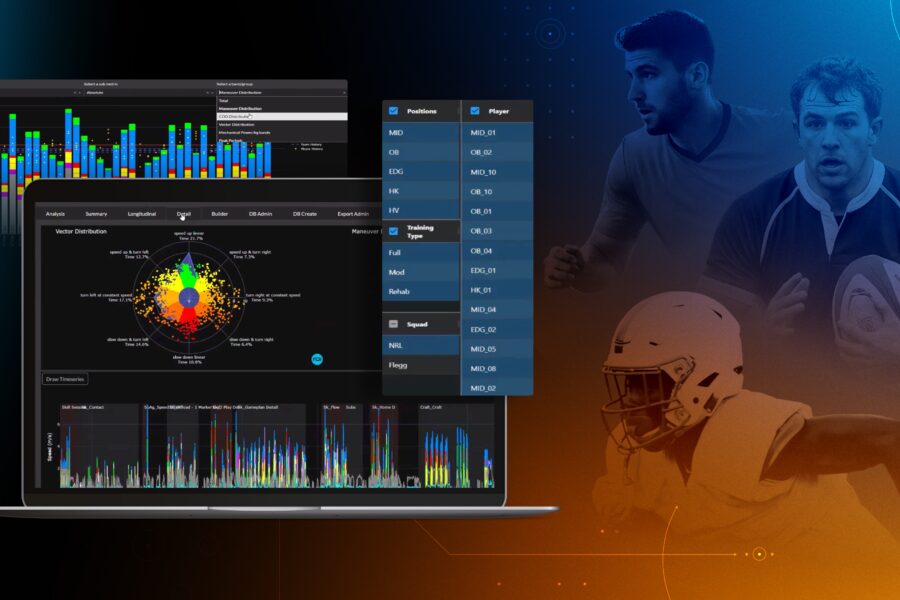
Athletic Data Innovations (ADI) bridges this critical gap in sports science. Built on decades of biomechanics research into multidirectional movement, ADI ingests raw tracking from any tracking system and transforms into advanced metrics that capture the complete picture that coaches, trainers, and medical staff need to truly understand athlete workload.
By measuring both speed-change and direction-change acceleration, ADI quantifies the true mechanical cost of every sprint, cut, and deceleration. Whether you're optimizing training loads, designing rehabilitation protocols, or making return-to-play decisions, ADI ensures you're working with the full story—not just 65% of it.
Ready to see the complete picture of your athletes' performance? Visit our landing page to learn how ADI can transform your approach to athlete monitoring.