Beyond the Straight Line: What the Roundtable Revealed
16 Jul 2026
5 min Read
Three of sport science’s leading minds rethink athlete monitoring for linear sports. Watch the recording of their live Sportsmith webinar.
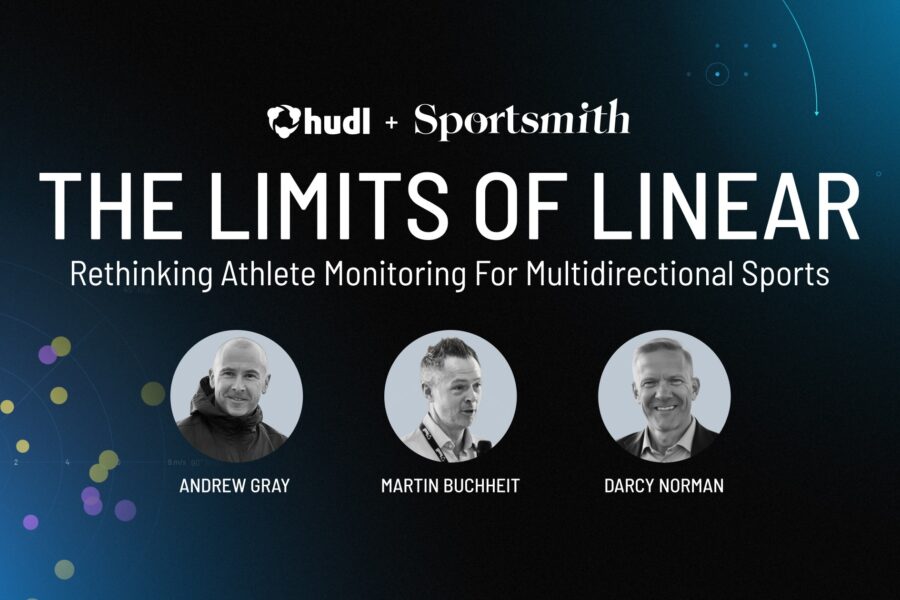
On July 9th, Andrew Gray, Martin Buchheit and Darcy Norman joined Sportsmith's Rob Pacey for an hour-long live conversation that cut to the heart of one of the most important questions in elite performance analysis: are we measuring athlete workload and performance on the field correctly?
Gray is the founder of Athletic Data Innovations (ADI), has held several roles as a practitioner and leader in elite sport, and is one of the world's leading authorities on athlete load monitoring. For over 15 years, ADI's platform has been trusted by elite organisations across global football, rugby, AFL, and American football to quantify the true physical cost of how athletes move.
Gray was joined by Buchheit — one of the most respected applied sports scientists in the world — and Norman, Director of Performance at Chicago Fire, for a discussion that ranged from the physics of acceleration to the governance of AI.
The result was one of the most substantive conversations about the future of athlete monitoring.
Watch the full roundtable below, then read on for the key themes and insights from the discussion.
Half the Work Has Been Invisible
The discussion opened with a question that Andrew Gray has spent his career answering: what does traditional GPS actually miss? His answer reframed the problem in terms that are difficult to ignore.
Every athlete on a field or court simultaneously changes speed and changes direction. Traditional tracking systems report one of those. The other is invisible. Across eight matches analysed using multidirectional mechanics, 40–50% of all mechanical work was unaccounted for by any metric that excludes direction-change acceleration.
The figure varies by sport — Australian rules football at 50%, global football at 47%, rugby union similar — but the principle holds across all of them. Critically, it is not a fixed bias that can be corrected by simply scaling existing metrics. The moment the movement mix shifts — different position, different game state, different drill — every threshold breaks.
We've only been seeing half the picture. The body doesn't care what the GPS speed says — it cares about the power it has to produce.
Andrew Gray
The Injury Risk That Hides in Plain Sight
One of the most compelling sections of the roundtable centred on Step Symmetry — and what it reveals that even the most experienced eye can miss.
Martin Buchheit described testing the sensitivity of trunk-mounted IMU sensors as far back as 2004, strapping his own Achilles and walking on a treadmill to see whether an asymmetry that subtle could be detected from a sensor that far from the foot. It could.
More significantly, the asymmetries are movement-specific: an Achilles injury loads during acceleration, an ACL shows across the board, an ankle injury reveals itself in changes of direction but disappears in straight-line running. This specificity is what makes it a genuinely powerful clinical tool rather than a general monitoring signal.
Darcy Norman added that the subtleties are easy to carry undetected — particularly once athletes begin moving multidirectionally, where compensation patterns hide within the complexity of the movement itself.
I still can't believe how good it is. You start to see an unloaded left foot — but only when he decelerates. Talk to the player. Patella tendinopathy. Incredible.
Martin Buchheit
Capacity, Demand and the Gap Between Them
The question of whether training intensity should be anchored to match demands or individual capacity produced one of the sharpest exchanges of the roundtable.
Martin Buchheit argued that match demands cannot serve as the intensity anchor — the variability introduced by ball-in-play time alone, which can vary by 20 minutes across a 90-minute game, makes any match-based reference inherently unstable before you factor in opposition style, game state and player position.
Andrew Gray offered a framework that brought the three threads together: anchor the dose to capacity, keep the match demand as the target, and define readiness as the gap between the two. It is a model that requires multidirectional data to work properly — because capacity and demand look very different once direction-change acceleration enters the equation.
The demand is the target. The capacity is the baseline. Readiness is the gap between what they're capable of and what they need to do.
Andrew Gray
AI as Superpower — and Its Limits
The roundtable's most candid section arrived when the conversation turned to AI.
Martin Buchheit spoke about building dashboards daily using Claude, and having moved entirely away from Power BI as a result. Andrew Gray endorsed the shift while offering an important qualification: AI is an assistant, not an authority, and the quality of its output depends entirely on the quality of the instructions provided to it. Practitioners who present AI-generated work without checking it thoroughly are walking into a trap.
Darcy Norman brought the governance dimension — data structure, naming conventions, GDPR compliance — and raised a concern shared by all three: younger practitioners moving from zero to full AI adoption without the foundational knowledge to recognise when outputs are wrong.
Figure out what your experiment is, your hypothesis is that you need to prove or disprove – and then go get what you think is the right thing. If you're just collecting for collecting's sake, don't waste your time.
Darcy Norman
Darcy Norman described the impact of centralised data as transformative — not just for efficiency, but for the cross-domain relationships it makes visible for the first time: between rehab, gym work, field sessions and metabolic load.
The panel agreed that consolidation is the prerequisite for everything else — and that having raw GPS data, video and advanced movement analysis all available in the cloud, in one place, is what makes the next generation of analysis possible rather than theoretical.
Andrew Gray pointed to ADI's integration into Hudl Signal as the practical realisation of this — a single environment where data from any tracking system can be interrogated via a natural language AI Agent, turning analysis that previously required significant technical resources into something any practitioner can access instantly.
Data all in one place — that's what makes all of this analysis possible. With ADI now in Hudl Signal, that's become possible with any tracking system in one location.
The discussion covered significantly more ground than any summary can do justice to — including a fascinating audience question about whether central processing demands leave a measurable mechanical fingerprint, and a deep dive into the challenges of building individual capacity profiles from game data alone.
Watch the full recording above, and get in touch to find out more about how ADI in Hudl Signal is ushering in a new era for athlete monitoring and performance analysis