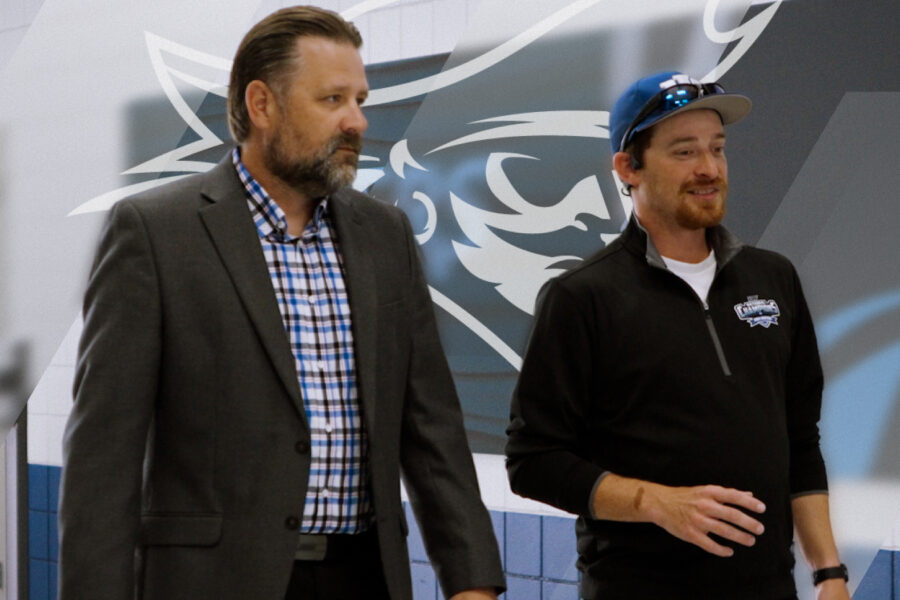
He'll also tell you there was a version of it that was quietly eating him alive.
Not the competition. Not the budgets. Not even the pressure of running 26 sports with a staff that's never quite big enough. It was something more specific — the creeping sense that no matter how hard his coaches worked, the system they were working inside was working against them.
"When 90 percent of your job is the part you don't like, and only 10 percent is the part you like — that's when you see burnout," Larson said. "I want to flip that."
That's not a technology problem. That's a leadership problem. Solving it required him to look at his department differently.
What the Budget Actually Revealed
Larson runs a zero-based budget. Every dollar justified from scratch, every year. It's the kind of discipline that forces visibility — and eventually, it forced a conversation he hadn't expected to have.
When he mapped out what Iowa Western was spending on technology across the department, the picture wasn't what he thought. Multiple vendors. Overlapping contracts. High-profile programs with professional tools. Mid-major sports on different video platforms. Some programs with nothing at all — not because the money wasn't there, but because nobody had told the coach it was an option.
The inefficiency was fixable. What bothered Larson more was what the fragmentation said about his department's values.
"This is not Power Four, where [they’re] getting multi-million dollar TV contracts," he said. "Every athlete's the same here. Whether it's bowling, swimming — they're all student-athletes wanting a great experience."
Including the ones with fewer eyes on them.
"That second-string kicker who's not been in the game and taken a [kick] live still wants to be able to have the same access to get game film to review and critique their performance," he said.
That's the standard Larson holds himself to. And his vendor strategy wasn't meeting it.
So he scrapped it.
The answer was an athletic department package from Hudl — one contract, one platform for every sport in the department. Film, AI sports cameras, livestreaming, analysis tools. All of it, for everyone, at a cost that turned out to be lower than what Iowa Western was already paying for its patchwork of individual contracts.
"We figured out it was actually cheaper for us to give these resources to every program than what we were paying for the seven or eight programs that had individual contracts," Larson said.
For Associate AD Ian Alumbaugh, the cost savings were almost beside the point. "We want to have a product that helps our athletes," he said, "and I will be the first one to say that if there's a product that's going to help our athletes be successful, we're going to pursue that opportunity."
The math was the easy part. The harder part — the part that actually mattered to Larson — was what it said to every coach in his department the day it went into effect. Tools and resources are now spread more evenly across the program. Nobody makes do anymore.
We figured out it was actually cheaper for us to give these resources to every program than what we were paying for the seven or eight programs that had individual contracts.
Shane Larson, Athletic Director, Iowa Western Community College
The Job Behind the Job
Alumbaugh has a job description most people never think about until something goes wrong. "If I'm doing my job right, you don't know what I do for a living," he said, "because I fix the problems before they happen."
That's the reality of the role — carrying operational weight that's invisible when it's working and very visible when it isn't. Scheduling livestreams, managing camera operators, troubleshooting the workflow that breaks on a Saturday night. Alumbaugh was doing all of it, for every sport, with tools that weren't built to work together.
His side of the budget conversation with Larson was simple: here's what I need, here's what I'm willing to pay. When the department package came up, something clicked. "All of a sudden my ears perked up," he said, "because I'm like, hey, that means that's money I don't have to spend."
But the money was never going to be enough on its own. Alumbaugh came in a skeptic, and with his old-school media background, he had a specific objection — not a vague distrust of automated cameras, but a working camera operator's read on what these things actually did.
"The first couple [clips] of other automated camera footage that I watched, I did not like at all," he said. "These cameras aren't very reliable. They kind of just bounce all over the place. They lose the ball." And losing the ball wasn't a cosmetic problem. "For our coaches, that's essential — they need that for their breakdown, for their success. They need to know who got that goal. They need to know who made that basket in the corner."
So he set a bar: "This is going to have to prove its worth to me." Then he tested one anyway. What changed his mind wasn't a sales pitch. It was a Hudl Focus camera angle he'd never had access to before. "There was that secondary angle of the panoramic view that can see the entire field, which is my favorite camera angle, because I can see things that I normally wouldn't have been able to see."
Within a month, the objection had flipped entirely. "I was quickly proven wrong."
By January, he had the entire baseball and softball streaming schedule locked in — games that would go live on their own, no operator, no graphic runner, no 6 p.m. panicked text about a dead battery. "I don't have to hire a camera operator. I don't have to hire somebody to run the graphic. I don't have to worry that my camera operator is going to fall asleep and not get the shot. Everything has really simplified the process with automation."
The job didn't get smaller. It got manageable. And that's a different thing entirely.
What Changes When the Infrastructure Fits
Larson doesn't talk about the athletic department package as a product. He talks about what his coaches do differently now.
"They can just leave now," he said.
"Not worry about it, go home, be a dad, be a mom. Spend time with their family. And I know when I get back in the office tomorrow, all of that work that used to happen after practice has now been taken care of."
That's a culture shift. The kind that doesn't show up in a budget line but shows up everywhere else — in retention, in recruiting, in the energy a coach brings to a 7 a.m. practice when they actually went home the night before.
Women's basketball coach Zach Loll, who has worked at other programs, notices it every morning. "I've walked into work at different places and felt defeated before I even step in the door," he said. "And here you step in and you kind of smile."
Larson had a simpler image for it. "It's fun to watch the kids see the technology put in place for the first time," he said. "The dance team being able to watch their routine in the gym — the giggles and the smiles and the 'oh, that's so cool.'"
That's the reason he got into this.
The Conversation Worth Having
College ADs don't need to be sold on the idea that their department deserves better tools. They already know.
What they need is proof that someone at their level has actually solved it — without a Power Four budget, without a full-time technology staff, without sacrificing the thing that makes small college athletics worth fighting for in the first place.
Iowa Western is that proof.
The system Larson built didn't start with a vendor decision. It started with a values decision — that every athlete in his department deserved the same experience, and that his coaches deserved to go home.
Everything else followed from there.
Sound familiar? See how the athletic department package could work for your program — start the conversation.
Want to see what this looks like across all 26 sports?