Winning the Week: How Modern Game Prep Fuels Fast Play on the Court
Jan 23, 2026
5 min Read
By Tony Miller
Head Coach & Podcast Host of A Quick Timeout
Use Hudl’s professional suite to save time each week by building a visual game plan that lets your players stop thinking and play fast.
Time is your most valuable commodity.
As coaches, we’re constantly searching for ways to maximize every minute of game prep time. The secret isn't working harder – you already do that. The secret lies in creating systems that turn video and data into actionable insights for your players.
For me, that system is the triple threat of Hudl Instat, FastDraw, and FastScout.
I recently sat down with coaches Rob Burke, Head Men’s Basketball Coach with Chowan University and Cam Schuknecht, Assistant Men’s Basketball Coach with Midland University to talk shop about how we’re all trying to maximize every minute of game prep. We’re all chasing the same thing: a way to turn a mountain of video and data into a roadmap our players actually want to follow.
Here’s how we’re changing the workflow to win the week.
Uncovering Tendencies with Hudl Instat
Game prep starts with a deep dive, but I don’t want to drown in the film. I use Instat as my virtual scout. It provides advanced analytics that go way beyond a box score, but the real power is in letting the tech do the heavy lifting.
As Coach Burke put it during our chat, "The AI self scout runs... Bam, read it, see where you're at statistically, let it do the work for you and then you turn around and you go quickly pull those clips out of Hudl Instat and you'll see the problems that you have."
I don't just see that an opponent's star scored 20 points. I can filter by play type and possession efficiency to see the "how" behind the "what." From there, I start breaking down offensive possessions into what Coach Schuknecht calls "families"—related actions that we then "funnel to our presentation from Sportscode."
It’s about a balance of the spreadsheet and the gut. You need the data, but you still need the eye test to see how the flow of the game is going. You have to have both in your bag.
Instat allows me to quickly analyze individual player tendencies. I can search play types and identify their most common ways to score. I also use the platform's filtering tools to find high-frequency sets, common entry passes, and defensive systems to find ways to exploit weaknesses. Maybe the most important function for my workflow is that I can use Instat to create specific video clips to share with my team to familiarize them before facing our opponent on the court.
Creating Visuals with FastDraw
Once I’ve identified those "families" and the opponent’s primary actions—their ATOs, BLOBs, and SLOBs—it’s time to draw things up.
For years, many of us were stuck with a pen and a legal pad. Burke admitted he was in that boat recently: "This time last year, I was still handwriting and drawing our plays...now as the season's gone along, I'm able to build it inside my laptop and I think that's been one of the biggest advantages for me."
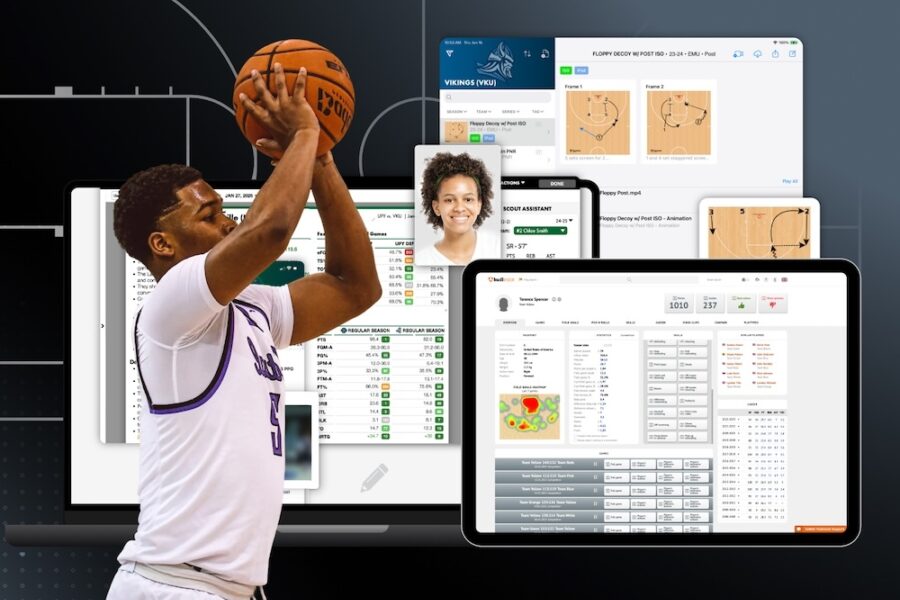
Using FastDraw, I can create professional diagrams in minutes. It isn't just about looking clean; it’s about clarity. When we pair these diagrams with the film, the "why" becomes obvious. As Schuknecht noted, "Guys can look at the diagrams. Guys can look at the film upload as well too that corresponds with that diagram."
It keeps things simple.
Prepare the "Instagram Generation" with FastScout
The final step is packaging. You can have the best game plan in the world, but if your players don't digest it, it doesn't exist. We have to respect the way modern athletes consume information.
"We’ve got to keep in mind this generation, it's an Instagram generation," Burke said. "It's about four to six seconds you got and they're swiping to the next thing... To me what I have found success with is six minute sessions."
This is where FastScout changes the game. I use the template feature to save time, pulling in team and player statistics automatically. "Saves me even more time once I get it set up," I told the guys. "I can put what I want on there, what I care about most... and then I get that template every single time." Thanks to the seamless integration, I can drop the FastDraw diagrams directly into each scout. Additionally, I can add notes to give further details on how we’ll guard actions.
I create Personnel Tiles for every opposing player, then send the whole report straight to their phones. We keep the communication simple, focusing on four or five key actions. As Schuknecht puts it: "You can't bog the players down where now they're thinking and now you're not playing fast... it has to be simple because you have to play fast."
FastScout allows me to automatically pull in team and player statistics, including advanced metrics, to save hours of data entry time and give my staff and players an immediate statistical snapshot.
One of the best parts is the ability to share the entire report through the FastScout mobile app or as a PDF. This allows players to review the scout on their phones, tablets, or computers anytime, anywhere.
Give Yourself 25 Hours Back
The goal of this workflow isn't just to win a game; it's to win your time back. When you combine the Hudl camera with Instat, FastDraw, and FastScout, you aren't just changing your process—you're improving your program's entire culture.
"The combination of being able to take the Hudl camera... do your scouting piece to drop it right into FastDraw and FastScout. That to me is invaluable," Burke said. "You're talking 25 hours minimum a week of workflow."
That’s 25 hours you can spend on the court coaching your players, or 25 hours you can spend with your family. By the time tip-off rolls around, the work is done. The players aren't thinking—they're reacting. And that’s when you’re at your best.
The key to all this is minimizing wasted time and maximizing clarity.
For coaches at any level, embracing this modern process will be the difference-maker in your program. It allows you to spend less time cutting up film and entering data and more time coaching the game plan on the court.