
Soft-tissue injuries cost Europe’s top leagues €610M+ in lost wages last season. Here’s why standard GPS misses the workload that causes them — and what J.League clubs can do about it.
Here's an uncomfortable thought for any J.League club: you're probably blind to about a third of the physical work your players are doing. Not through negligence — but through the limits of the tools most clubs rely on. And that blind spot is where the most expensive injuries in football are quietly happening.
You can't manage a risk you can't see. So before asking how to prevent injuries, it's worth asking how much of the workload that causes them are you actually measuring? Because for most clubs, the honest answer is "less than we think."
The cost of injuries is bigger, and more measurable, than clubs admit
Injuries often get filed under bad luck. A lot of them defined as a preventable expense. An injured player is still paid in full, so every day he's unavailable is wasted budget — on top of the points, goals and league position his absence costs you.
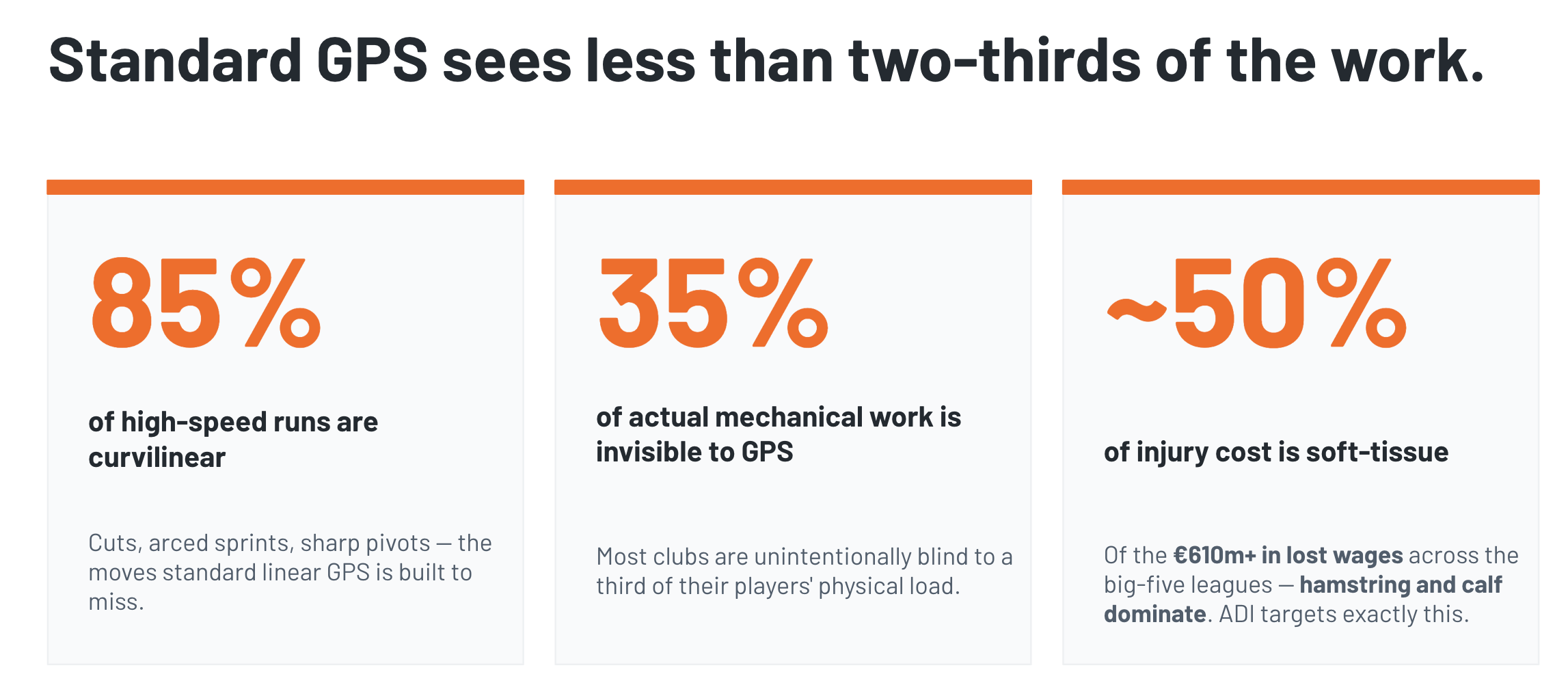
The scale is sobering once you add it up. Across Europe's big-five leagues, soft-tissue injuries alone cost more than €610M in lost wages last season — a huge sum of money paid to players who couldn't take the pitch.
Roughly half of all injury cost is soft-tissue, and within that, hamstrings and calves take most of the damage. These aren't freak collisions. They're the injuries most tied to how a player is loaded, monitored and recovered, which is exactly why they're the ones a club can do something about.
For a J.League club the maths is, if anything, harsher. Squads are leaner than in Europe's wealthiest leagues, so a single long-term injury to a key player strips out a far bigger share of your quality, and the pathway behind him is thinner. The wage you keep paying hurts more when there are fewer players to absorb the gap.
The on-pitch cost is just as real
Lost wages are only half the bill — the rest shows up on the scoreboard. When Tottenham lost James Maddison to a cruciate ligament injury, the club didn't just keep paying him through 398 days out; it forfeited more than 20,000 minutes of the attacking output he'd normally provide. Chances not created, goals not scored, points not won, all from one absence.
Now picture that in a J.League season where your fixtures already stack up — league, the Emperor's Cup, the AFC Champions League, international call-ups for your best players. Spread that load across a thin squad and "availability" stops being a medical footnote and becomes one of the biggest levers on your results.
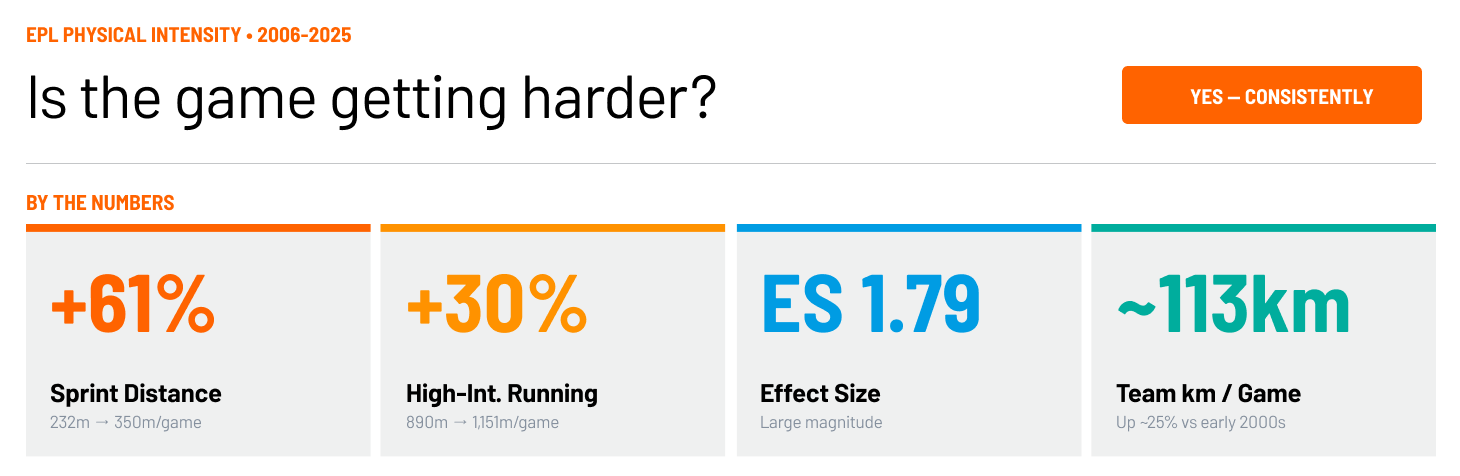
And the demand is only climbing. Research shows that the physicality of top-flight football has gotten measurably harder over the past two decades: sprint distance per game is up around 60%, high-intensity running up roughly 30%. High-pressing tactics, fixture congestion and sharper sports science have all pushed the physical ceiling higher.
And the J.League is rising on the same curve, not insulated from it. More load, applied more often, means more of exactly the soft-tissue risk that's already the most expensive category.
The question isn't whether you track players — it's what you're measuring
Almost every J.League club tracks its players now; GPS vests are standard kit from J3 to the Premier League. So the honest question isn't "should we be monitoring workload?" You already are. It's "are we measuring the thing that actually causes the injuries?"
For most clubs the answer is no — and not through any fault of their own.
Standard GPS is built to measure movement in straight lines: top speed, total distance, sprint counts. But football isn't played in straight lines. Around 85% of a player's high-speed runs are curvilinear — the cuts, arcs, pivots and changes of direction that put the real strain through a hamstring or a calf.
The mechanical cost of all that twisting and decelerating is precisely what linear GPS is built to miss. The result: as much as 35% of a player's actual mechanical work is invisible to standard tracking. A player can post a perfectly normal distance and sprint count on Monday while having quietly absorbed a third more load than the numbers show.
That's the blind spot — and it's the same one from Tokyo to Manchester and everywhere in between.
WIMU takes the complementary route, pairing precise tracking data with football context through its integration with Hudl Sportscode. Instead of a wall of numbers detached from what happened on the pitch, staff can see the workload alongside the video that produced it — far more useful when you're explaining to a coach why a player needs managing. It's the system Spain and Fulham FC rely on to do exactly that.
The common thread is football context. Raw distance and top speed tell you a player ran. They don't tell you what that running cost him, or where the next injury is forming physiologically. The data that does, is the data worth measuring.

Availability is the cheapest gain you've got
Measuring the real load changes how you manage minutes effectively. You can rotate on evidence rather than instinct, spot the asymmetry that precedes a hamstring strain, and protect the players who are both your best performers and your most valuable assets — the ones, as a later piece will explore, that Europe is increasingly watching.
That last point matters more for J.League clubs than almost anyone. The player you fail to keep fit isn't just a selection problem; he's an asset whose value — and whose eventual transfer fee — erodes every week he spends in the treatment room. Protecting availability protects the resale value you're working to build.
Availability is the cheapest performance gain in football. You don't have to outspend anyone to capture it — you have to measure the right things. Injuries will never disappear from the game, but flying blind to a third of the workload causing them is a choice. And it's an expensive one.
Want to know what your current data tracking is missing? See what ADI and WIMU reveal about your squad's real workload — book a demo and we'll walk through it with your squad.