Different Pathways To Score in Transition


What makes Europe’s top transition teams unstoppable? Baskeroseno Scouting CEO Ander Isuskiza breaks down the film and tactics.
In the first part of this article, Beyond the Arc: What Actually Wins in Europe, we focused on data to identify the best teams in transition. Now we turn to film to actually see how they do it.
A lot has been written about teams like Paris or Valencia, as the flag bearers of the transition game in the past few years. High pace is one of the latest trends in modern basketball, and coaches are analysing fast-paced teams to try to implement their concepts into their own game.
However, it's not just running a faster offense that makes you score more. Finishing offenses according to the characteristics of the roster and emphasizing quality shot selection can also increase output.
Here are a few examples I think show this:
MHP Riesen Ludwigsberg
Are we going too indie now? In a city known for its Baroque heritage, this German club replicates some of the exuberance and intense emotions the artists expressed back in the day in the form of a fast and furious team that relies on pace (Second highest in Bundesliga) and 3-pointers.
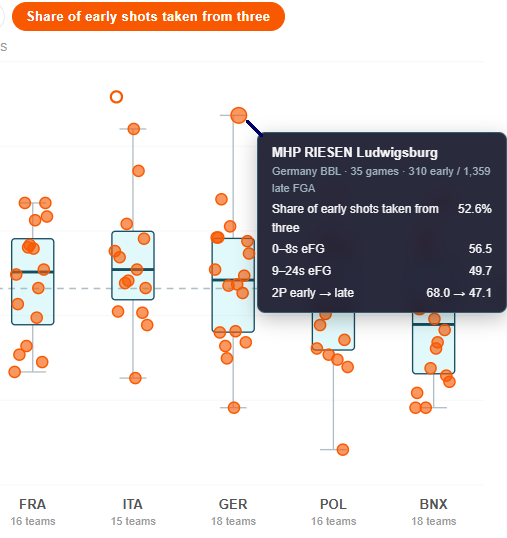
Mikko Ripinen’s name might not be mainstream, but he developed a clear style with Norrköping, finishing top-3 in three-point attempts in Swedish Basketligan over the four previous seasons. His team also recorded the highest transition 3-pointer per game in the 2024-25 season, his last one before moving to Germany.
Now with Ludwigsburg, having fearless shooters like Elijah Hughes, who fires 7.7 3-point attempts per night (13 per 40 mins!), definitely helps fit the profile. Nevertheless, this team needs to take care of the ball a bit better, as they turn it over a lot.
So the signing of a coach is directly related to pace and shot diet, right? It reminds me of the case of Pedro Martínez, who developed his now acclaimed style in Manresa and then skyrocketed it in Valencia, leading the team to win the Spanish ACB and unexpectedly making the Euroleague Final Four.
The question now is whether he will do the same with Real Madrid or adapt to the roster and a more result-oriented powerhouse.
Brose Bamberg
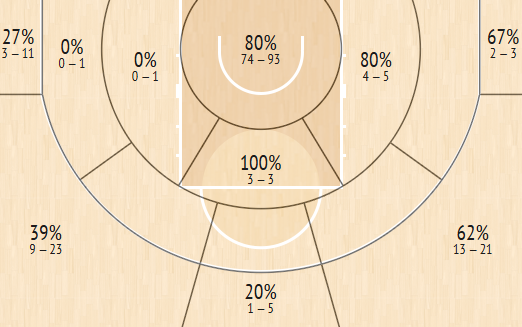
Here’s another German team but with a different style. Instead of over-indexing on 3-pointers, the Bavarian side has been practical and stands out with an amazing two-point percentage of 78%in the first 8 seconds of the possession. If we do the math, you need to score 52% on 3-pointers. For context, the best team in the top European league is the aforementioned Olimpia Milano with 45% (the equivalent of 68%2P). See their numbers in transition: