Football Wyscout Statsbomb Performance Analysis

The Accumulated Debt of the Modern Football Calendar


7 min Read

The 2026–27 Premier League season began just 33 days after the World Cup final. The league had already pushed its start date back as far as it could, yet 33 days was barely enough time for players to complete FIFA's mandatory three-week post-tournament rest and report for pre-season.

Five games into the new campaign, the Premier League paused for an international window unlike any before it: 16 days, four matches per nation, with the September and October breaks merged into one. Eight England players withdrew due to injury or load management.

Using Wyscout physical tracking data alongside Hudl Statsbomb event data, I analysed two of those eight withdrawals: Declan Rice and Cole Palmer.

Their circumstances could hardly have been more different. Rice played 64 games for Arsenal and England last season before immediately playing seven matches at the World Cup. Palmer did not go to the World Cup. His 2025–26 season was instead disrupted by injury, three different managers and a loss of attacking consistency.

Yet both cases reveal the same problem: the physical story can diverge from the performance story long before either becomes obvious to the naked eye.
The Weight of 64 Games

Five games into the new season, early data shows Declan Rice doing more with the ball and less without it, a shift that his mounting workload may go some way to explaining.

The physical toll began well before the summer.

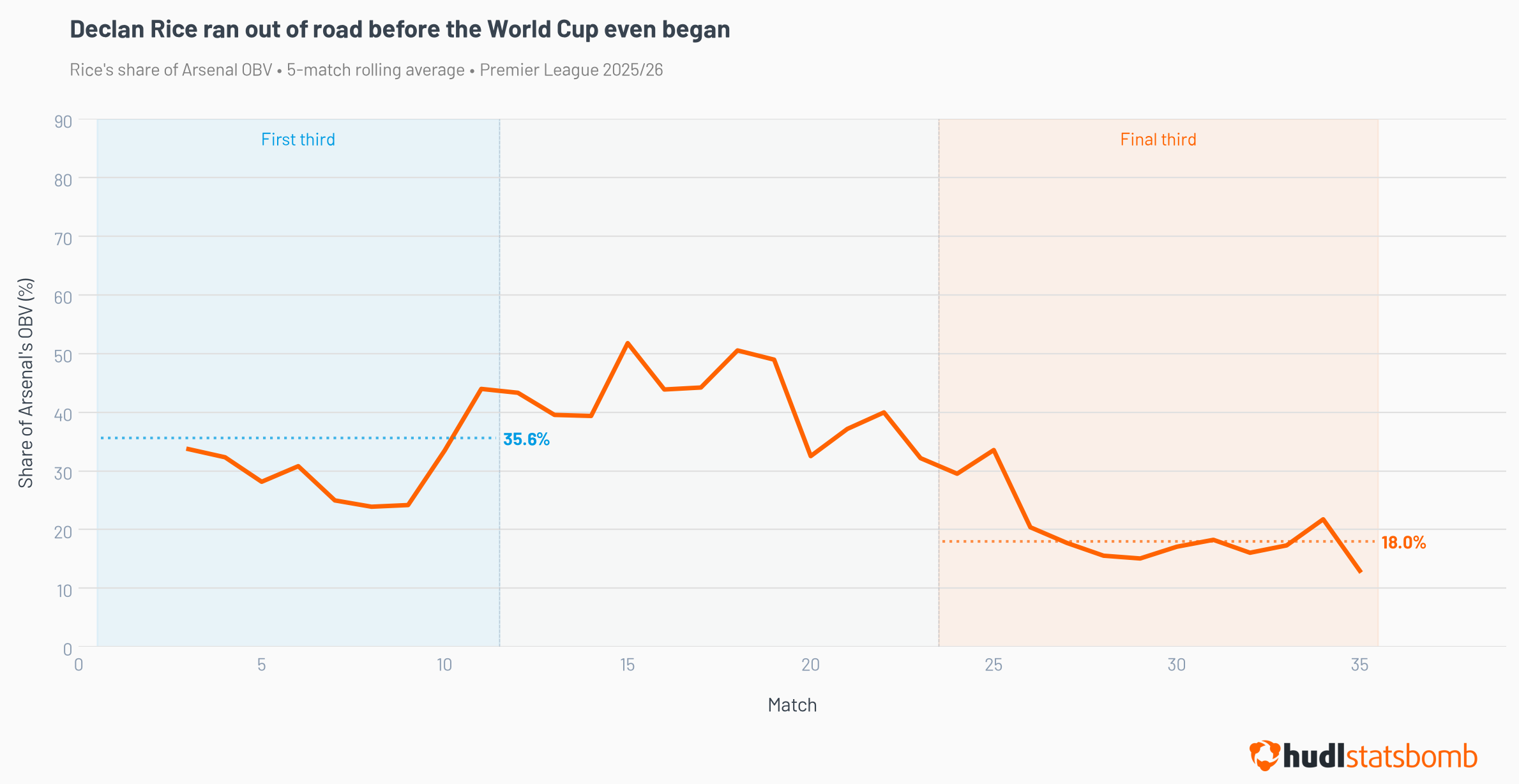
Rice logged more than 4,450 minutes for Arsenal in 2025–26, and by the run-in, his on-ball output was falling. Statsbomb's On-Ball Value, which measures a player's contribution to goal probability, averaged 0.524 per 90 in the first third of the campaign. By the final third, it had fallen to 0.245, a 53% decline.

The decline was Rice-driven rather than Arsenal-driven. Arsenal's average OBV per match actually rose across the same period, while Rice's share of the team's OBV fell from 33% to 17%.

That does not, by itself, prove fatigue. But it is notable when a player's on-ball efficiency declines so sharply while his team improves.

Then came the World Cup.

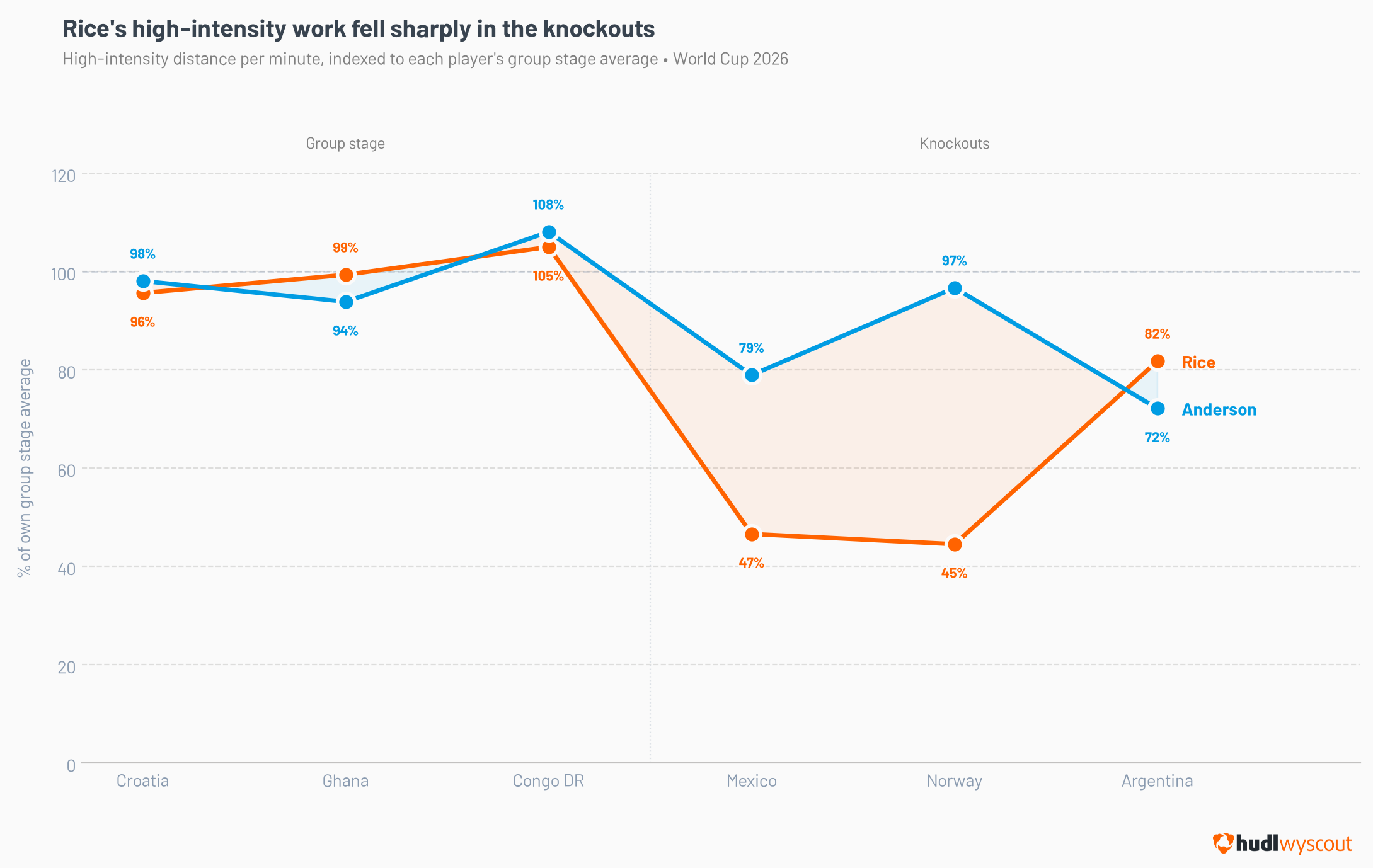
Following a group stage in which his high-intensity distance averaged more than 7 metres per minute, fatigue and illness began to take hold. Elliot Anderson, tracked across the same matches, held his output through the knockouts, finishing the tournament within 30% of his group-stage average. Rice went the other way. After 109 minutes at altitude against Mexico, he lasted just 45 minutes in the quarter-final against Norway, recording a single sprint and a tournament-low 156 metres of high-intensity running after days in bed.

Tuchel said afterwards that Rice simply could not last 90 minutes.

The semi-final against Argentina told a similar story. Before England took the lead, Rice's high-intensity output had already fallen to around 80% of his group-stage average inside 30 minutes. The decline therefore preceded the change in game state, making it difficult to explain purely through tactics.

In the third-place playoff against France, his high-intensity output was still 20% below his group-stage level.

The pattern has continued into the new Premier League season, though it’s still early days.

Rice is covering less total ground, but the decline in high-intensity work is considerably sharper: high-intensity running has dropped and sprint counts more so. These actions are what Rice’s defensive game is built on – closing down, winning second balls, recovering ground and arriving quickly at the next phase of play.

With the ball, however, his role has moved in the opposite direction.

Rice’s average touch location has dropped around five metres deeper. His pass volume is up 22% and his forward passes have nearly doubled. Receiving the ball deeper naturally increases the opportunity to play forward, but that increased involvement has not produced greater impact: his overall OBV has fallen 14%, while passing OBV is down 28%.

The picture is consistent: less explosive work without the ball, alongside higher-volume but lower-efficiency possession with it.

Whether Arteta is protecting a heavily loaded engine or adapting his setup, Rice's withdrawal from the England squad was a practical response to a physical burden that had been building for months.
The Other Side of Absence

Palmer's story is different.

He did not travel to North America in the summer. Thomas Tuchel left him out of England's World Cup squad after an injury-disrupted season in which he struggled to find consistency at Chelsea.

For Palmer, however, missing the World Cup created something Rice never had: time away from international football to rest and reset.

His 2025–26 campaign had been repeatedly interrupted. A persistent groin problem kept him out for around two and a half months, with further physical setbacks adding to a stop-start season. He managed just 2,693 minutes across all competitions, down 33% on each of the two prior seasons. Chelsea also went through three managers: Enzo Maresca, Liam Rosenior and caretaker Calum McFarlane.

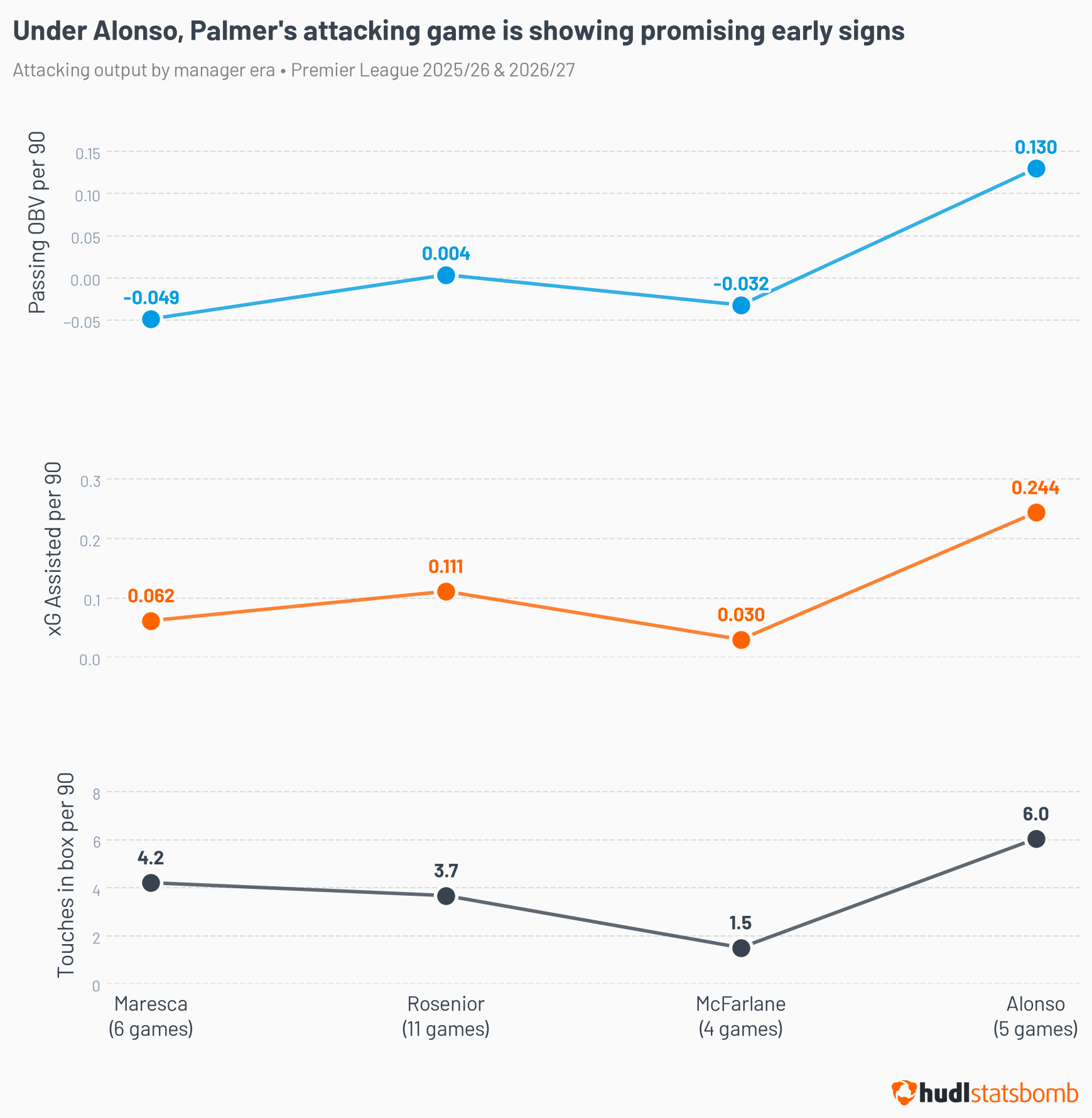
The result was a season in which Palmer never established a sustained attacking rhythm. His passing On-Ball Value per 90 was barely positive under Rosenior and negative during McFarlane's caretaker spell.

The summer offered a chance to start again.

And under Xabi Alonso, Palmer appeared to do exactly that.

Five games into Alonso's tenure at Stamford Bridge, his attacking numbers had rebounded sharply. Palmer's xG assisted per 90 stood at 0.244, more than double the 0.09 he managed across the baseline period of fit games under Rosenior and McFarlane. His touches inside the box had nearly doubled too, from 3.1 to 6.0 per 90, while his key passes were up 60%.

Alonso was also using him differently from Maresca: less as a progressive carrier and more as a final-third creator. Where Maresca's Palmer generated value through progressive play, Alonso's version was getting into dangerous areas and creating from there. Early in the season, the change was working.

His physical numbers, though, pointed elsewhere.

In four of his five appearances, Palmer's high-intensity output came in below his spring levels. The outlier was Fulham, a chaotic 2-3 win Chelsea came from behind to take, where the game state pushed his numbers unusually high. Alonso may also have been managing his workload deliberately, keeping Palmer higher up and asking less of him without the ball. Even allowing for both, the dip was there most weeks – and it was deepest at Hull City on September 12th, the same afternoon he produced three key passes and 0.428 expected assists.

On September 18th, Palmer was recalled to the England squad. Three days later, he withdrew with a minor muscular injury.

Chelsea know more than the data does. Match-level tracking cannot tell us whether the physical decline caused the injury, whether it was an early warning sign, or whether the two were unrelated. But it reveals a gap conventional performance metrics would have missed: Palmer was creating at well above the levels he set last season while his high-intensity numbers were generally running below his own spring baseline.

The Same Signal, Two Different Routes

Neither case proves that fatigue caused an injury. The pattern is subtler: physical strain can become visible before performance collapses.

Rice carried an extraordinary workload through an entire club season, a World Cup and into the following campaign. His physical output and on-ball efficiency deteriorated together.
Palmer's route was almost the opposite. After an injury-disrupted season and a summer without international football, his attacking output rebounded sharply while his physical markers remained below his established baseline.

The accumulation looked different in each player. The signal was the same.

The eight England withdrawals do not prove that the football calendar has broken these players. But they do suggest that load management is no longer simply a question of minutes played. It is about the accumulated physical cost of repeatedly asking players to produce at the highest level, and the gap that can open between what the body is doing and what the performance data still shows.

By the time the performance numbers move, the physical data may already have been telling the story for months.


Physical comparisons across tracking versions carry inherent limitations; where possible, figures are drawn from within the same system.