How Iowa Western Women's Basketball Makes Every Player Count
Aug 28, 2026
4 min Read
After 30 years coaching basketball, Iowa Western’s Zach Loll got his time back — and put it exactly where it belongs.
Zach Loll has been coaching basketball for 30 years. At Iowa Western, he has two of them with each player.
The JUCO window doesn't leave room for a learning curve. Recruits come in, develop, and move on — every season. No catching up, no buying time with extra staff. Just Loll, his assistants, and a job that doesn't fit into one description because it isn't one job.
The 30-year coaching veteran has been around long enough to know what that lack of face-to-face coaching costs his program.
Stuck In The Day-to-Day
The film doesn't watch itself. The recruits don't call themselves. And when the bus pulls back into Iowa Western at midnight, Loll already has to be thinking about the next opponent.
That's college coaching. The job doesn't fit neatly into one description because it isn't one job — it's film work, recruiting, academics, logistics and actual coaching, all layered on top of each other, all running at the same time, on a staff that can't afford specialists for any of it. Although Loll’s tech has helped alleviate some of that workload, he realizes playing many roles will always be a part of college coaching.
"Part of the job has evolved in that you don't have to wear as many hats sometimes," Loll said. "But you've still got to make yourself valuable and find as many ways as you can to help the program."
At Iowa Western, Loll took that advice long before he ever gave it. The window for his athletes is two years. The pipeline turns over every season. There's no catching up — only keeping pace. For most of his career, the only answer to that pressure was more hours. Then the tools changed.
How He Got His Time Back
Hudl didn’t magically change how much work Loll had to do. Now, he can complete his film review in a fraction of the time it used to take.
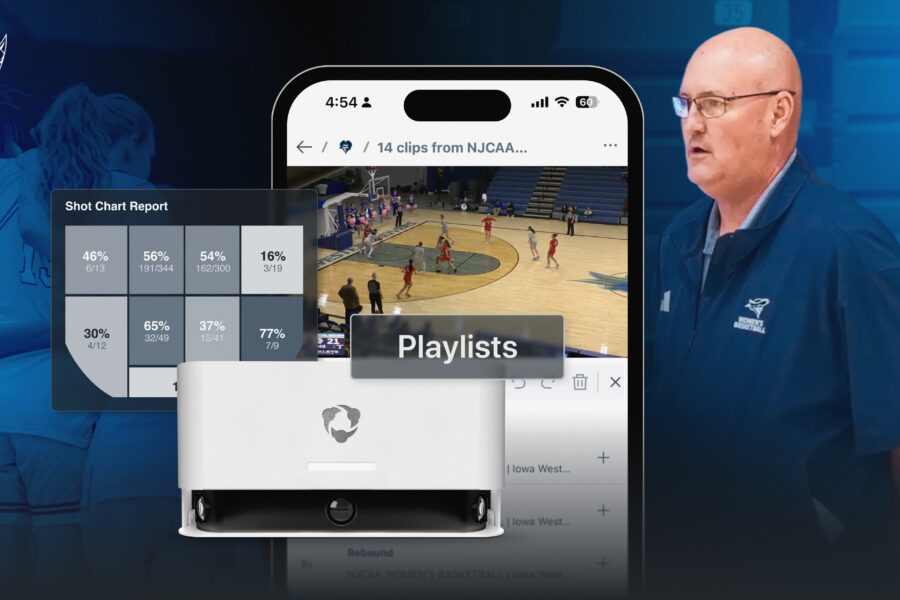
With his Focus camera automatically uploading game and practice footage to Hudl, he can start his film review faster than ever.
"Before, it may have been 3 to 5 days before you got [film] back. Where now, by the time you walk to the locker room, you can watch film if you wanted to," Loll said.
Not only can he get his film much more quickly, but with Hudl Assist, Loll doesn’t have to spend hours breaking it down. Assist handles it for him.
"I use the Assist program to go in post-game and be able to look at specifics for players and pull specifics right away — see where people made shots from, where turnovers were happening. We can pull up the exact moments when things happen and share those with the players,” Loll said.
Assist handles post-game film breakdown. Focus captures practice automatically. Replay puts footage in front of players the moment they need it. Now, Loll gets the chance to spend more time on the front lines.
The Real Benefit of Saving Time
With decades of coaching experience, Loll thought a lot about what the job is actually for. Wins matter. Development matters. But what he comes back to most is harder to measure.
"When we all start in coaching, everybody thinks about the wins, the championships," Loll said. "But it started to change for me. Seeing them not as pieces, but actual people."
For Loll, basketball is the vehicle — but what the values his players carry out of Iowa Western are what it’s really about. His job isn’t just leading them to success on the court, but setting them up for it after they leave Council Bluffs.
Beyond The Box Score
Players from Iowa Western often go on to sign with four-year programs. By conventional measures, his program is producing. What Loll thinks about just as much is the player who doesn't make the highlight reel — the one who showed up every day, put the work in and might have spent two years wondering whether any of it was noticed.
“Hudl helps us build that trust and give them a why behind things. When you give them the why, it helps them know that we've got their best interests at hand," Loll said.
That level of intentionality is why former players often come back just to tell Loll thank you. To him, that's what a great program truly looks like.
The Technology Changed. The Job Didn't.
Coaching has always been a relationship business. But for most of Loll's career, the grind was claiming the hours that belonged to it. Now his tools let him get back to the heart of what being a coach is about.
"It allowed me to build more of a relationship with my players rather than spending more time behind a computer screen," Loll said.
Want to get your time back and reinvest it in your players like Coach Loll did?