Head Coach Search: Supporting Sustainable Succession Planning

Minimize risk in your next coaching appointment. Head Coach Search delivers objective insights to find managers who truly fit your club’s needs.
A Smarter Way to Search
Head Coach Search provides an objective means of reducing a universe of coaches down to a shortlist of viable options. Built on Hudl Statsbomb and Hudl Wyscout data, it covers more than 6,000 managers across men’s, women’s, and youth football since 2015.
This new dashboard allows you to quickly define what you’re looking for, compare and contrast potential candidates, and deliver clarity to your decision-making.
Don’t let each coach appointment redefine the future of your club. Align your succession planning with your philosophy and budget to set the foundations for long-term success.
Find the Coaches Who Truly Fit your Needs
Hudl’s Head Coach Search streamlines the search with a series of customisable filters, helping to quickly narrow down a potential list of candidates based on the criteria that matter most:
- Employment status - available now or worth the wait?
- Experience - an emerging talent or a proven veteran?
- Competitions managed in - familiar with your league’s demands?
- In-possession style - does their build-up match your identity?
- Out-of-possession style - pressing intensity aligned with your squad?
These results can be benchmarked against the incumbent manager and more weight can be added to specific stylistic elements that are important to your desired game model, in order to fit the coach who truly fits your needs.
Whatever your requirements, Head Coach Search gets you from wishlist to shortlist in a couple of clicks.
A Model To Measure A Coach's Influence
How can you tell what impact a head coach has on their team’s performance? Our model answers that question by separating a coach's influence from all the other factors at play.
It’s built on a simple idea: a player’s statistical output in a match—whether it's their pass completion rate, non-penalty expected goals (np xG), or number of tackles—is the result of several key variables. By accounting for each of them, we can isolate the coach’s true impact. These variables include:
- The player’s inherent ability or tendency (e.g., a player who consistently generates high-value passes, as measured by our OBV model, regardless of the system they play in).
- The manager’s tactical influence (e.g., a coach whose system leads to their players attempting and completing more progressive passes than the league average).
- The strength of the opponent and their coach's strategy (e.g., it is statistically harder to complete passes or generate xG against a team known for an intense, high-pressing defensive system).
- The position the player had in the match (e.g., a center-back is expected to have a higher pass completion rate than a striker playing in the final third).
- Natural, match-to-match variation (e.g., the random variance in a player's output that isn't explained by any of the other factors).
Our model looks at all these factors at the same time, allowing us to see how much a coach improves (or diminishes) their players' performance, independent of the quality of their roster.
For example, a team's pass completion rate isn’t just about their coach's build-up philosophy. It’s also affected by an opponent's pressing intensity and the technical skill of the players on the field. Our model untangles these factors to show the coach’s actual contribution to that specific metric.
We also built in position-specific age curves for every metric. This is key because performance changes throughout a player’s career. It helps our ratings show how much a coach elevates players compared to what’s expected for their age and role.
Review your Shortlist in More Depth
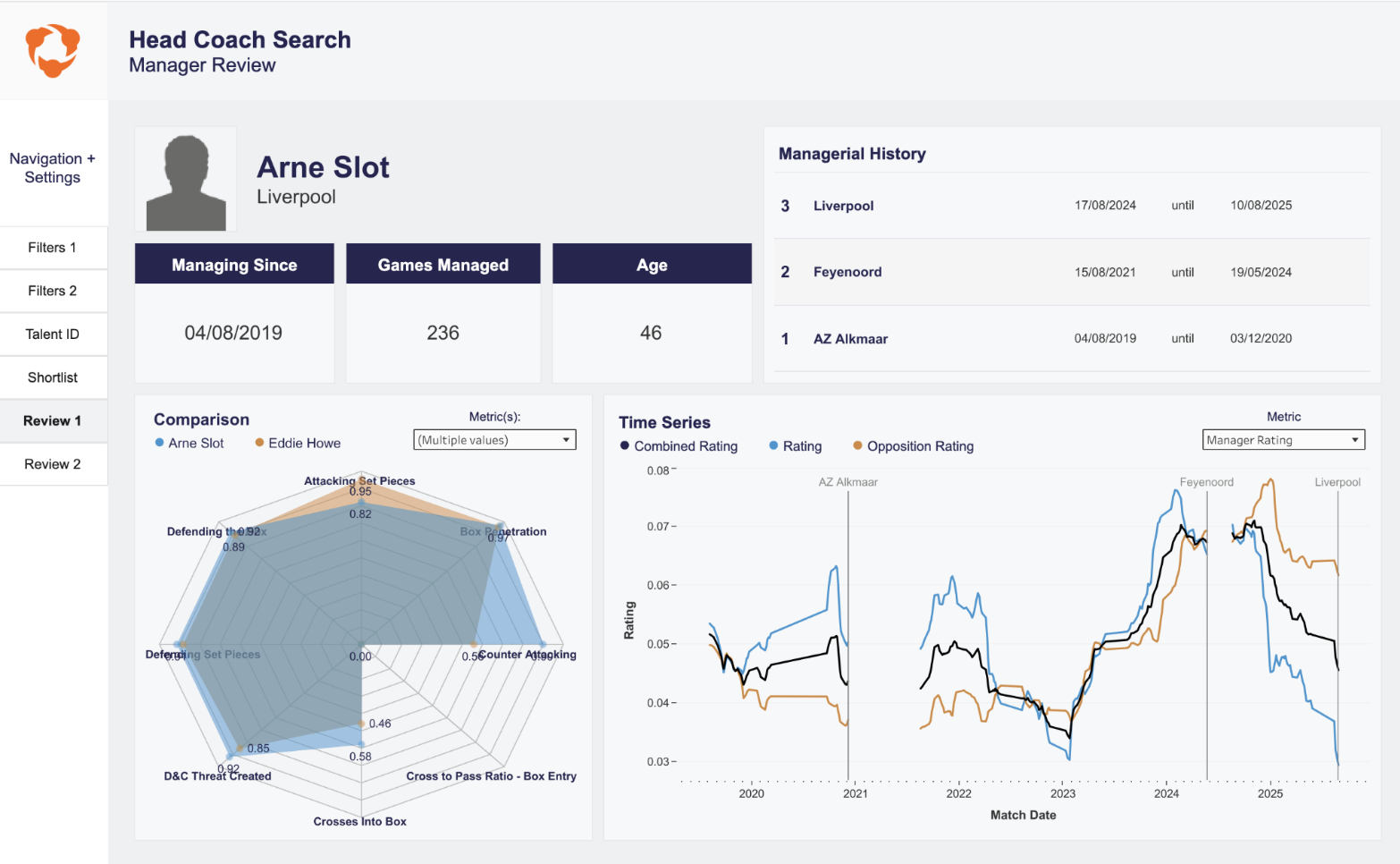
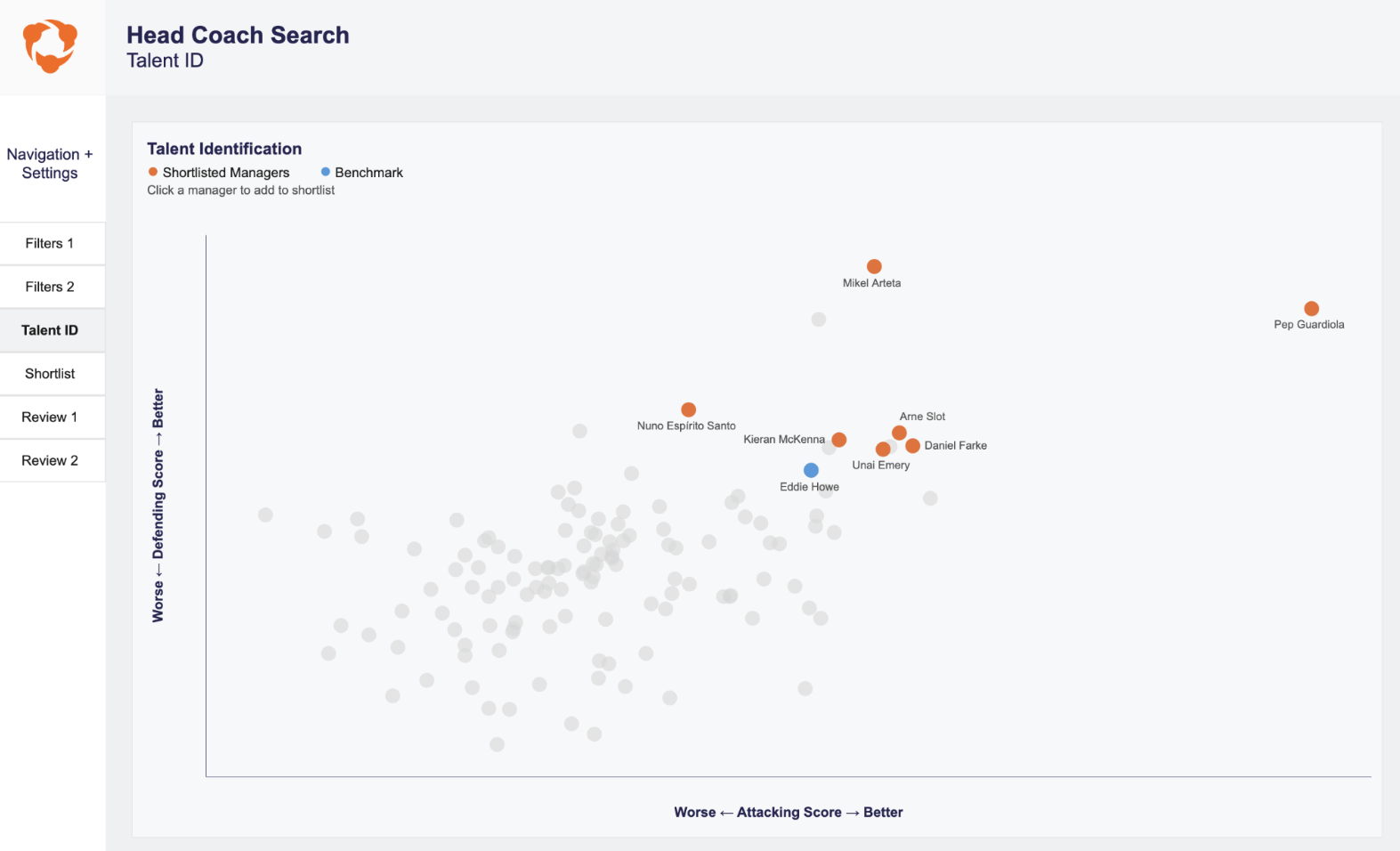
Shortlists come to life through radar profiles, scatterplots, and career performance trends.
With coach performance isolated from squad quality, you can now compare candidates fairly—understanding not just what they achieved, but how they achieved it. This is particularly valuable when assessing coaches who've worked with varying levels of talent.
For instance, a coach who achieved mid-table finishes might not normally jump out but Head Coach Search can identify whether they have consistently overperformed expected results based on squad quality over the course of their career.
Once you’ve pinpointed someone you’re interested in, send them for further review and quickly align with leadership change with squad identity.