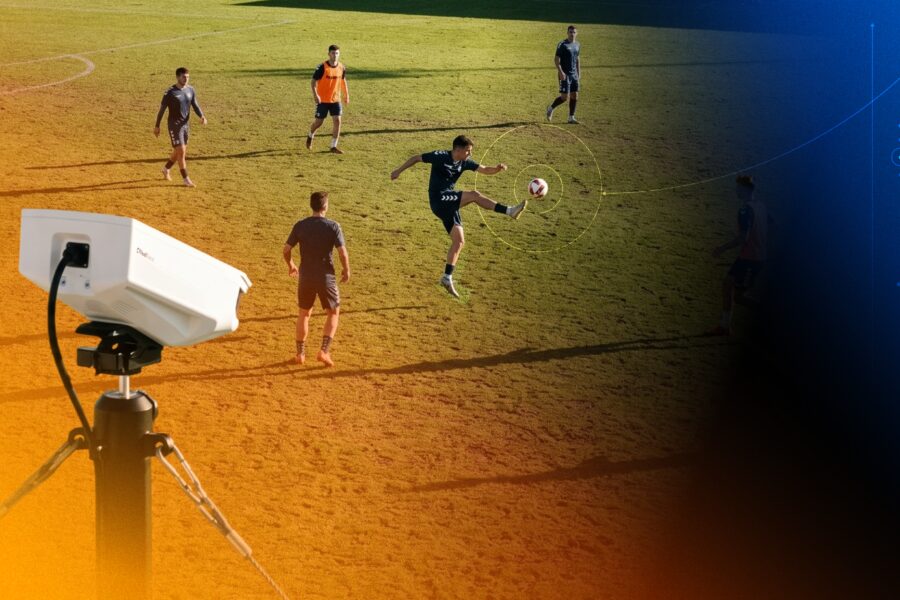
Learn how to record football matches with the right camera setup, positioning, and technique — so your club gets clear, usable footage every single week without having to hire a cameraperson.
If you record matches at a grassroots or semi-pro club, you already know the problem. Getting footage means either roping someone in to film it, or paying for a cameraperson — and even then, you might wait days to get anything back, and what you do get is often a mid-level side-on shot that tells a coach nothing. No full-pitch view. No tactical picture. Just 90 minutes of the ball being followed around.
The real issue isn't wanting better footage. It's that most non-league grounds don't have the vantage point a cameraman needs to do their job properly, and even if they did, the cost mounts up fast across a full season. So clubs either cut corners or go without.
This guide covers what actually matters for match footage that's usable — for post-match review, clips for your socials, or player and coach development — without turning matchday into a production shoot.
What Does Good Match Footage Actually Look Like?
Good football film balances two competing needs. Players and supporters want zoomed-in, highlight-worthy moments — a mazy run, a last-minute winner. Coaches and analysts want the wide picture for tactical analysis: shape, spacing, and how the team moves as a unit.
You don't have to choose. The best setups capture both from a single position:
- A high vantage point, level with the halfway line. This gives you a full-pitch view that shows shape and structure, not just the ball.
- A stable camera. A tripod (or a mount that doesn't move) removes the shake that makes footage hard to review — and impossible to clip for socials.
- Multiple views without multiple cameras. Focus Flex shoots a wide tactical angle and a tighter broadcast angle in the same recording — so you're not sacrificing highlights for analysis or the other way around.
Clear kit numbers, visible ref signals, and the odd scoreboard shot all help too — they make it far easier to break a match down afterwards, whether that's for a coach's Monday review or a highlights reel.
Choosing How to Record: Phone, Cameraperson, or Automatic Camera?
Most clubs record one of three ways. Each has a real trade-off.
Filming it yourself (phone or basic camera)
Filming yourself is the lowest barrier, but someone's committed to holding a steady, wide shot for 90+ minutes — not an easy ask. The bigger issue at non-league level is vantage point. Most grounds don't have an elevated position that gives you a proper full-pitch view, so you end up with footage that looks fine on the surface but tells a coach nothing tactically. You also can't see formations, track player spacing, or understand how the team is actually set up.
Hiring a cameraperson
Hiring a cameraperson solves the person problem, but not the vantage point one — and now you're paying for it too. Costs add up across a 30-game season. You're at the mercy of their schedule, their setup, and their idea of what useful footage looks like. And when you need the footage fast — for a Tuesday debrief, or a midweek match turnaround — you're waiting on someone else's workflow.
Automatic capture cameras
AI football cameras take the person out of the equation entirely. Set it up, hit record, and the camera uses AI to track the game on its own. That's exactly why they've become the norm for clubs at every level of the game — not just elite clubs with full-time video analysts.
We build Hudl football cameras, so we're not neutral here. But the logic is simple: if getting footage is complicated or expensive, it won't happen consistently — and inconsistent footage is nearly as useless as none at all.
Football Recording Equipment: What You Actually Need
The wrong setup — or missing one thing on matchday — can cost you important match footage. Here's what matters:
The camera
This is the obvious one, but it's worth being specific. As mentioned above, a smartphone will get you something, but not a tactical view. A standard camcorder needs an operator. An AI football camera like Hudl Focus Flex is the only option that gives you a high-quality, full-pitch recording without a person dedicated to running it.
A mount or tripod
Whatever camera you use, it needs to be stable. A shaky handheld shot is hard to watch and harder to analyse. A tripod or dedicated camera mount keeps the frame consistent and frees up the operator to focus on positioning rather than steadying the device. For AI cameras, most come with a purpose-built mount and tripod.
Power and storage
For a day with multiple matches — or a season where you're filming every week — battery life and storage matter. Carry a spare battery or a charging bank. If you're using an SD-based camera, bring more cards than you think you need. With Focus Flex, onboard storage and a full-day battery cover most fixture schedules without fuss.
A reliable WiFi connection or hotspot
If you want footage reviewed the same day, you need a way to get it off the camera quickly. Focus Flex uploads over WiFi — so if your ground has a connection, or you're running a mobile hotspot, your coach can have the video before the post-match debrief is over.
How to Record: Setting Up with Hudl Focus Flex
Hudl Focus Flex is built for exactly this — a portable football camera that goes wherever your team plays, home or away, no press box or fixed rig required. Point it at the pitch, and it handles the framing itself.
A few reasons it fits how grassroots and semi-pro clubs actually operate:
- It uploads over WiFi, so footage can be reviewed the same day — not after someone remembers to plug in an SD card, or a cameraperson gets round to sending a file.
- You get two views in one recording — a wide tactical angle for coaches, and a tighter broadcast-style angle for highlights — so you're not choosing between the two.
- Battery and storage cover a full day, which matters if you're covering more than one match — a Saturday morning fixture list, a tournament, or first team and reserves back to back.
Test It Before Matchday
Before your first competitive fixture, run the camera at a training session or a friendly. It's the easiest way to catch positioning issues, get the angle right, and make sure whoever's setting it up knows the routine — before it matters.
Don't Overlook Kit Colours
It's easy to think of good footage as purely a filming problem — but kit choices affect it just as much. Numbers that don't contrast clearly against the shirt are hard to read on camera, and even harder for automated tools to pick out. Combinations like yellow-on-white, grey-on-black, or red-on-black are the usual culprits.
Solid, bold numbers in a contrasting colour make life easier for anyone reviewing the footage afterwards — human or AI.
Get More From Every Matchday
Recording a football match doesn’t need to be complicated. Get the position right, keep the camera steady, and make sure your kit numbers are actually readable — and you've already solved most of what makes match footage hard to use.
Camera choice matters too. Filming it yourself works, but it ties up a person for the full 90 and more. An automatic football camera like Hudl Focus Flex removes that entirely, and gets footage in front of your coaches and players the same day — not days after.
Find out more about Hudl Focus Flex today.