Small college athletic directors are being asked to do more with less — more sports, more content, more accountability, fewer staff. The way a program captures video is either working for them or quietly creating more work.
A recent webinar brought together two programs at different stages of the same journey: Glen Brittich, Director of Athletics at Elmhurst University (NCAA DIII), who has built out a multi-angle facility in their indoor arena, and Ian Alumbaugh, Associate Athletic Director at Iowa Western Community College (NJCAA), who has implemented multi-camera capture at the softball complex and is expanding the vision campus-wide.
Here's what they learned — and what you can take back to your department today.
What Your Camera Angle Is Actually Teaching
Multi-angle video isn't just a production upgrade — it's a teaching upgrade. When you add a second or third angle, you stop recording events and start building a coaching library.
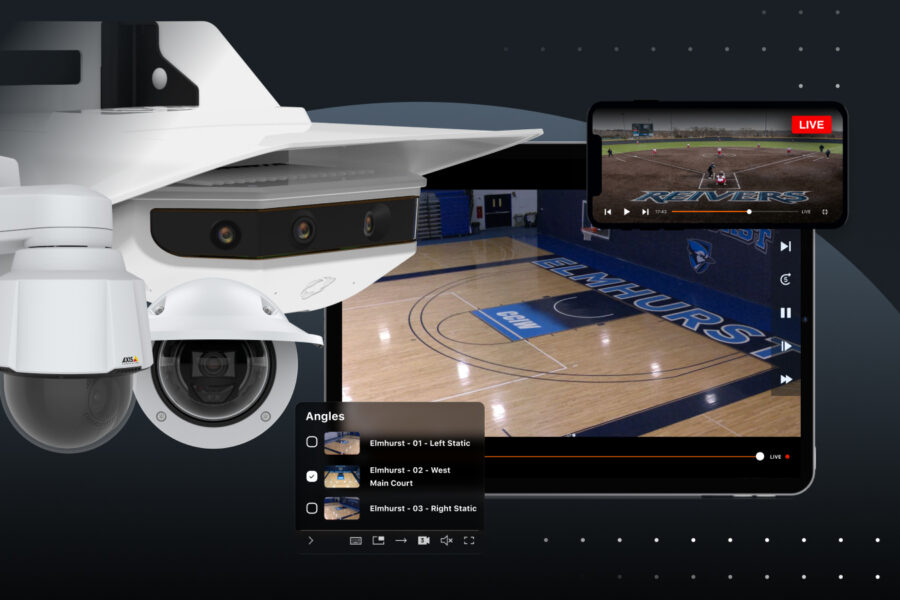
Brittich made this concrete when describing why his coaching staff pushed for a rafter-mounted Hudl Focus Point camera in the gym. The top-down view, paired with the sideline footage from their Focus Indoor sports camera, transforms game footage into something closer to a whiteboard, giving them a multi-angle setup where no moment goes missed.
Coaches can show a point guard exactly how they're running a pick-and-roll, or walk a defender through where they lost their assignment — not with a diagram, but with actual footage of the athlete doing it.
That coaching philosophy translates directly to player development.
Brittich described rolling a portable TV to courtside during preseason camp so coaches can show real-time footage from the rafter-mounted cameras — athletes learn it in the morning, see it on screen at practice, and carry it into the game. The loop between instruction, execution, and review tightens in ways a single sideline camera simply can't support.
That same infrastructure, it turns out, opens the door to live review using Hudl Focus Replay, which is built into all Focus Cameras. With iPads now permitted on sidelines, Glen's coaches can tag clips during games and bring them to the locker room at halftime — showing specific offensive sets the opposing team is running before the second half tips off.
The multi-angle setup means those clips aren't just "did you see that?" moments. They're precise, from the angle that actually explains what happened and why.
Our coaches can actually go into the locker room at halftime and they can show specific offensive or defensive sets that the other teams are executing and that's going to give our student athletes a leg up on those second-half adjustments. It’s preseason, it's in-game, it's during practice. It's giving us the best teaching angle absolutely possible.
Glen Brittich, Director of Athletics, Elmhurst University
The Infrastructure Becomes the Brand
The angles that make your coaches better are the same angles that make your athletes' experience better. That's not a coincidence — it's one investment doing two jobs at once.
Brittich was direct about what a high-quality video setup communicates to student athletes, particularly at the Division III level, where recruiting against larger programs is a daily challenge:
"This is giving them something that others don't have. And this is giving them an experience that is going to say 'I'm being taken care of,’” he said. “I'm getting something from a high-level coaching perspective that I would not get if I went somewhere else."
For programs where retention is the priority, multi-angle capture becomes part of the proof that the program is invested in its athletes. The cameras are visible. The footage is accessible. The coaching is better. That's something athletes can see and feel every week.
And when it comes to recruiting new athletes, the footage itself does the talking:
"One of the biggest challenges in recruiting is bad tape,” said Brittich. The more you can utilize some of these outstanding tools, it's going to promote your student athletes."
For programs focused on transfer placement — a core goal across much of the NJCAA — multi-angle video gives athletes the highlight reel that gets them noticed.
Alumbaugh described how Iowa Western's softball athletes build their own highlight profiles from the multi-angle footage, cutting clips that show exactly what a four-year coach wants to evaluate: wrist position, footwork, release point, approach off the mound.
The high home plate camera catches the play. The side angles explain the technique. A pitcher trying to get recruited to a DI program doesn't just have footage — she has the angle that proves what she can do.
Iowa Western's softball team consistently ranks among the highest on Hudl for hours viewed — second only to football. The multi-angle footage is part of why. Athletes log in, review their own film, and even gather in groups to coach each other. That level of engagement doesn't happen when the footage is limited to one flat angle.
One System, One Less Thing to Manage
Alumbaugh put a number on what automation actually buys back. By setting up his full broadcast schedule in August — once, before the season — he reclaims roughly twenty minutes before every single game.
That may not sound like much until you think about what game day actually looks like: table workers to confirm, ticket gate to staff, concessions to check, visitors to greet, and, previously, a camera setup to manage and a camera operator to track down.
The twenty minutes he gets back aren't idle time. It's twenty minutes previously spent stressed, distracted, and stretched thin.
Brittich's operational story is different in scale but identical in logic. When he took over as Assistant AD, he was managing video services across twenty-one sports — twenty-one billing cycles, twenty-one due dates, and a running pattern of service suspensions because invoices got buried.
One unified package changed all of that: every camera, every sport, on one app. It allowed him to schedule streams, make changes on the go, run multiple games simultaneously — without juggling vendors or logins.
More importantly, it changed what his coaches are responsible for:
"I hire coaches to coach basketball, football, volleyball, baseball, softball. I don't hire them to be invoice managers. I don't hire them to be budget managers. Consolidation of that allows us to be more efficient and allows our coaches to do what I've hired them to do, which is coach,” he said.
That's the operational case. But there's a high-stakes case too.
Brittich described a block-charge call late in a game where his officials used the multi-angle footage to zoom all the way in and determine — half an inch — that the defender was outside the restricted area. The call flipped. They won the game. That's not a coaching story or a content story. That's the infrastructure working for you in a moment that actually matters.
And those moments are about to matter more. Alumbaugh noted that the NJCAA has already added official review in football and basketball, and that some conferences are already requiring member programs to have multi-angle capabilities in place. "Five years ago, I didn't think multi-camera angles were going to be necessary," he said. "Now I'm looking at it from: it's not only necessary — where is it going?"
Programs that build the infrastructure now won't be scrambling to catch up when the mandate arrives. Brittich’s estimates that the installation pays for itself in a single postseason game.
"Our motto here at Elmhurst is not to think outside the box — it's to smash the box,” he said. “ How can we be innovative? How can we be different? Because if it benefits our student athletes, then let's do it.”
The full conversation goes deeper — infrastructure installs, coach buy-in, how Iowa Western is expanding its multi-angle vision across the arena, and a look at Hudl's new end zone cameras for football.
If you're an AD or associate AD thinking through what this looks like for your program, it's worth an hour of your time.