Q&A: How Bakersfield Christian’s Student Broadcasters Gained Skills, Confidence, and Career Plans

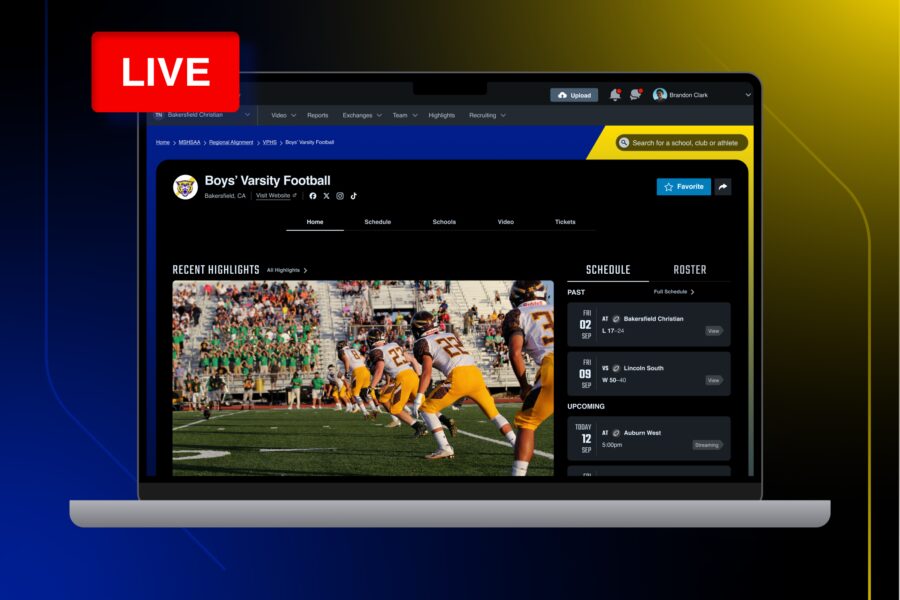
At California’s Bakersfield Christian High School, four students—John Khalil, Waylon Hufford, Jude Cheshire and Spencer Watkins—broadcast athletic events captured by the school’s Hudl cameras and livestreamed on its Hudl Fan profile, under the guidance of Visual Performing Arts teacher Bob Hudson.
We sat down with the Eagles’ student broadcasters to learn how the experience shaped their time in high school and helped unlock new avenues for their futures.
Hudl: When did student broadcasting become an option at Bakersfield Christian, and why did it appeal to you?
John: I was in a digital video production class with Mr. Hudson, and he came with the idea of commentating for basketball. At first, I was scared, but I thought, ‘This is a good path.’ Then he said, “Hey, want to do some baseball games?” I wasn’t the best with baseball, but he threw me right into it, and it was the best thing for me. Now, I’m pursuing this career.
Waylon: Last year, I took the broadcasting class to learn how to edit videos. Mr. Hudson talked to me about broadcasting this year to expand our football broadcast. We added a pregame and postgame show and analytics. We went over stats, what to look for, and a halftime show, going over key plays people may have missed.
Jude: I took broadcasting last year. I learned how to produce and edit videos. This year, we expanded our football broadcast, which I wanted to be part of. I’ve always loved sports and wanted a commentating role. I got hands-on training and was able to commentate games on the radio, which was really cool.
Spencer: This is my third year broadcasting. In my first two years, I had a smaller role in football, but now I’m one of the main people. I took the class because I’ve known I wanted to be a broadcaster or do something in sports communications for a long time.
What skills have you developed through your broadcasting experience that might be valuable to you after high school?
Jude: I’ve learned how to edit videos and communicate more efficiently and effectively to a mass audience. It’s gotten me out of my comfort zone, and I’ve tried things I wouldn’t have done otherwise.
Spencer: I’ve learned how to communicate better. I used to talk way too fast, so I’ve slowed down. I’ve learned how to deliver the news well.
Waylon: Learning how to communicate better, whether in front of a camera or a live audience. Just learning how to talk clearly and share information.
John: Learning more about the dynamics of commentating—not just speaking, but telling a story of what’s going on in the game. A lot of people don’t know the inside of the game like we do, so we explain situations, offensive and defensive schemes and make it entertaining.
How has being involved with broadcasting helped shape your high school experience?
John: It opened up doors. I wasn’t really connected with the school, but now, commentating with these guys, working on videos and commercials, it’s connected me with more people and made high school more fun.
Jude: I was super shy and stayed behind the camera, but this got me out. I’ve shared my voice, been on the news, everyone knows my face now. It’s been great for getting out of my shell.
Spencer: It made high school a better experience. It gave me something to look forward to every day. I loved that class, and I knew it was something I wanted to do.
Waylon: It’s something to look forward to during the day. Broadcasting sports after school is always a fun time.
It opened up doors. I wasn’t really connected with the school, but now, commentating with these guys...it’s connected me with more people and made high school more fun.
Where do you hope to take this experience with you in the future?
John: I got into the Chapman Dodge program, a broadcast journalism school. I’ll start broadcasting their sports and working with the news. They do a lot of writing too, so I’ll develop that skill. I hope to find a career or internship, maybe with a sports team or network.
Jude: I want to go into this, too. I’m looking at Arizona State’s Walter Cronkite School of Journalism. That’s the ideal. I’ve got a ways to go, but I’m starting now. It could lead to a network or streaming service—so many directions.
Spencer: I have an internship lined up with a minor league hockey team for next fall. I’ll put all my effort into that and figure out what part of broadcasting or journalism I want to pursue.
Waylon: I’m going to college to study marketing, and this gives me insight into sports entertainment, whether it’s an internship or a job later on.
Were there any hurdles you had to overcome to get comfortable with broadcasting?
John: It wasn’t easy. Going on air for the first time is scary. You can plan everything, but once you’re live, you just have to talk. That was the hardest part—learning to stay calm and tell the story. But after a couple of games, you start to feel confident and it becomes fun.
Jude: My first game was football on our radio station with hundreds of people listening. It was daunting. I had to tell myself to calm down. I’ve watched football my whole life, so I just went through the motions. As the season went on, it became muscle memory.
Spencer: The hardest part was figuring out what to say during timeouts and between quarters. Talking about the game is easy—it’s the pauses that are tough.
Waylon: For me, it was finding stats and putting together reports. We ended up contacting our football coach, and since they use Hudl, we got all the stats from there. That made it easier to prep.
Has this experience opened your eyes to any career paths or avenues in your life that you hadn’t considered?
John: It opened my eyes to broadcasting. I didn’t want to do commentary at first—I just wanted to write. But it showed me the path and taught me a lot.
Jude: I’d always thought it would be cool to do this, but I didn’t know how. Then I saw this class and thought it could be cool. It’s become more than I ever expected.
Spencer: It showed me how many people it takes to run a broadcast and how many career paths there are within it.
Waylon: This opened a new avenue. I didn’t know what I wanted to do after college, but working in a broadcasting department doing marketing is something I’d really look forward to.
What advice would you give the next wave of students looking to follow in your footsteps?
Waylon: Be willing to try it. I wasn’t comfortable getting in front of a camera at first, but after the first time, it became natural and fun. Be open to new things.
Jude: Have fun with it. It’s an unbelievable opportunity. You’ll do a lot of things you never thought you would. It’ll come naturally. Everyone’s talented, so just let it show.
John: Be yourself. If you love sports, pursue it. It’s a fun thing to do, and once you start, you’ll see how great it is.
Spencer: Give it a shot to see what it’s really like. My first year, I didn’t really want to do it. But once I saw what it looked like and how it worked, it completely changed my perspective on everything.
What are you most proud of with your experience so far?
Jude: We reached more people than this program ever has. We had pregame shows, halftime shows, and postgame recaps. We even landed sponsors, which was wild—huge credit to this guy [gestures to Mr. Hudson]. It turned into a full-on production.
John: Honestly, just helping grow the broadcasting department. It was solid before, but since then, we’ve expanded so much—sponsors, analytics, full broadcast segments. Just seeing that growth and how everyone contributed, it makes me proud.
Waylon: Solving the challenges that came up. Like, not being able to broadcast away games, or dealing with a feed that cut out—we found ways around it. Making sure people could still watch even when things went wrong is what I’m most proud of.
Spencer: Yeah, same for me. Getting the job done even when things didn’t go as planned, away games, technical issues, whatever it was. We always figured out a way to get the broadcast out to people.