Benchmarking the Best: South America's Next Female Stars


In this article, we use Hudl Statsbomb data and Hudl Wyscout video to match Copa Libertadores Femenina players to the South Americans already thriving in Europe and the NWSL.
For decades, South America has been one of football’s most fertile talent regions. In the men’s game, recruitment departments have consistently looked to the region as a source of high-ceiling players capable of making the leap to Europe. From academy systems across the continent, the route from local promise to global stage has been well established.
In the women’s game, that pathway has taken far longer to form. Although the technical foundation and cultural relationship with football may have been present, the investment, professional league structures and long-term development planning have not progressed at the same rate.
That context makes the current moment particularly interesting. A growing number of South American players are no longer just reaching Europe and the US, they are excelling there. Using Hudl Statsbomb advanced data to benchmark the top-performing SouthAmerican players in Europe and the NWSL, we can shine a light on domestic players with similar profiles and skillsets.
And with every match of the CONMEBOL Copa Libertadores Femenina available for analysis via integrated Hudl Wyscout video, those statistical indicators can be supported – or challenged – by crucial visual context, allowing performance profiles to be assessed through both data and video when judging whether they are ready to make the step up.

Finding the Next Caicedo
Few players represent the rise of South American and Colombian women’s football more clearly than Linda Caicedo. The 21-year-old Colombian’s meteoric rise from teenage Libertadores star to key player for Real Madrid Femenino and Copa America Golden Ball winner has been nothing short of spectacular. Combining explosive ball carrying with consistent attacking output, Caicedo has swiftly become the jewel of South American women’s football.
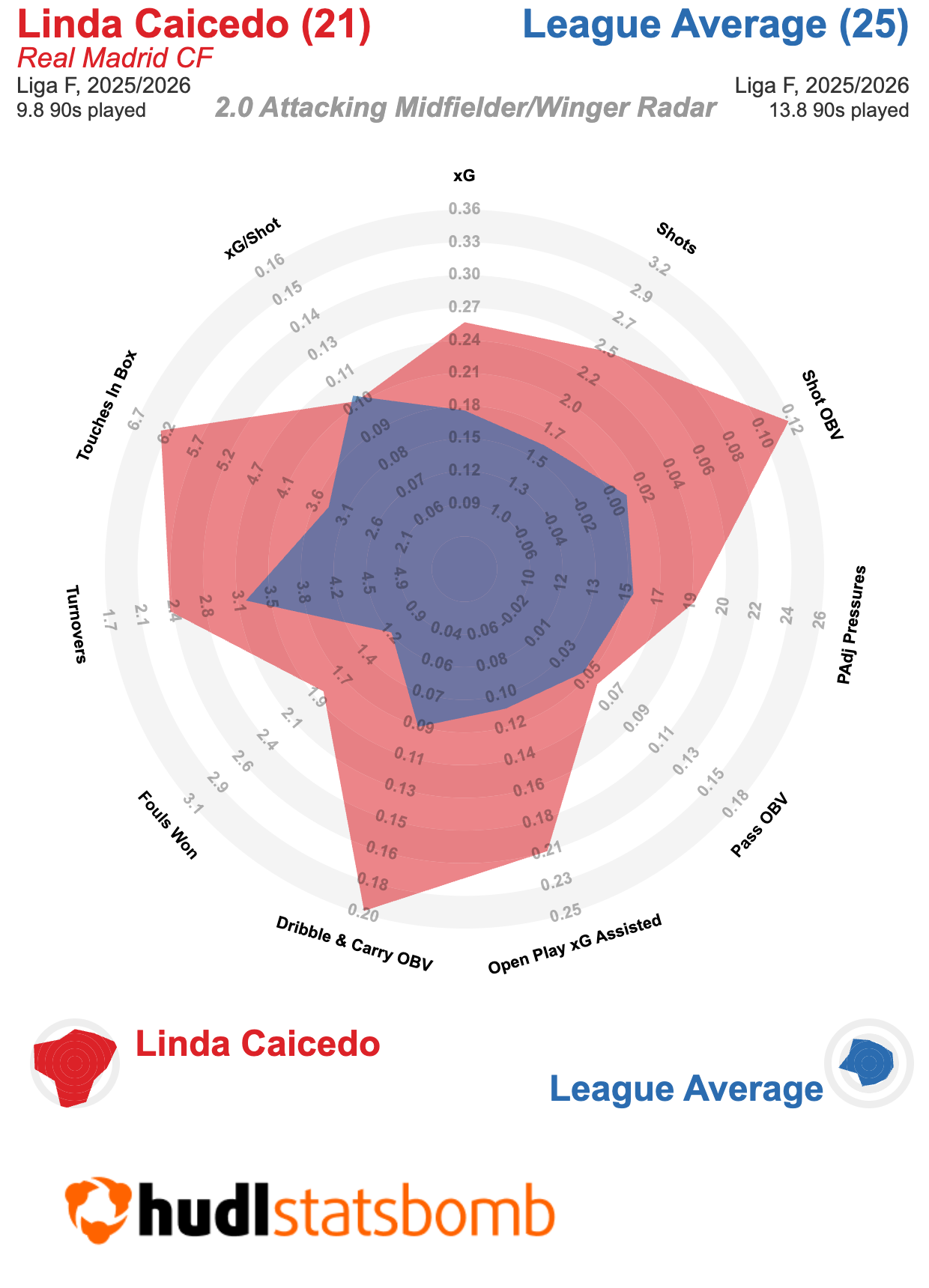
Now competing in Liga F, Caicedo continues to rank among the league’s most dangerous attacking players. Her profile is defined by her high volume of dribbles, progressive ball carries and frequent chance creation - a combination that makes her one of the most difficult wide attackers to contain.
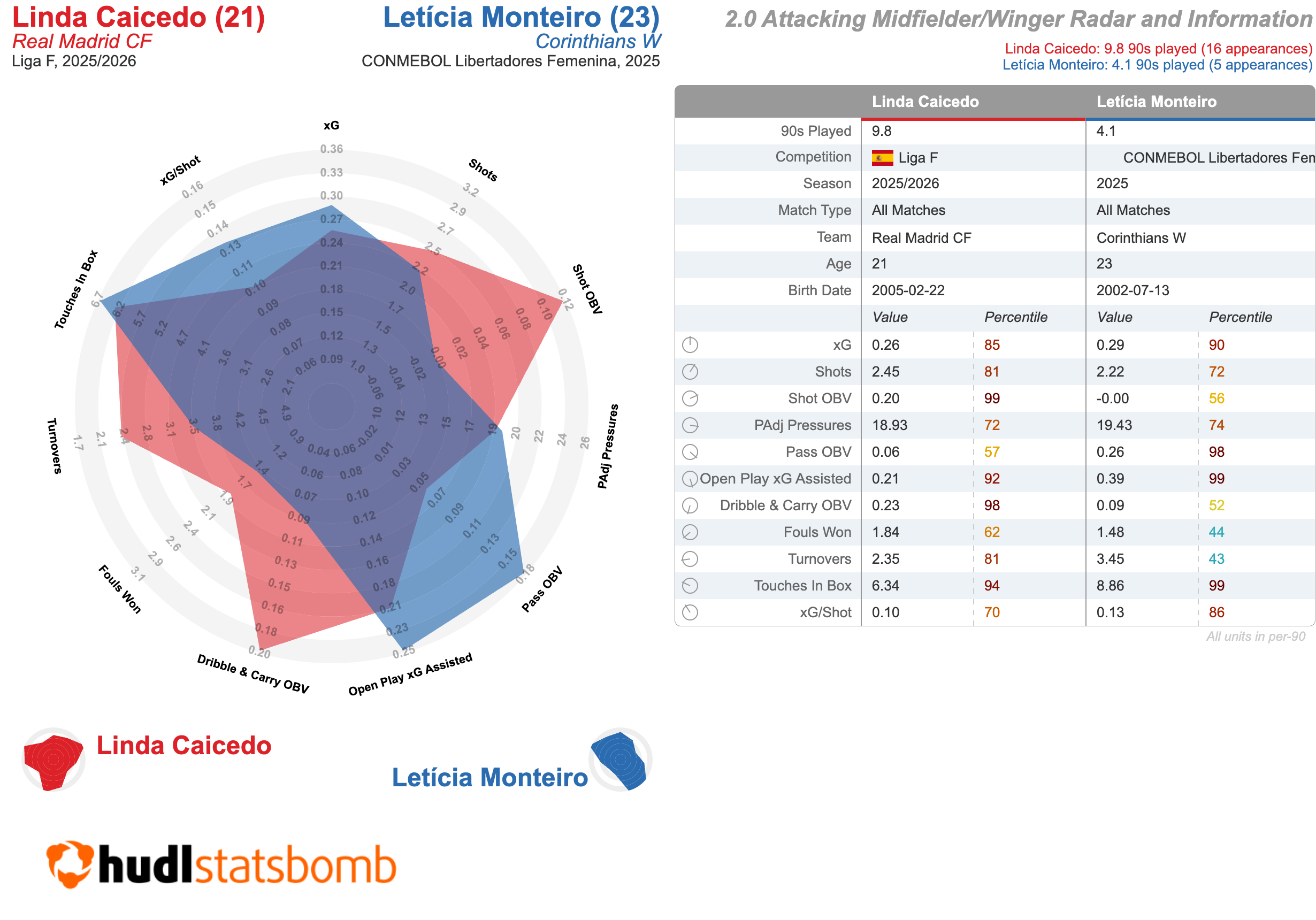
While not quite as explosive a dribbler as Caicedo, Monteiro is very much a creator from wide areas. Her Pass OBV puts her in an elite bracket, while her 2.77 xG+xGA during the 2025 Libertadores ranked as the fifth highest in the competition, underlining her consistent attacking involvement.
Watching footage on Wyscout, Monteiro is quick and intelligent in her movement, with her darting runs into the half-spaces making her a difficult player for opposition defences to track. Combined with her ability to both finish chances and create for teammates, she consistently contributes directly to attacking output.
That attacking presence is also evident in her high volume of touches in the box, reinforcing that she is a player capable of both creating and finishing chances.
While Colombia may not have been able to quite topple Brazil at last year’s Copa América Femenina, the talent pipeline remains strong. A new generation led by Linda Caicedo and supported by upcoming players such as Greicy Landazury at Palmeiras, Gisela Robledo at Corinthians Women and Karla Viancha of Independiente Santa Fe Women suggests a promising future for Las Chicas Superpoderosas.
Brazilians Waiting in the Wings
If Colombia represent one of the fastest rising forces in South American women’s football, Brazil remain the continent’s established powerhouse. Their victory at the Copa América Femenina, however narrow, once again underlined the Seleção’s enduring dominance at international level.
For decades Brazil have produced a remarkable variety of attacking talent and that influence is also reflected in the number of Brazilian players thriving in elite leagues around the world. From established stars such as Marta, Debinha and Kerolin to younger players already making their careers abroad like Luany, Maiara Niehues and Gio Garbelini, Brazilian forwards continue to shape the attacking identity of the South American game.
So, using these top performing Brazilians as a benchmark, which young players from the Copa Libertadores Femenina have similar profiles?
Taking Luany as an example and using the Hudl Statsbomb Similar Players tool, one of the younger players it flags up is 22-year-old Isabelle Guimarães of São Paulo. Known simply as Isa, the winger had one of the highest take-on success percentages and, like Luany, excels in 1-v-1 scenarios.
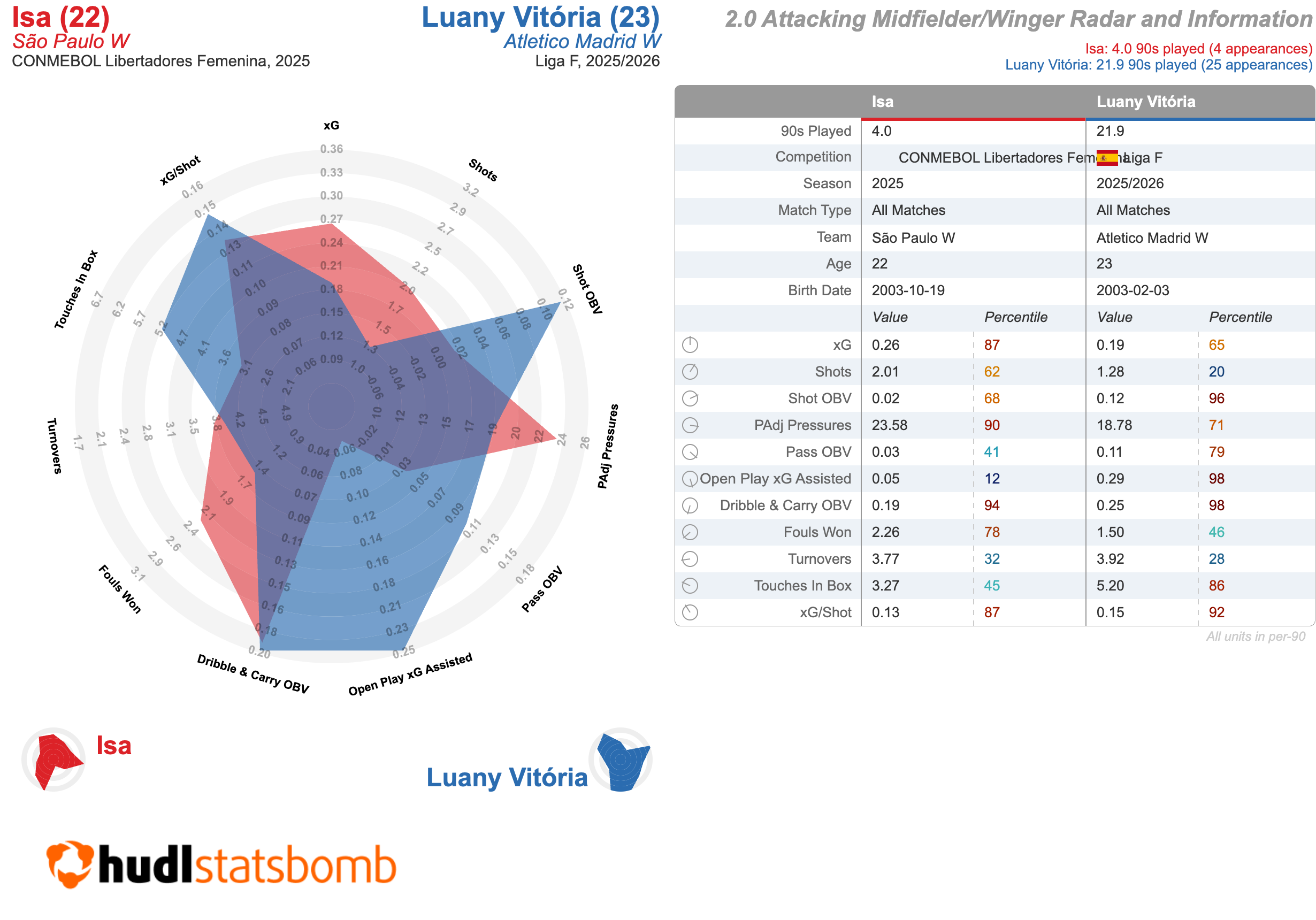
A look at the tape backs this up, with Isa demonstrating pace and willingness to attack defenders in wide areas — a very desirable trait both for teams looking for direct threats on the flank or those looking for someone with the tools to break down a low block.
Interestingly, Jhonson appears to be a different profile to the stereotypical, dribble-heavy Brazilian attackers mentioned earlier. Looking at the data, her metrics align more closely with players such as Spanish international forward Alba Redondo - a forward whose impact is driven less by ball carrying and more by intelligent movement, finishing efficiency and consistent penalty-area presence.
Modern Full Backs from Across the Continent
Although the spotlight often falls on attacking stars, South American clubs are increasingly producing full-backs whose profiles resemble those already competing at the top European level.
Key benchmarks for this trend are Tarciane, a versatile 22-year-old defender now at OL Lyonnes, and Isabela Chagas, otherwise known as Belinha, the 24-year-old right-back currently at Paris Saint-Germain Féminine. Both players shone in South America, winning two Libertadores titles with Corinthians, before moving to Europe, combining defensive reliability with the ability to contribute in advanced positions – a modern full-back profile that clubs now seek to replicate.
One of the defining qualities of Tarciane’s profile is her versatility, and a comparable trait can be seen in Evelyn Burgos of Ecuadorian side Dragones Independiente del Valle. While often used at left-back, the tape shows that Burgos has also been deployed as a centre-back and in defensive midfield, illustrating the positional adaptability that many clubs now prioritise when assessing defensive talent.
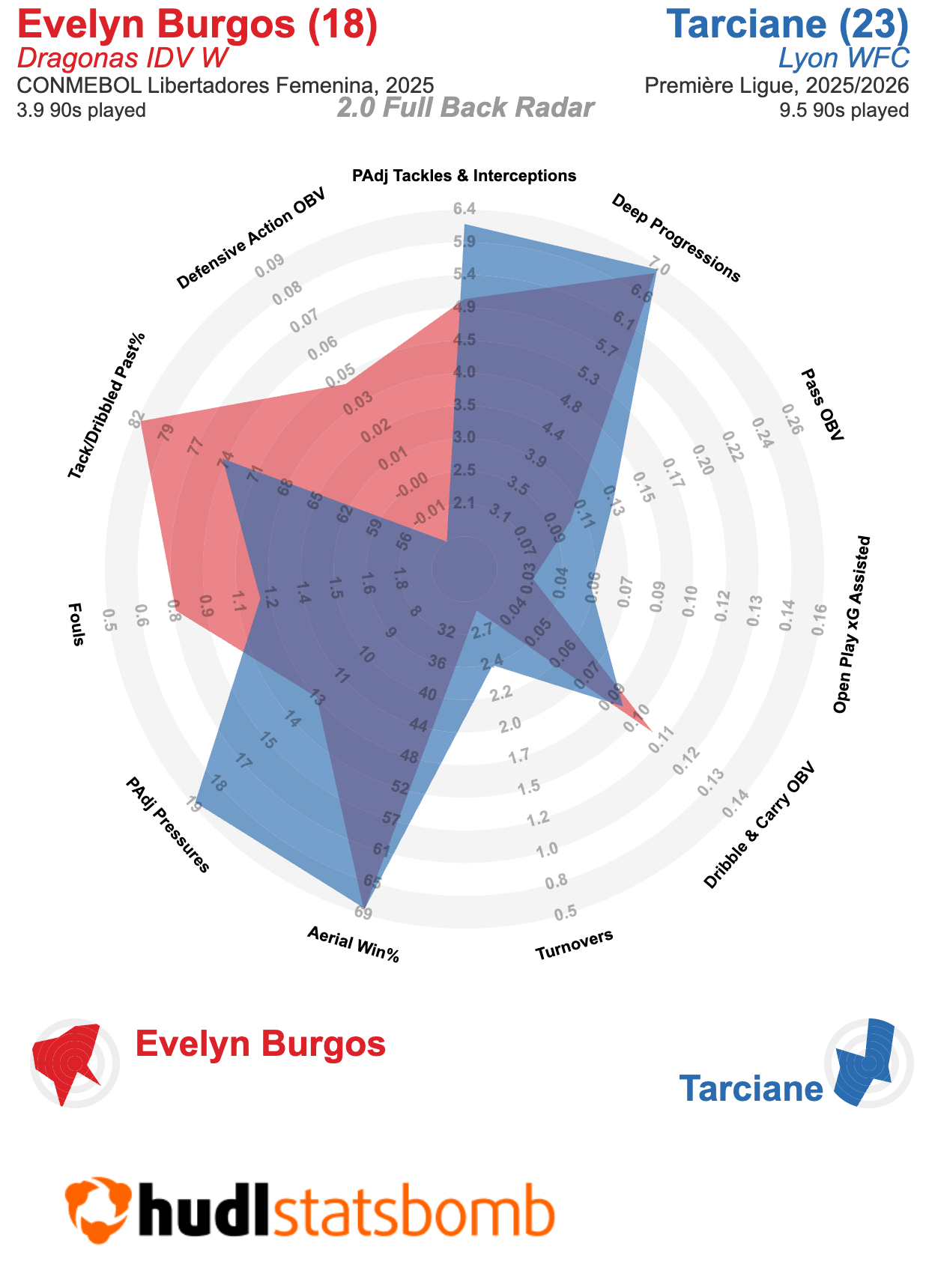
Still only 18, Burgos played a key role in Independiente del Valle reaching the quarter-finals of the Libertadores Femenina, combining defensive reliability with strong involvement in possession phases. Watching her performances, her ability to disrupt opposition attacks stands out, while her contribution to IDV’s build up from the back was always noteworthy – always looking to move the ball forward rather than simply recycle possession.
Unlike the more positionally flexible profiles of players such as Tarciane and Evelyn Burgos, Michelle Olivares of Colo-Colo Women fits more closely into the mould of a traditional attacking full-back. In fact, recent Copa Libertadores Femenina data shows Olivares to be one of the most statistically comparable players to Belinha, highlighting a similar balance between defensive contribution and attacking involvement from wide areas.
Olivares played a key role in Colo-Colo reaching the semi-finals, contributing one goal and two assists. While she is not as much of a goal threat as Belinha and not as dominant in the air, the two players nevertheless share a lot of characteristics.
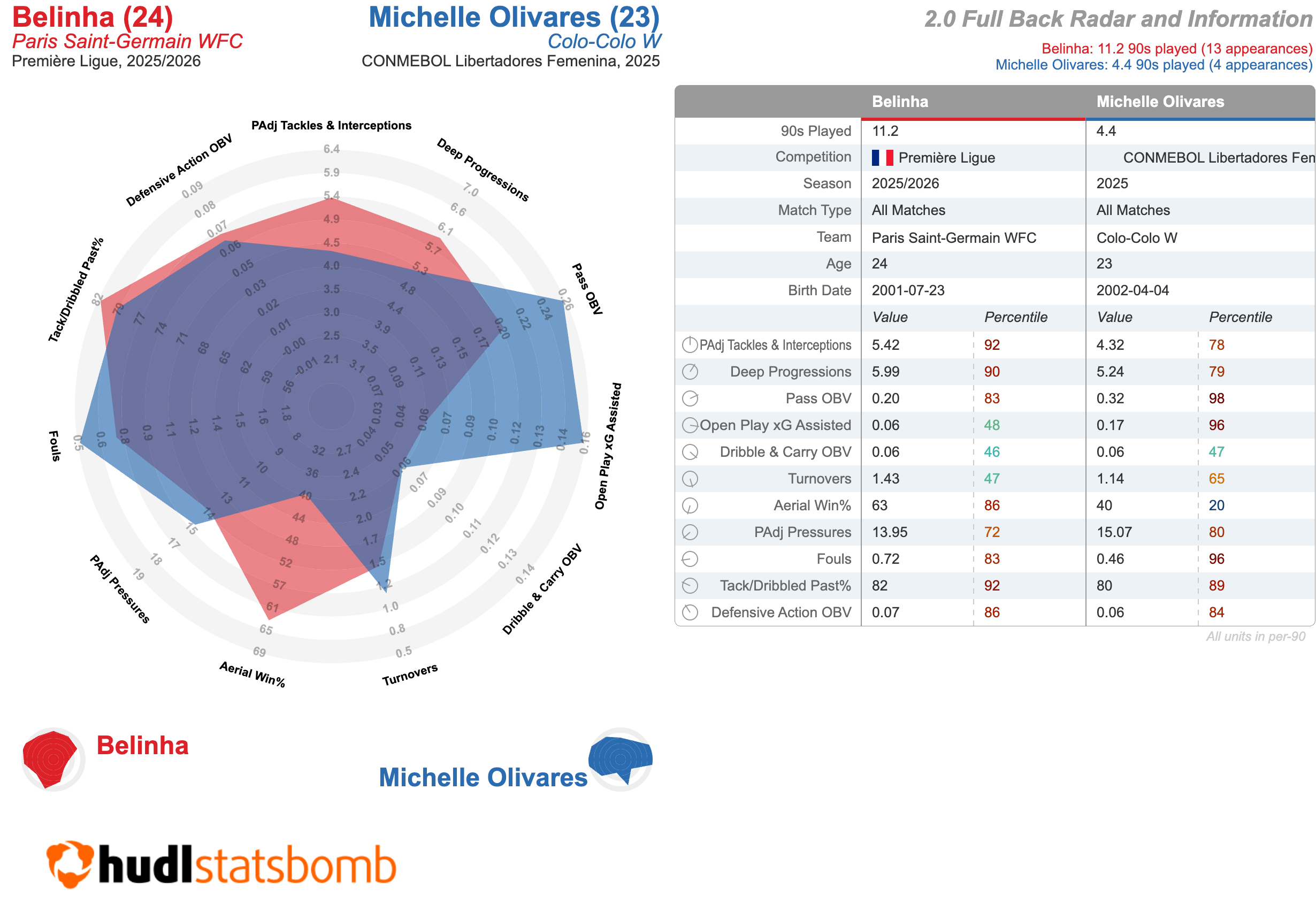
Beyond these numbers, when watching Olivares in action she excels in possession, regularly progressing the ball through defensive and midfield lines and combining defensive solidity with forward involvement. This is backed up by her strong Pass OBV and Open Play xG Assisted numbers, one of the areas she has the edge on Belinha.
Together, Burgos and Olivares exemplify how South American clubs are producing full-backs who combine defensive reliability with the technical and progressive qualities required to succeed in Europe – and the opportunity for clubs abroad looking at previously untapped markets in the women’s game.
Argentina’s Next Attacking Prospect
While Colo-Colo showcased some of the most dynamic attacking talent in the 2025 Copa Libertadores Femenina, Argentina is producing its own exciting young forwards. Argentina are the only side to wrestle a Copa América Femenina title from Brazil, a high point in the Selección’s history that now feels increasingly distant. An aging squad has left room for emerging talent, and a new generation of young players is beginning to stake its claim.
Among them is 19-year-old Kishi Núñez, a rising striker whose combination of pace, technical skill, and intelligent movement has already begun to turn heads in domestic competitions. Núñez’s game is defined by verticality and directness, but she brings a distinctly Argentine style to her attacking play, blending quick interchanges with sharp positional awareness in and around the penalty area.

Using Hudl Statsbomb’s industry-leading data to compare with top performing South Americans, Núñez shows similarities to Venezuelan star Deyna Castellanos, underscoring Núñez’s versatility as a forward capable of both finishing and creating opportunities for teammates in dangerous areas.
Núñez exemplifies how South America’s next generation of forwards is beginning to emerge, with the combination of skill, movement, and finishing that, with continued development, could see her reach the highest levels of the women’s game.
Paraguayan Profiles Emerging
And it’s not just the more established South American regions producing top-level talent. The Paraguayan national team has quietly developed several players whose statistical profiles compare well with those already performing in Europe.
Building on the earlier discussion of Colo-Colo Women, Dahiana Bogarín, currently with the Chilean club, shows strong statistical similarities to Atlético Madrid’s Brazilian centre-back Lauren. Both players combine high defensive activity with progressive ball movement, offering value in both defensive structure and build-up play.
Another Paraguayan player worth noting is Naomi de León, whose defensive profile aligns closely with Brazilian international Rafaelle Souza, a centre-back known for her composure in possession and effectiveness in duels. In the 2025 Copa Libertadores Femenina, 20-year-old de León recorded the highest number of shots blocked in the competition, highlighting her defensive awareness and willingness to put herself in positions to disrupt opposition attacks.
Paraguay has already seen one player make that step to Europe. Lice Fabiana Chamorro Gómez, now 27, is a regular goalscorer in Spain with Levante Badalona, demonstrating how Paraguayan forwards can successfully translate their attacking qualities to elite leagues.
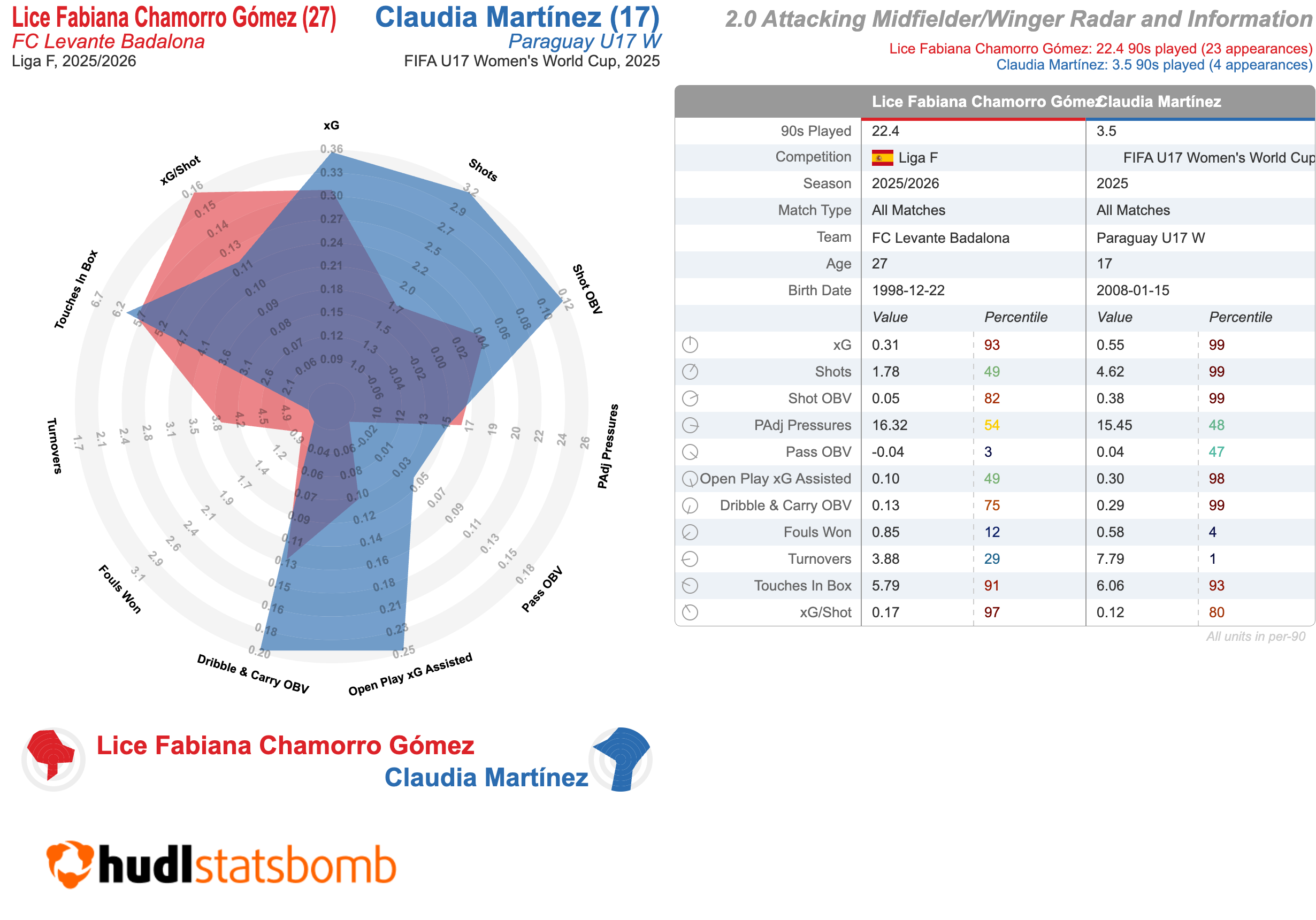
Following in her footsteps appears to be Claudia Martínez, one of the most exciting young prospects in South American football, who has made the move to Washington Spirit from Olimpia. Lightning quick and a constant threat in transition, Martínez finished as the top scorer at the 2025 Copa América Femenina at just 18 years old, and she also lit up the U17 Sudamericano last year – one of the competitions available in the Wyscout Youth Pack.
Together, these three talents illustrate how Paraguay, often overlooked in discussions of South American talent, is beginning to produce players capable of making an impact both on the continent and beyond.
Data and Video Revealing the Next Wave
From Brazil and Colombia to Argentina and Paraguay, the latest insights from the Copa Libertadores Femenina highlight just how quickly the talent pipeline in South American women’s football is developing. A new generation of players is emerging across multiple positions, combining the technical qualities long associated with the region with increasingly strong performance data.
For recruitment departments, the real value comes from combining those numbers with video analysis. With full matches and player footage available on the Hudl Statsbomb platform, scouts can marry the metrics with video evidence to evaluate how these profiles translate on the pitch.
As more players make the transition from South America to Europe and North America, competitions like the Libertadores are becoming one of the most valuable scouting environments in the global women’s game. And with both data and video available to analyse, the next breakout star may already be waiting to be discovered.
See how Hudl Statsbomb’s industry-leading data and integrated Wyscout video can power your analysis and recruitment.
Follow Golazo on X.