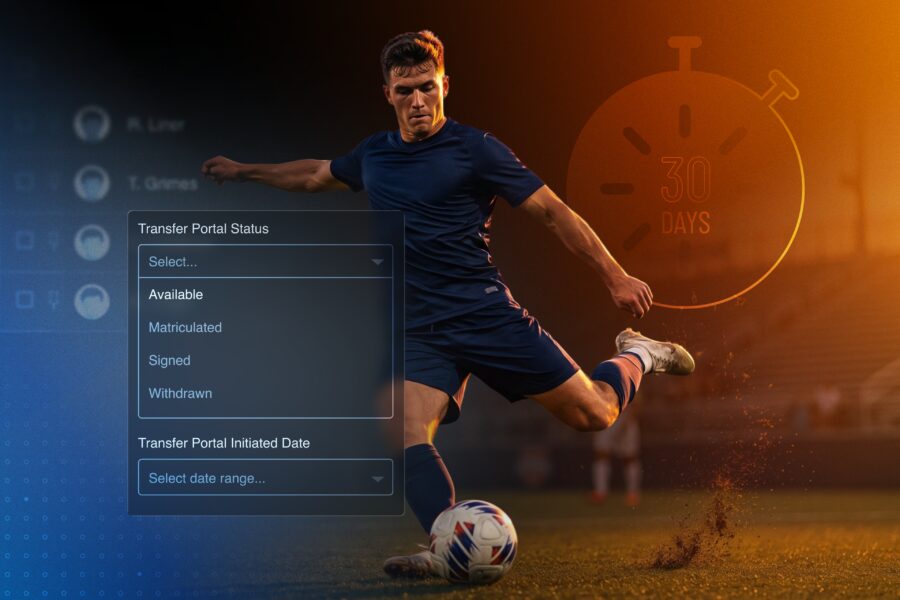
Portal entries have doubled since 2018. D1 programs now turn over 25% of their rosters every cycle. Here’s what that means for how you recruit.
Roster-building in college soccer looks nothing like it did five years ago. The programs adapting fastest are pulling ahead.
UNC men’s soccer this season is a useful illustration. Through the first half of 2026, their top two scorers both came through the transfer portal. Neither arrived as a marquee recruit.
Joschi Schelb started at Saint Francis - a small program in the Northeast Conference - scored 10 goals in his sophomore year, and moved to Rutgers. A year later, he moved again to Chapel Hill. He’s currently sitting on 12 goals and two assists.
His teammate Ryan Zellefrow took a similar route. He spent two years at Vermont, earned All-Conference in his sophomore season, and transferred to one of the most storied programs in college soccer. He’s second on the team with four goals and four assists, at the time of writing.
UNC didn’t stumble onto these players. They went and found them. That’s what the portal makes possible, and it’s why the programs taking it seriously are proactively building better rosters every cycle.
The portal wasn't always like this
The NCAA Transfer Portal launched in October 2018. In those early cycles, it was a trickle. A relatively small number of players sought new programs. Most coaching staff treated it as a secondary concern.
Then, in 2021, the NCAA introduced the one-time transfer exception. This meant any athlete could transfer once and play immediately, no sit-out year required. Portal entries jumped, programs adapted fast, and a de-facto second recruiting season was created.
In 2024, the NCAA went further: unlimited transfers, with few restrictions. As a result, portal entries in men's D1 soccer have more than doubled since 2018. For women's D1, the numbers have followed the same trajectory.
This cycle, an estimated 600–700 men's players and 700–800 women's players are expected to enter. That's roughly 6–7% of the entire D1 soccer population, every single year, looking for a new place to call home.
Rosters are being rebuilt, not just topped up
Here's the number that changes how you think about all of this: D1 soccer programs now turn over approximately 25% of their rosters via transfers every year.
Gone are the days of just backfilling one or two positions. Coaching staff at the D1 level now hold between a quarter and a third of their roster spots specifically for transfer players. Recruiting high school players remains essential. But the portal has become the second pipeline. And for programs in active rebuilds, it's often the primary one.
The logic is understandable. A transfer is a known quantity. You can watch them play. You can pull their xG across a full season, see their intensity week-in week-out, and monitor their performance in clutch games. Compared to projecting where a 17-year-old will be in three years, that data, verified by video, is considerably more useful.
Thirty days. Hundreds of programs. The same player pool.
There is an in-built time pressure to the portal. The fall window runs November 23 to December 22 for both men and women. Thirty days in which every D1 program in the country is searching the same pool simultaneously.
But in order to “win the portal”, programs can’t rely on just being the fastest to react when it opens. Speed still matters of course. But being the quickest or most efficient is more tied to preparation. Programs that enter the window with shortlists already built - the ones who've identified targets, watched the video, run the numbers - have a real advantage over those who start from scratch on day one.
The data available to programs today is vastly more sophisticated than anything that existed when the portal launched. Advanced metrics, pressing numbers, passing networks, defensive actions - the tools exist to evaluate a midfielder from a conference you've never scouted in roughly the time it used to take to make a phone call.
Around half of all players who enter the portal don't end up at another school. The market moves fast and unpredictably. A player you've identified in week one may be committed by week two. Programs that know exactly which players fit their system, budget, and culture before the portal opens make better decisions, not just faster ones.
What this means for your program
The portal has made college soccer more dynamic, more competitive, and more demanding for coaching staff. Every program already engages with it seriously. The question is how well-prepared you are when it opens.
Programs that rely on informal networks and highlight reels are competing against programs that filter by xG, pressing intensity, and positional fit before making a single call. That gap widens every cycle.
Hudl Wyscout gives coaching staff the player data, video, and analytics to build smarter shortlists and make better decisions during the transfer window.