The J1 League You Didn't See: A Hudl Statsbomb Data Analysis

Pressing intensity, OBV, line-breaking passes, and more — Hudl Statsbomb uses the 2025 – 26 J1 season to unpack how to use world-class data to measure performance.
Kashima Antlers' Title Run: What Happened After Matchday 23?
After a run of near-misses, Kashima Antlers became champions of Japan for the first time since 2016. The turning point was an unbeaten run beginning after matchday 23.
Despite losing key defender Ikuma Sekigawa to injury mid-season, the title run was based on the implementation of effective defensive tactics.
Context to the Kashima Defensive Revival:
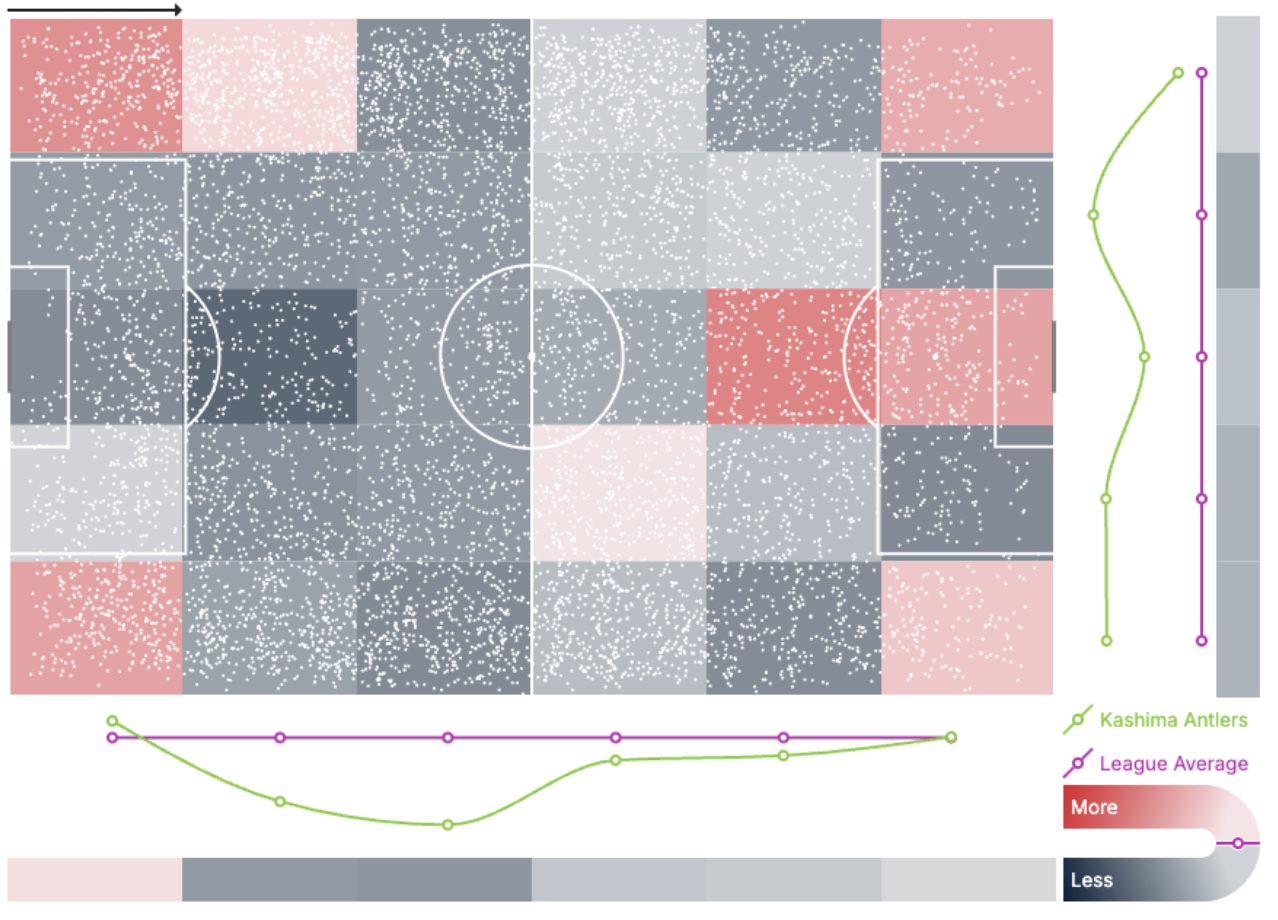
Kashima’’s defensive activity is concentrated at the extremes - deep in their own third and, situationally, high in the final third - while ceding the central midfield zones more readily than the average J1 League team.
The Hudl Statsbomb heatmap below bears this out: a dark, low-activity cell in front of their own box sits alongside red patches in the wide attacking half-spaces, the classic signature of a mid/low block that holds its shape centrally and only presses aggressively when a trigger presents itself in advanced areas rather than pressing continuously through the middle third.
On-Ball Value: Best Defensive Teams
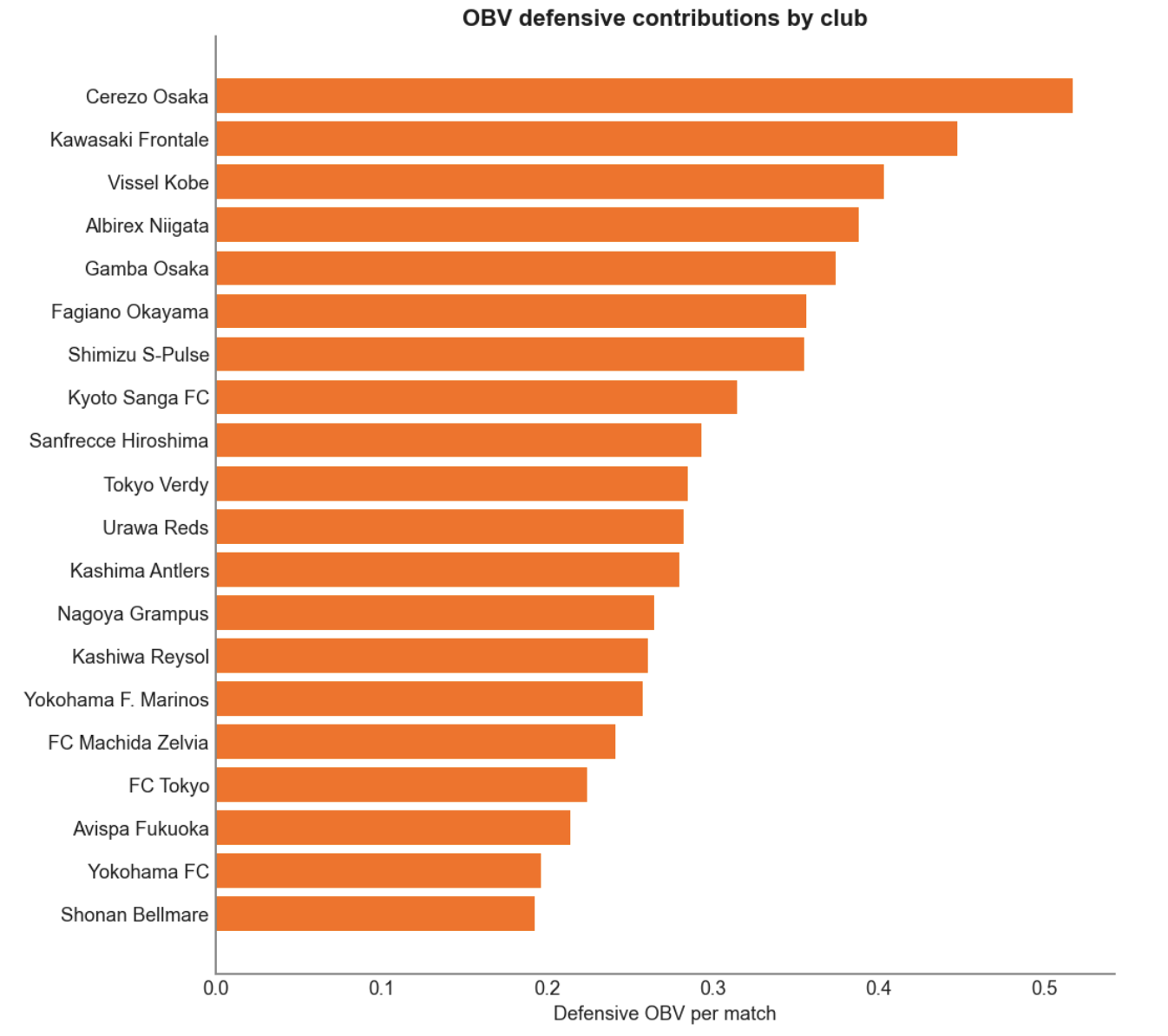
Cerezo Osaka lead the J1 League in defensive OBV contributions for the 2025 season, generating just over 0.5 in defensive on-ball value per match, comfortably ahead of the next-best sides, Kawasaki Frontale and Vissel Kobe, who sit in the 0.40–0.45 range.
Defensive On-Ball Value (OBV) contributions measure how much a player's defensive actions - such as tackles, pressures, blocks, and interceptions—reduce the opponent's likelihood of scoring. It moves beyond raw counts by assigning a concrete goal-prevention value to each defensive event based on pitch context.
Cerezo Osaka's defensive numbers stood out all season, topping the J1 League for defensive OBV per match in 2025 and underlining the value their pressing and ball-winning added beyond the raw defensive stats.
With Kawasaki Frontale and Vissel Kobe close behind, the data points to a competitive upper tier built on proactive defending, while clubs like Shonan Bellmare and Yokohama FC generated far less value from their defensive actions - a gap that lines up with the wider season narrative around high-press sides outperforming deeper, more passive setups.
High Pressing vs Defensive Aggression Across the J1 League
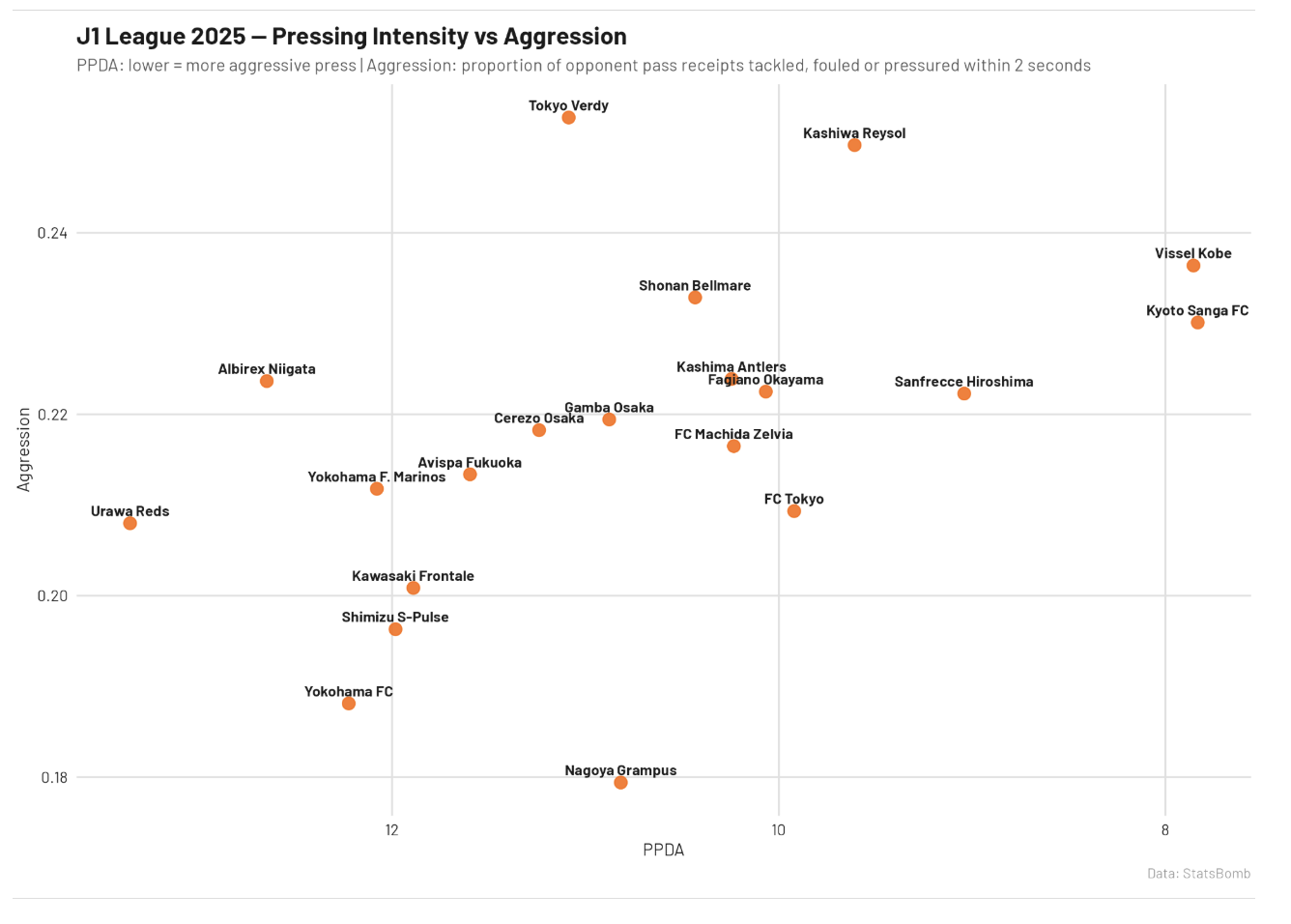
The teams pressing highest up the pitch in the J1 League are backing it up with consistently aggressive defensive behaviour. Vissel Kobe and Kyoto Sanga FC sit at the extreme end of the PPDA axis - allowing opponents the fewest passes before making a defensive action - and combine that with aggression scores among the highest in the division. It is a coherent defensive identity: press early, engage immediately, and give opposition build-up as little time to develop as possible.
Perhaps the most telling comparison in the chart is between Tokyo Verdy and Nagoya Grampus. The two sides sit at almost identical PPDA values, suggesting a similar willingness to press in terms of when and where they do so. But their aggression profiles diverge sharply. Verdy ranks among the highest in the league for immediate ball-hunting - their players engage opponents within seconds of a pass receipt, suggesting a press built on energy and intensity at the point of contact. Grampus, by contrast, shows one of the lowest aggression scores in the division despite their PPDA, pointing to a side that presses with structure rather than urgency - holding their shape, waiting for the right trigger, and committing to the press selectively rather than reflexively.
What Fueled Kashiwa Reysol's Surprise Campaign?
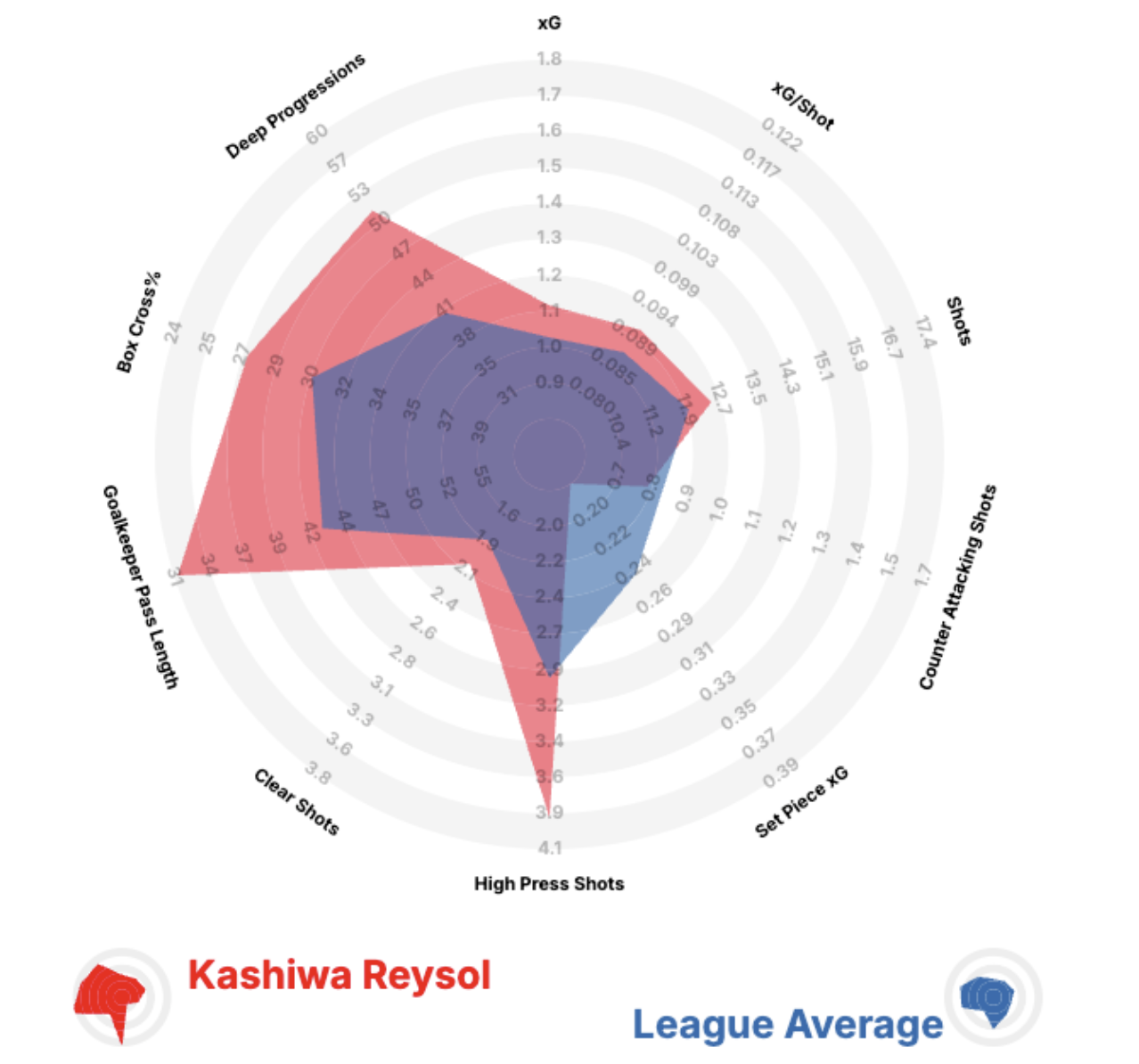
After finishing 17th in back-to-back seasons, Kashiwa Reysol made a big leap to a 2nd place finish. Remarkably, they never lost from a leading position in the 25 games they went ahead (21 wins, 4 draws). Their success combined a solid defense and the third-best attack, combining with an ability to convert chances efficiently.
Analyzing Kashiwa Reysol's leap up the table:
The underlying data shows a genuine three-year build: possession climbed from 43% in 2023 to 47.3% in 2024 to 59.5% this season, while their pressing intensity (PPDA) sharpened from around 7.3 to 5.35 and their progressive output - Deep Progressions per 90 - rose steadily from 33.6 to 36.4 to 47.0. This wasn't an overnight tactical switch; it was a gradual shift from a deep, reactive team into a possession-dominant, front-foot side, and the numbers back it up year by year.
Zero Losses From Winning Positions for the J1 League’s Great Improvers
Rather than sitting deep to protect leads, Kashiwa actually pressed harder in matches they won than in matches they drew or lost — pressures in the opponent's half averaged 96.8 per match in wins versus just 59.8 in losses. Their second place finish showed the value of suffocating teams into submission, rather than sitting on leads.
The bigger question is sustainability. Kashiwa's non-penalty expected goal difference improved every year — from +1.28 in 2023, to +4.19 in 2024, to +9.79 this season - a real and steady quality gain. But their actual non-penalty goal difference this season was +27, nearly three times the model's expectation, driven by a +15 non-penalty goal overperformance in attack (a sharp reversal from -3.8 and -3.7 in the two prior seasons) alongside a defense that also slightly outperformed its expected numbers for the first time.
The identity shift - more possession, more pressing, more progression - looks durable. The scale of this season's points total, propped up by finishing well above its underlying numbers, looks harder to repeat.
Line-Breaking Passes confirm Kashiwa's identity shift
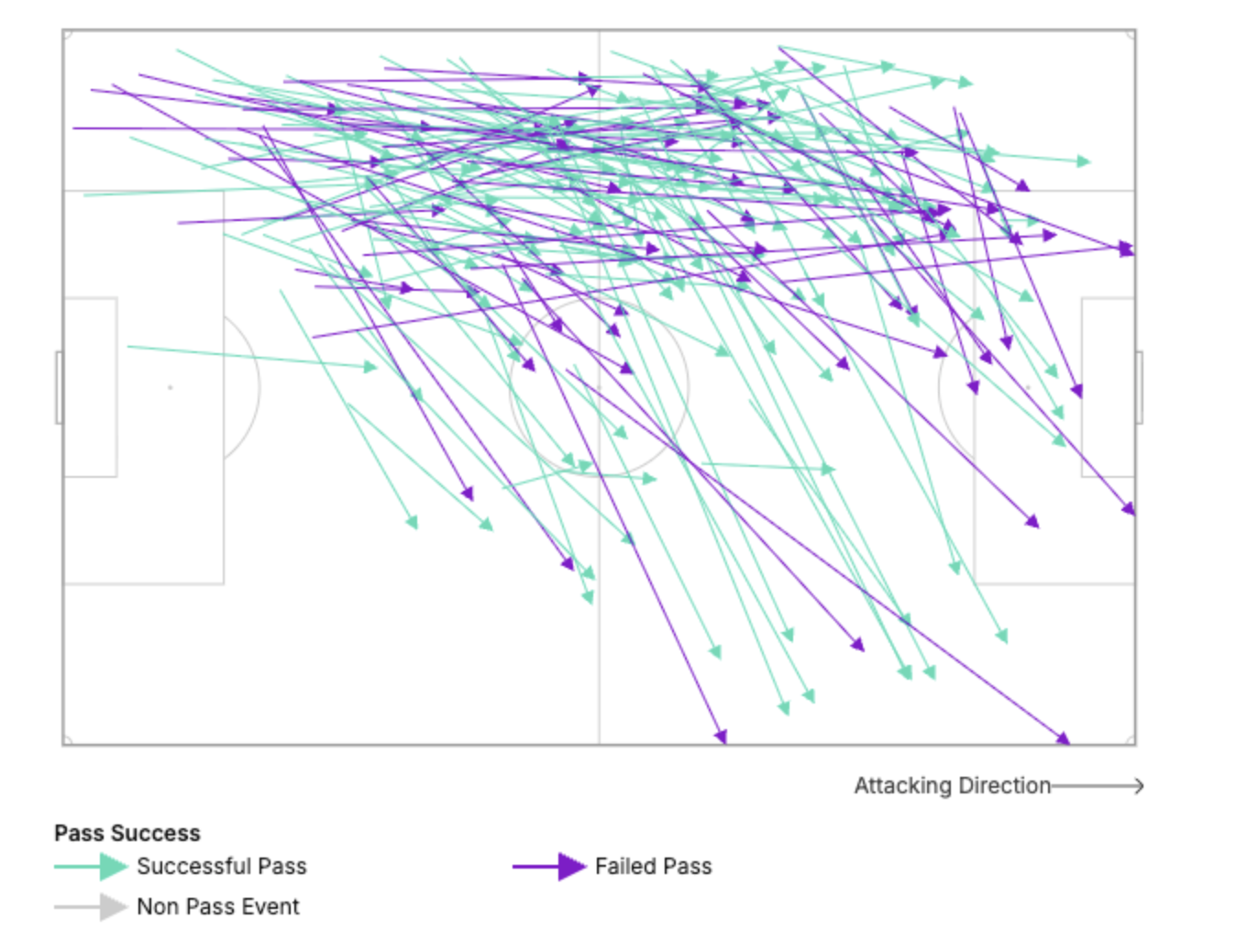
Kashiwa Reysol completed more line-breaking passes than any other side in the J1 League in 2025, averaging 61 per match - a clear gap over second-placed Shimizu S-Pulse (52) and Albirex Niigata (51). Line-breaking passes measure something narrower and harder than general forward progression - passes that actually cut through an opposition defensive line - and Kashiwa's dominance by this stricter definition points to a team built around breaking structure rather than going around it.
Within the squad, Taiyo Koga drove the most volume with 301 completed LBPs across the season. But the most compelling individual profile belongs to Daiki Sugioka, who recorded 11.1 completed LBPs per 90 - the highest rate in the squad by a significant margin - with a 69% completion rate and the highest LBP OBV per 90 of any Kashiwa player (0.107). Sugioka's minutes are more limited than Koga's, but when he played, his passes were breaking lines and creating genuine attacking value.
The Shots-Without-Goals Problem: What the J1 League xG Data Reveals About Volume vs Output
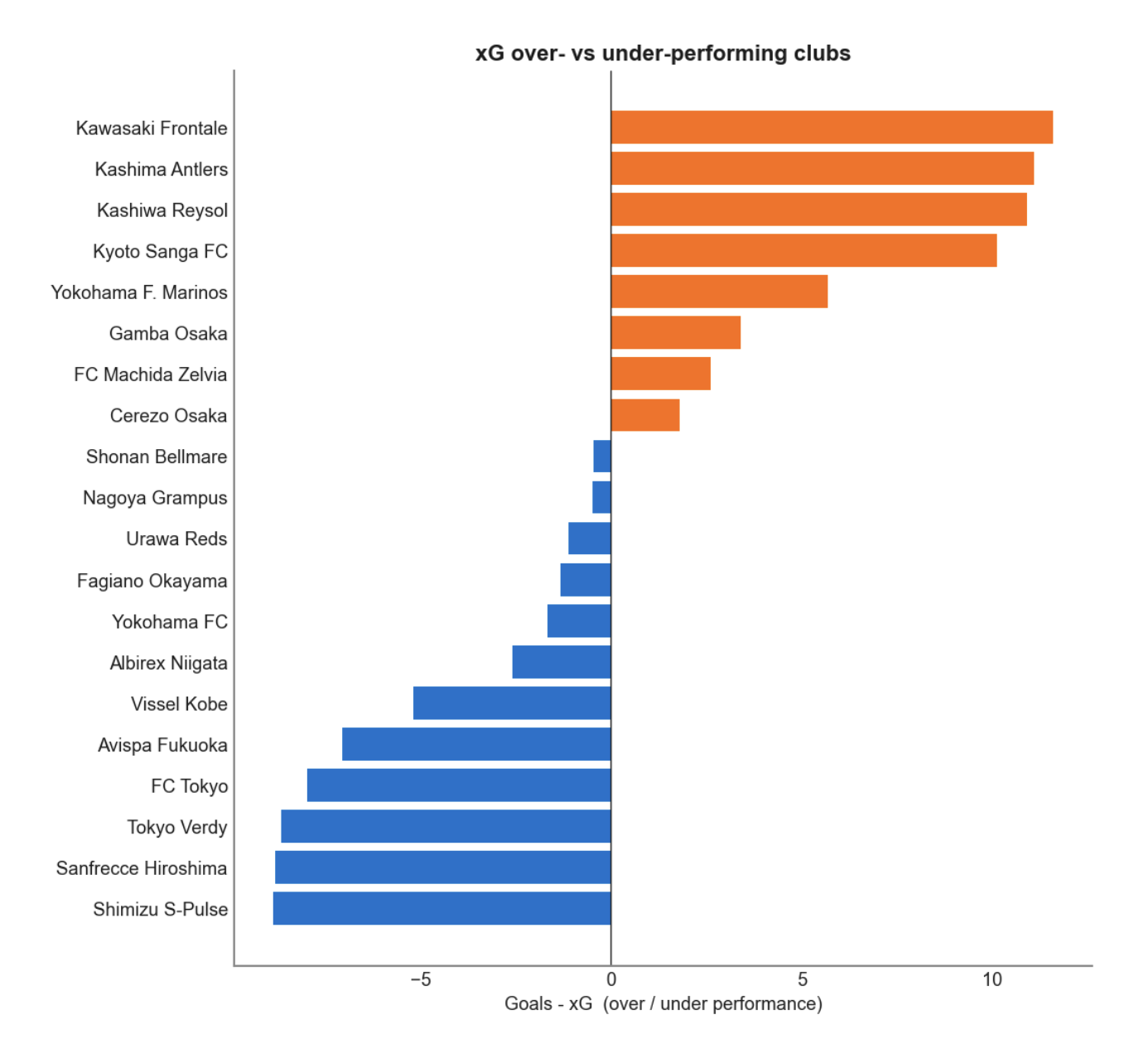
J1's 2025 non-penalty goals-minus-xG table ranged from Kashima Antlers (+15.6) and Kashiwa Reysol (+14.8) at the top to Tokyo Verdy (−8.4) and Sanfrecce Hiroshima (−6.8) at the bottom. Sanfrecce's case stands out: they led the league in shot volume, had the closest average shot distance in J1, and generated more clear shots than almost any rival - yet their xG per shot ranked just 13th of 20, and only 28.4% of their shots ever forced a save.
Their box touches, crosses, and passes into the box correlate strongly with shot volume,but barely with goals, and only 25.2% of crosses found a teammate in the box - a wide, cross-heavy pattern over central cutbacks. It shows individually too: Kosuke Kinoshita's 29 shots carried the best xG per shot on the roster (5.95 xG total) but returned just 3 goals, while shot-leader Akito Suzuki finished roughly xG-neutral.
The lesson: volume and territory don't guarantee quality. Sanfrecce led the league in shots and shot proximity, and still finished second-worst on goals relative to expectation due to wayward finishing.
Moving forward:
Taken together, the last J1 season was one of contrasts: a champion built on defense rather than star power, a mid-table side finally cashing in three years of quiet improvement, unheralded defenders proving their worth in the data before scouts caught on, and a high-volume attack that couldn't turn dominance into goals. Different clubs, different problems - but the same lesson: the numbers behind the table tell a richer story than the results alone.
There's a fitting symmetry to the timing. This was the last J1 season played under the traditional February-to-December calendar; as from this season, the league shifted to a European-style autumn-spring format to align with the AFC Champions League Elite. Kashima's title pursuit, Kashiwa's breakout, and Sanfrecce's shots-without-goals problem will be remembered as the final storylines of an era using the old calendar.
Whether that changing of the guard runs deeper than the calendar remains to be seen. Will Kashima's role as a top side in the league be built to last; did Kashiwa's rise have real foundations, even if this season flattered them; and we will see if Sanfrecce's fix starts with how they deliver the ball, not how often they reach the box. As J1 resets its rhythm using the new calendar, the clubs that adapt fastest may be the ones who define what comes next.