Hudl Lens: Building Human Advantage in an AI World
26 Jun 2026
6 min Read
AI is reshaping how organisations operate — and sport is no exception. We give the Hudl perspective on how leaders can build genuine AI advantage without losing the human judgment that underpins high performance.
This article draws on leadership sessions delivered by Hudl for VSI Executive Education and the United Nations Institute for Training and Research (UNITAR). It is co-authored by Ed Sulley (Director of Customer Solutions & Implementation), Austin Fuller (Product Director, Global Football & Rugby) and Andreas Hofmann (Senior Solutions Consultant).
Few technologies have moved from curiosity to boardroom priority as quickly as AI, and few industries feel that shift as keenly as sport. For leaders of clubs and organisations, the pressure to act is real. But so is the noise around what AI can and can't do, and the temptation to adopt tools for their own sake.
Working with experts across the industry, we keep returning to one practical question: how do you build genuine AI advantage without losing the human judgment that underpins high performance?
The answer has less to do with technology than most people expect, and more to do with how an organisation chooses to work. Here is what we've learned.
What AI Is — and Isn't
The most common mistake organisations make when approaching AI is starting with the technology. The more useful starting point is the work itself.
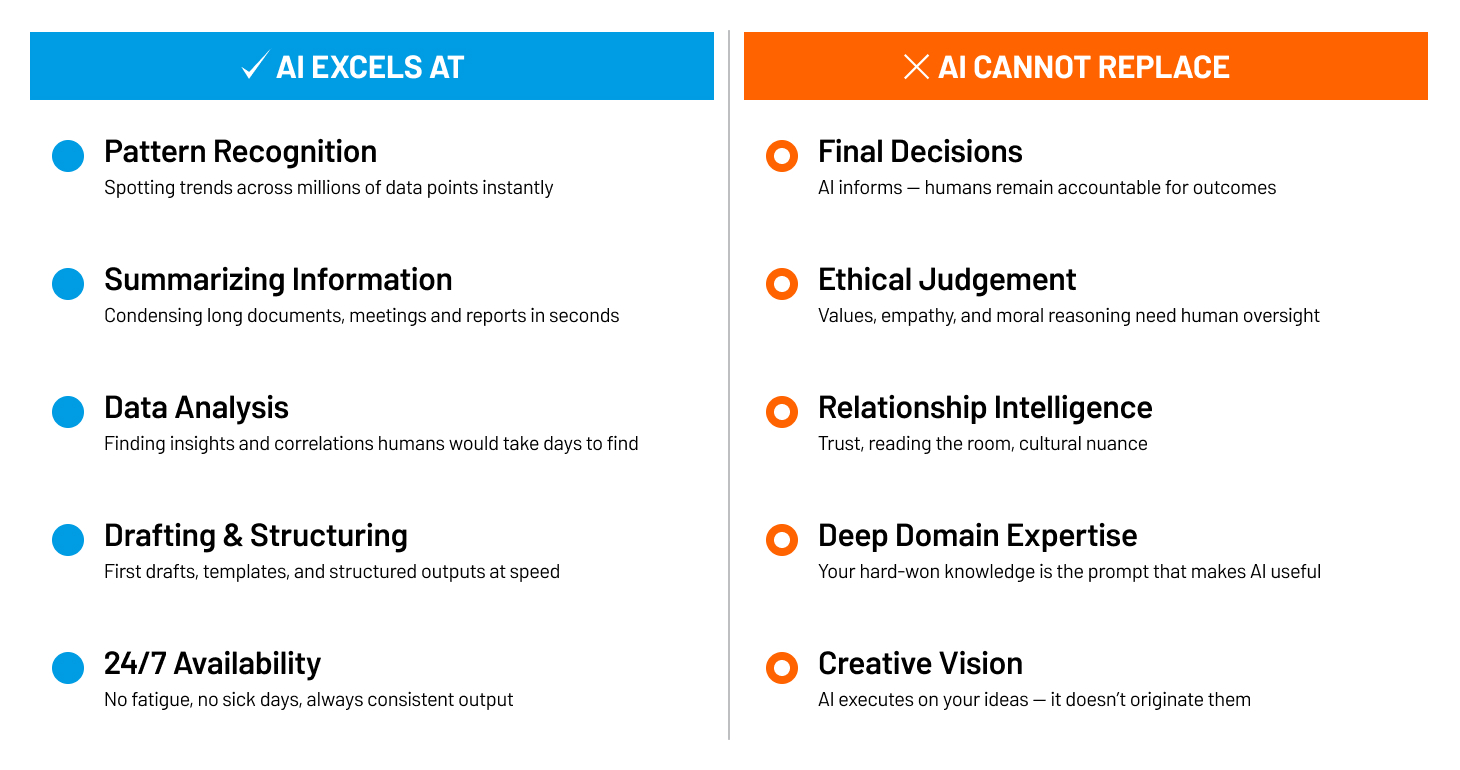
It helps to think of AI as hiring someone who never sleeps, never forgets, and takes on your most repetitive work — freeing you to focus on the things only you can do. Used this way, AI is extraordinarily capable. It excels at pattern recognition, summarising large volumes of information, drafting and structuring content, and maintaining consistent output at scale.
But there is a clear line. AI cannot replace final decisions, ethical judgment, or the relationship intelligence that underpins trust. Those remain human responsibilities.
The philosopher Hannah Arendt once wrote: ‘To think is to be alive.’ Given today’s technological capabilities, she would probably have left the task of calculating, summarising and processing her own thoughts to a machine, and saved her own energy for what mattered most to her – moral judgement and an active intellectual life.
It is precisely this distinction between mechanical work and independent thought that should mark the boundary between AI and human judgement.
In our own product teams, for instance, the ability to prototype up to four times faster has collapsed the distance between an idea and something a customer can react to — but the judgment about what is worth building stays firmly human.
The Four Foundations of AI Advantage
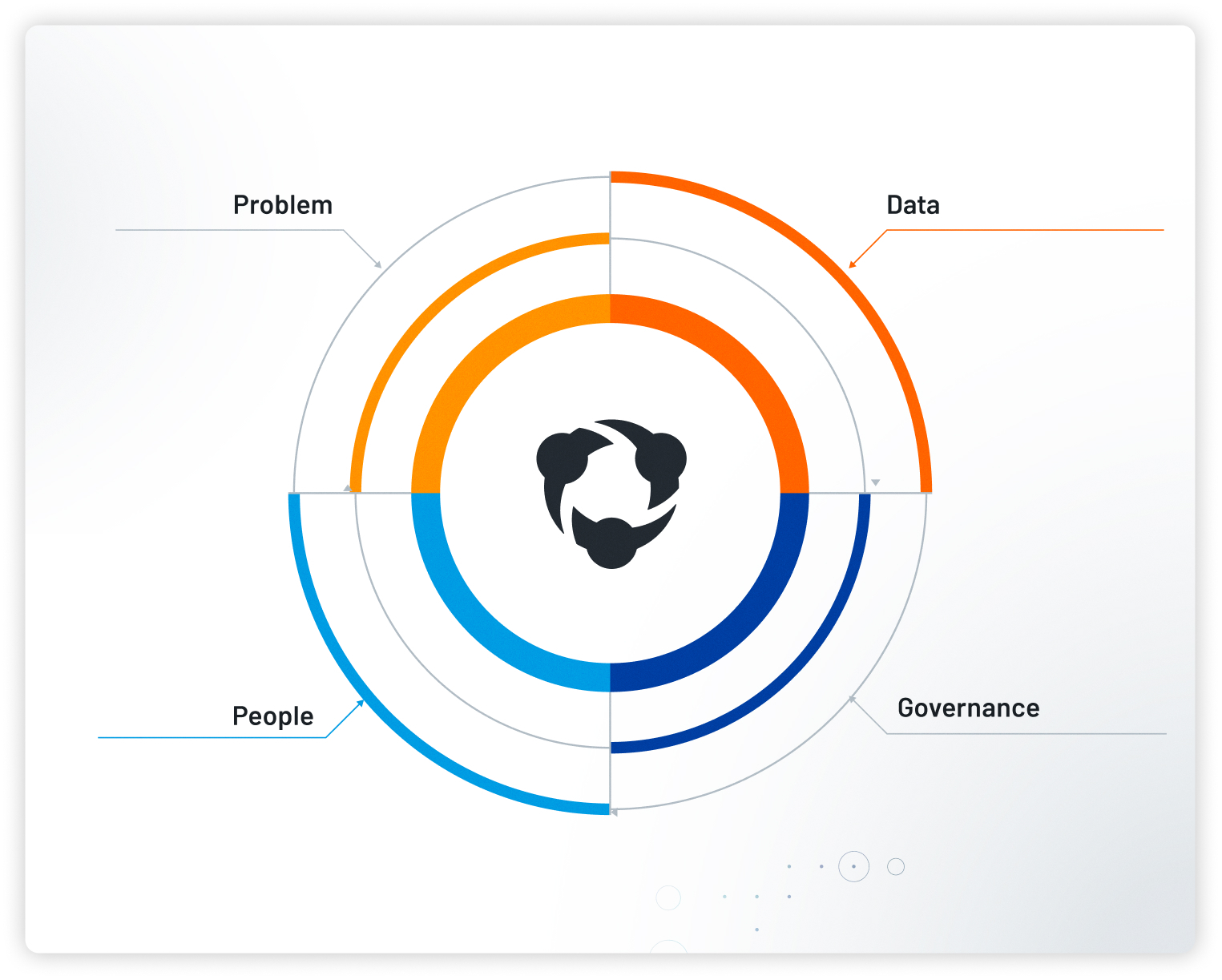
In our experience, the organisations that build lasting advantage from AI tend to get four things right. They are interlinked, and each reinforces the others.
Problem: the task you are actually trying to solve.
Data: the foundation everything else sits on.
People: the capability to use it, spread across the organisation.
Governance: the balance of value and risk, maintained over time.
Let's look at each in more detail.
Problem
Start with your most repetitive, time-consuming tasks, then ask whether AI could handle the first 80% of them. That is your entry point — not the technology, but the problem it solves.
This keeps the focus where it belongs: on decision-making. The repetitive 80% is rarely where your edge lies; the final 20% — the judgment, the context, the call — almost always is. Hand over the former and you protect time and energy for the latter. Begin with the simple, high-impact automations that build confidence and momentum, before moving on to the more complex, transformational changes.
Data
AI is only as good as the data it sits on. Many organisations will be sold AI capabilities embedded in tools they already use — and some of those claims are well-founded.
But the organisations that build a durable advantage are those that have invested in a centralised data structure — one that gives them control over their own data, maintains security and privacy, and can adapt as their needs evolve.
In sport, where a single result can shift the mood of an entire building for a week, the strength of that foundation is what lets AI produce cost-effective quality at speed without producing noise. Without it, AI tools remain disconnected, inconsistent and, ultimately, difficult to trust. With it, every subsequent AI investment compounds in value.
People
Capability has to be spread across the organisation, not siloed in a handful of enthusiasts.
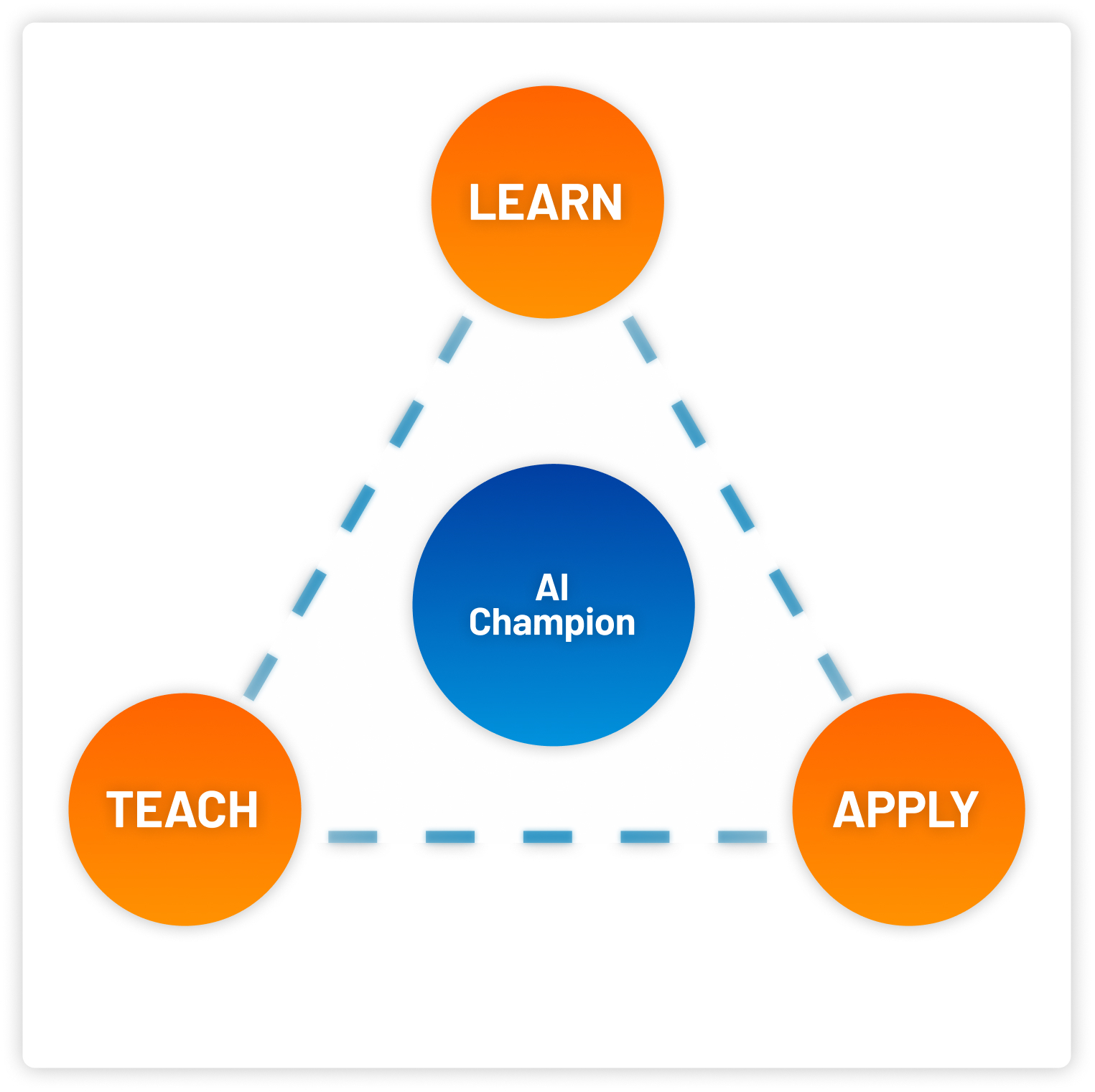
One practical model is to appoint an AI champion in each department: a single trusted, enthusiastic colleague, given additional training and tasked with sharing good practice in a simple cycle of ‘learn, apply and teach’.
Supported by clear policy from senior leadership and a common set of tools, this spreads fluency faster than any top-down training programme. It helps to be honest about where capability actually sits, picturing a ladder from beginner (little to no knowledge), through novice (occasional experimentation), to practitioner (consistent, independent use) and expert (fluent enough to teach others).
The aim isn't for everyone to reach the top rung — it's to move the whole organisation steadily up it. One trusted champion per team will do more for that than any single training programme.
Governance
Every AI decision involves a trade-off: the value created on one side vs. the risks introduced on the other. Picture a seesaw — keeping it balanced over time is the central job of leadership.
That framing is deliberate. It shifts AI from a technology conversation to a governance one, and good governance is stewardship rather than bureaucracy. Leaders should be able to answer three questions: who owns AI-related decisions, where challenge and review are built in — not just at adoption, but on an ongoing basis — and how you'll know when the balance starts to tip.
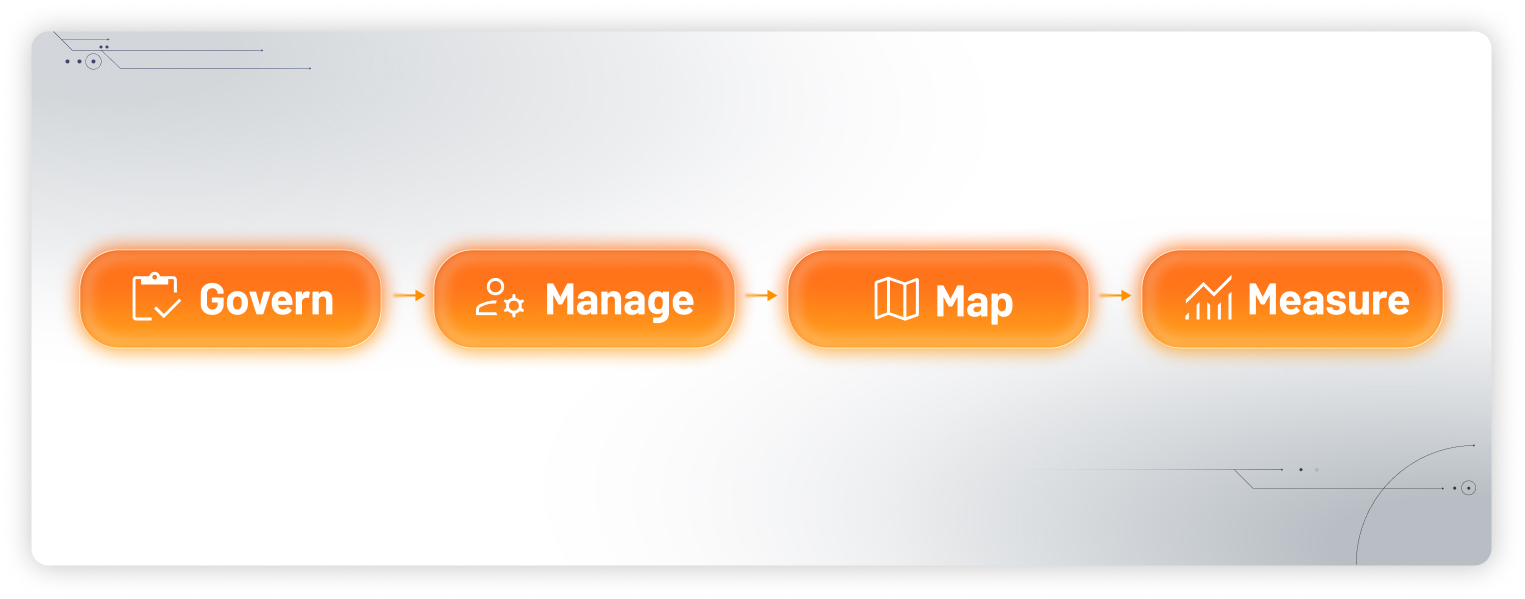
A simple way to keep that honest as adoption scales is to work across four dimensions: govern (set the policy and accountability), manage (run AI use day to day), map (understand where and how it is being used) and measure (track whether it is delivering value and where new risks are emerging). Each serves a different function, and together they stop governance becoming a one-off box-ticking exercise.
Where to Start
The theory is one thing; the first move is another. A useful way to begin is to plot two axes — efficiency along the bottom, effectiveness up the side — and honestly place where your organisation sits today. The goal is to move up and to the right: not just faster, but better.
From there, here are the takeaways leaders tend to find most useful:
Map your current use across three areas: where AI already drives operational efficiency, where risk and reputation need to be considered, and where value-creation opportunities exist that haven't yet been captured.
Start with quick wins. Simple, high-impact automations build the confidence and momentum to tackle the harder, transformational changes later.
Treat AI as culture, not a side project. Set clear policy from the top, give people shared tools, and track fluency openly — so you can see where support is needed rather than assuming it.
Ask the question that matters most: what will you stop doing in the next 30 days because AI can do it better — and what will you start doing with the time you get back?
At Hudl, we consistently put our expertise at the service of current and future customers to solve the biggest challenges in elite sport.