Chasing the Why: How Modern Hockey Minds Build a Culture of Collaboration

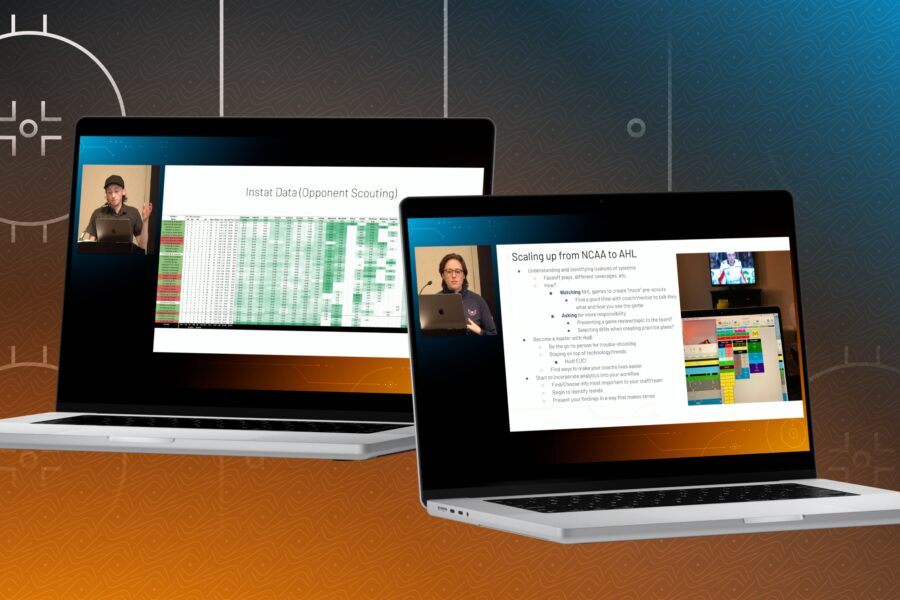
The most successful teams are the ones where the video room and the bench communicate effectively and consistently. Hudl’s Suite is the tool that can help your team ensure alignment across the board.
Ryan Kearney started his hockey career with a secret: He had never actually played hockey. Not in high school, not in a beer league—nowhere. Starting as the director of hockey operations for the Colgate Women’s Hockey program – and now as the Director of Operations and Video Analytics at the University of Minnesota – Kearney built his career by becoming the architect of a data-driven culture that helped propel the Raiders to the Frozen Four.
A few hundred miles away, Emily Engel-Natzke is doing the same for the Washington Capitals. Her journey from Wisconsin to the American Hockey League and finally to the NHL is a masterclass in curiosity. On the surface, Kearney and Engel-Natzke operate in different worlds. One is navigating the recruitment-heavy waters of DI college sports, the other is preparing for the high-stakes grind of the professional playoffs.
But look closer, and you’ll see they are solving the exact same problem– how to turn a mountain of video and data into a clear, actionable game plan that coaches and players actually trust.
Starting Small, Winning Big
When Kearney first arrived at Colgate, the ask from the coaching staff was simple. "All they were really interested in from me was tracking average shift length," Kearney said. "I was like, 'All right, start off small. That sounds pretty good, very manageable.'"
But for Kearney, "manageable" wasn't enough. He grew up in the Chicago suburbs and cut his teeth volunteering for the University of Iowa football team. It was there he learned about "explosive plays"—the idea that if you limit a team to two or fewer big gains, your win percentage skyrockets. He took that football mindset and brought it to the ice.
He began using Hudl Instat data and Hudl Sportscode to build what he calls a "Game Log." He wasn't just tracking shifts anymore; he was tracking possession. He discovered that when Colgate possessed the puck at even strength for over 56% of the game, they won nearly 88% of the time.
"The analytics will tell that story for you," Kearney explained. "We’re preaching that message of reloading and doing all the little details... it reinforces the importance of that."
By providing these insights, Kearney did more than just hand over a spreadsheet. He gave the coaching staff the evidence they needed to double down on their identity. He moved from being a "video guy" to a collaborative partner, helping the staff decide which goalie to start or how to spot an opponent's tiring defensive pair.
From "What" to "Why"
Engel-Natzke’s path to the Capitals followed a similar trajectory of constant evolution. For her, the breakthrough wasn't just about spotting a system—it was about understanding the motivation behind it.
In the NHL, everyone knows what an opponent is doing. The edge comes from knowing why it’s happening and how to break it. When Engel-Natzke breaks down an opponent’s forecheck, she isn’t just looking at player movement, she’s looking for personnel weaknesses.
"Once you can spot those nuances, it’s about ‘how can you exploit those?’" Engel-Natzke said. "Is there a recent trend you’re seeing or is it something you’ve seen all season? How do you start to do this? Listening to other coaches run meetings, how do they talk about systems and execution?"
She uses video evidence to build a roadmap for players. If an opponent is aggressive in their forecheck pressure, she’s not just showing their pressure; she’s finding the clip that proves their D is cheating high, leaving the stretch pass wide open. By combining data with curated clips in Hudl Sportscode, she gives the coaching staff the confidence to tell their players: If we move the puck here, this lane will be open. "Basically, the more tools or evidence that you have to support it, it really helps your coaching staff have the confidence to say, 'Okay, great game plan, here’s what we’re going to do,'" she explained.
That is what builds trust in a locker room. Whether she’s presenting a game review to professional veterans or suggesting a new drill for a practice plan, her goal is to simplify. In the NHL, where you might only have five to 10 minutes, being able to deliver a message that’s clear and concise— backed by undeniable video evidence—is the difference between a win and a loss.