How AI Is Transforming Volleyball Coaching & Analysis
Jul 28, 2025
8 min Read
Discover how AI is reshaping volleyball — helping coaches improve decisions, save time and unlock deeper insights.
Artificial intelligence is revolutionizing volleyball coaching and analysis, giving programs at every level access to insights previously available only to elite teams with dedicated analysts. From automated tagging to generated insights, AI tools are changing how coaches prepare, teach and strategize. Here's what forward-thinking volleyball coaches need to know about this technological revolution.
Why Volleyball Is Primed for AI Innovation
Volleyball's structured nature makes it particularly well-suited for AI analysis. Each rally consists of clearly defined touches (e.g., serve, pass, set, attack, block, dig) and having only six players in set rotations creates predictable patterns. There’s also quantifiable skills which have established rating systems. Not to mention there are clear outcomes and visible court boundaries which help with AI accuracy.
All these characteristics create what data scientists call a "structured environment," where AI can easily identify patterns and track performance metrics.
Coaches demand precision and insights.
Volleyball coaches have long been data-driven compared to many other sports, embracing statistics well before the AI revolution. Traditionally, coaches already track serving percentages, kill efficiency and passing ratings, and programs from high school to professional levels commonly use video analysis.
This existing analytical culture means volleyball coaches are ready to adopt and apply AI insights, with established frameworks for translating data into coaching decisions.
This fast-evolving sport benefits from smarter tools.
Modern volleyball has undergone significant tactical evolution, creating demand for advanced analytics.
Today’s game is faster and more complex than ever, driven by:
Increased speed of play across all levels of volleyball.
New offensive routes that challenge traditional defensive and blocking systems.
Coaches need smarter tools to analyze performance, adjust strategy on the fly, and stay ahead of the game.
Hudl Assist is Now Powered by Balltime AI
Hudl acquired Balltime in February 2025, and have now integrated their AI tech into a new product: Hudl Assist powered by Balltime AI. Over the past few months, both teams have been working hard behind the scenes to bring Balltime’s powerful AI features into the Hudl platform.
Hudl Assist powered by Balltime AI offers automated breakdowns.
Balltime AI represents the cutting edge of automated volleyball analytics. Here’s what you can expect:
Faster processing: Matches are processed quicker than ever, with full stats typically available within 1–2 hours after upload—saving coaches valuable time.
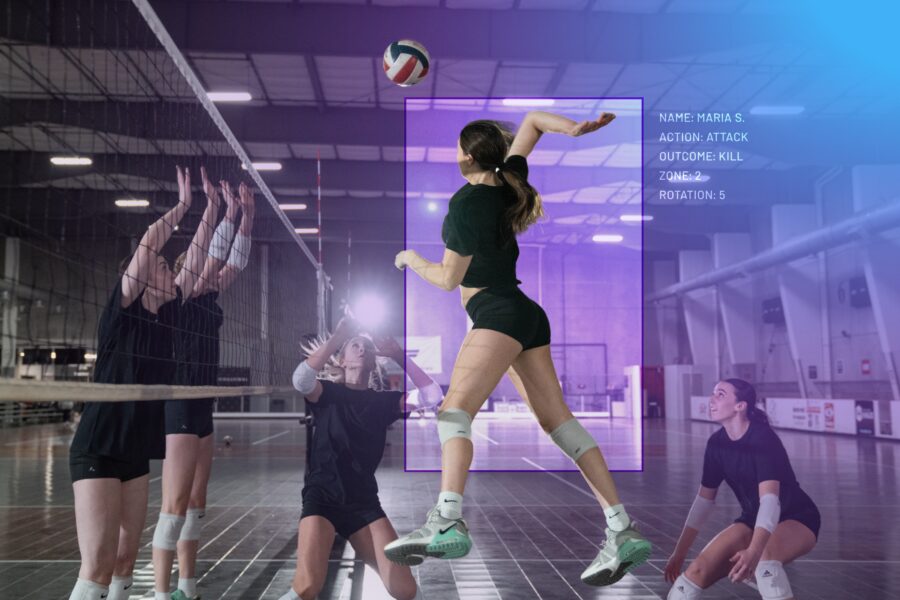
Computer vision technology: Advanced AI algorithms identify player movements, positions and ball contacts.
Comprehensive metrics: The system tracks everything from basic touches to complex metrics like rotational tendencies and attack height.
Seamless Hudl integration: Stats integrate directly with existing Hudl video libraries.
Real-World AI Coaching Workflows
Prep before matches with detailed reports.
Many coaches have successfully developed an efficient pre-match routine using reports, and it’s easy to replicate.
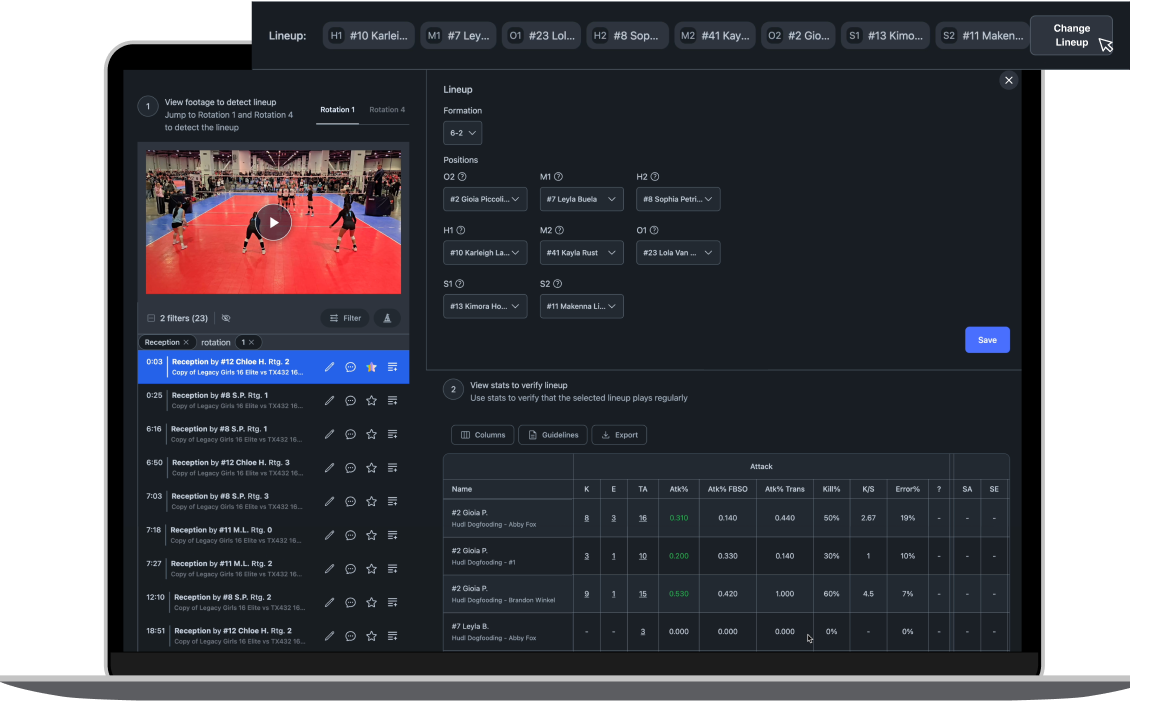
Review rotation tendencies: Evaluate your team’s serve receive formations and offensive patterns by rotation to select the lineup that gives you an advantage.
Identify matchup advantages: Pinpoint which player combinations on your team create the most consistent scoring opportunities.
Create serve targeting plans: Analyze your own serve performance and consistency to build smarter, more intentional serving strategies.
Prepare blocking schemes: Assess your team’s blocking efficiency by position and adjust responsibilities to improve coverage and timing.
A pre-match workflow like this can take less than an hour—compare that to the 3-4 hours it can take with traditional video review methods without AI breakdowns.
Analyze post-match metrics.
After matches, analyzing performance is a must-do for coaches—but with assisted breakdowns, it doesn’t have to be time-consuming. Here’s an example workflow:
Analyze performance trends: Review key metrics compared to season averages.
Identify skill development priorities: Pinpoint specific skills needing improvement.
Create player development plans: Generate individualized feedback based on performance data.
Review AI Insights: Uncover performance trends and standout moments automatically identified by AI.
Adopting this post-match workflow will only take you 30–45 minutes—not the 2–3 hours it would take with traditional video review methods without assisted breakdowns.
Game-Changing Use Cases from the Court
Save hours on volleyball film review.
There's never enough time for coaches like you. This is where AI analytics delivers its most immediate and appreciated benefit—giving coaches back precious hours in their week.
When coaches adopt AI-powered analysis tools, they're often amazed at how quickly they can accomplish tasks that used to consume entire evenings. Instead of tediously scrubbing through footage to find specific plays, AI systems automatically generate categorized clips that coaches can access with a simple click. Need to review all your team's serves from zone 1? Or perhaps all the attacks your outside hitter made in the third set? What used to take an hour can now be done in seconds with instant filtering capabilities.
The efficiency extends beyond just finding plays. Coaches can upload multiple matches simultaneously for batch processing, review the insights on their phones while waiting for practice to start, and easily create highlight reels for individual players or specific situations.
Detect rotation patterns and tactical trends.
You know those coaches who seem to have a sixth sense for the game—who can spot patterns and tendencies that others miss? AI can essentially give every coach this superpower, revealing insights that would be nearly impossible to detect with the naked eye.
Ever had a match where one rotation consistently underperforms, but you can't quite figure out why? Stats like sideout percentage, earned point percentage, and first ball sideout efficiency are available—but buried in box scores. The real game-changer is AI analysis that surfaces these insights automatically.Instead of manually piecing it together, AI identifies exactly which rotations are underperforming—and why—so coaches can focus on adjustments that matter.
The pattern recognition extends to opponent tendencies as well. Here’s a few examples:
AI-generated heat maps reveal where opponents tend to attack from and where they aim—helping you identify high-frequency zones and vulnerable areas in your defense.
Set trajectory data can show where each individual hitter's sets are landing, allowing your block to line up more accurately based on their preferred tempo and location.
Rather than making adjustments based on feel or limited observations, coaches can now make data-driven tactical decisions based on comprehensive pattern analysis.
Unlock insights beyond human tagging.
One of the biggest advantages of AI in volleyball analysis is its ability to deliver consistent, unbiased insights. Traditional stats often depend on human tagging, which can vary based on who’s watching—and what they notice. AI removes that subjectivity by applying the same lens to every contact, every time.
Take pass rating, for example. Human taggers might grade the same pass differently based on their angle, experience, or even subconscious bias. But AI uses frame-by-frame tracking and measurable factors—like location, airtime and the setter’s position—to evaluate each pass with precision. Every touch is assessed the same way, across every match, so nothing gets lost in interpretation.
The result? More reliable data, a clearer picture of player performance, and smarter decisions driven by facts—not your gut feeling.
The Future: What's Next for AI in Volleyball
It’s natural to consider what the power of AI might unlock down the road.
Automatic predictive scouting and opponent analysis?
The volleyball coaching world is on the verge of a predictive revolution. Soon, you could be able to walk into pre-match talks with AI insights that don't just tell you what opponents have done, but what they'll likely do against your specific team. These systems could forecast how opponents respond in key situations—like knowing a setter's distribution to their outside hitter jumps from 40% to 70% when trailing by three points. Imagine receiving real-time tactical recommendations based on emerging patterns, rather than pre-match assumptions. You would be able to make adjustments precisely when they matter most.
Perhaps most exciting is the possible ability to run virtual simulations testing different strategies against opponent tendencies before implementing them in actual competition. Combined with win probability modeling providing real-time calculations of match outcomes, volleyball could be transformed from reactive coaching to proactive, analytically-driven competition.
Player development with longitudinal AI stats?
AI is fundamentally changing how we develop volleyball players. Instead of generic feedback like "your serving needs work," coaches can show precisely how a player's progression compares to successful athletes at higher levels. Imagine being able to map development trajectories showing exactly where a 15-year-old's skills need to be at 16, 17 and 18 to reach their collegiate goals.
These systems could also generate personalized training recommendations by analyzing thousands of similar players, identifying which drills and focus areas will most effectively address individual needs. The same technology could help optimize training loads by balancing intensity with injury prevention, identifying early warning signs of potential overtraining before performance drops or injuries occur.
Wearable data for total performance views?
The most transformative development that could be on the horizon is the convergence of AI video analysis with wearable technology. Elite programs are already testing systems that merge data like jump metrics, heart rate and movement patterns with skill execution metrics, revealing crucial correlations. For instance, how serving accuracy drops 17% when heart rates exceed 85% of maximum, or how attack velocity decreases after certain jump count thresholds.
This integration would revolutionize injury prevention by identifying movement patterns associated with increased risk—like changes in landing mechanics when fatigued—which would allow coaches to intervene before injuries occur.
Connect with Hudl to Get Started
Artificial intelligence isn't just changing volleyball analytics—it's transforming how coaches teach, prepare and develop players. By embracing these powerful tools, coaches at all levels can save valuable time, uncover hidden insights, and create more effective training environments.
Whether you're coaching high school, club, collegiate, or professional volleyball, AI tools like Hudl Assist powered by Balltime AI offer accessible entry points into the future of volleyball coaching and analysis. Learn more at hudl.com/products/assist/volleyball/ai.