Identifying Fast Passers Using Data


As a coach of my 11-year-old son’s 9‑a-side team, nothing frustrates me more (except for kids taking a pair of scissors to their socks – but they wouldn’t let me write a blog piece about that) than players not getting their head up, taking too long on the ball and failing to pick out a pass to a teammate in open space.
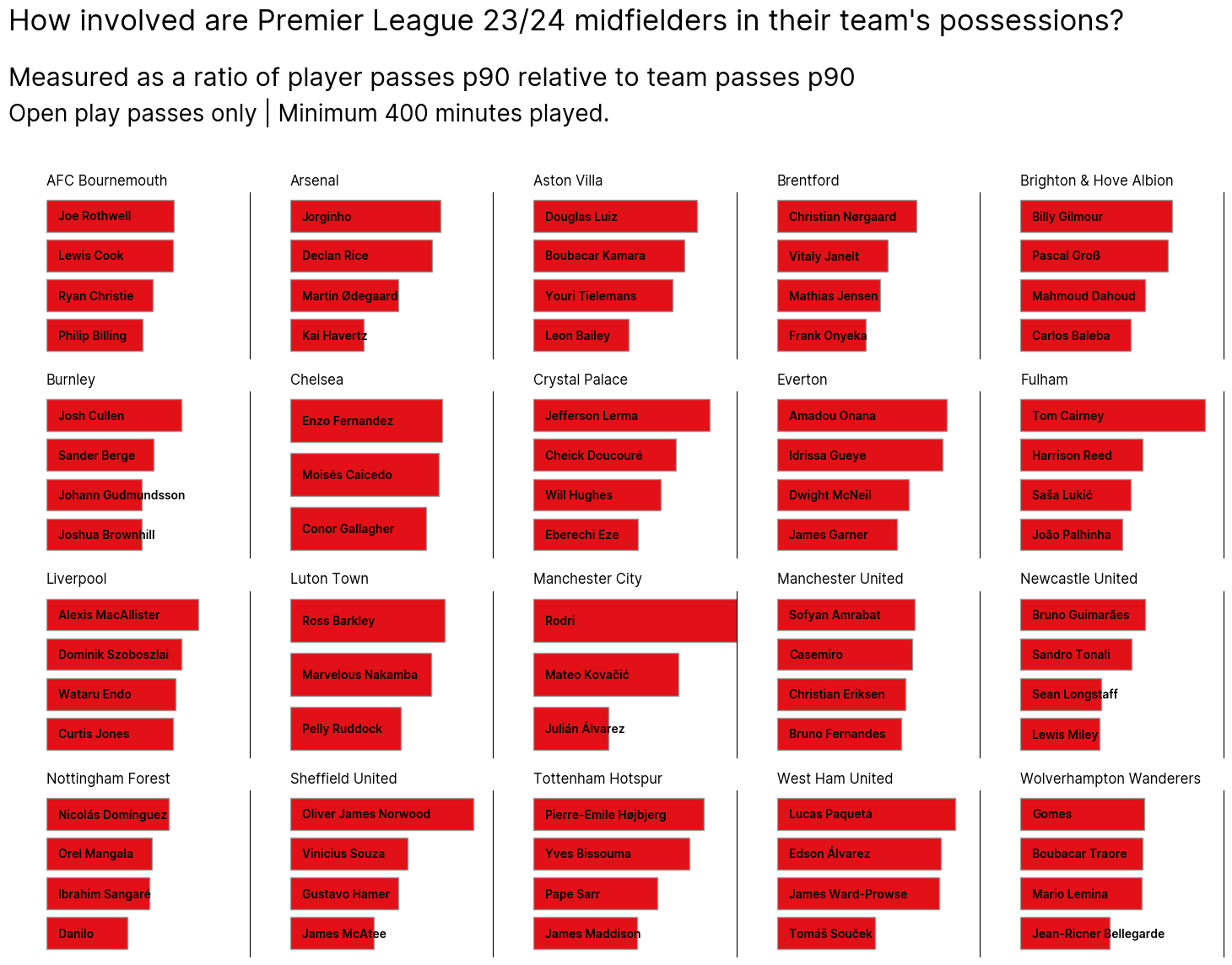
Although this is a fairly simplistic calculation of a player’s total passes p90 divided by the team’s total passes p90, and it doesn’t account for the differences between when the named player is on or off the pitch, it passes the eye test for what I’d expect for most teams.
Rodri is pivotal in Manchester City’s play, Jorginho and Declan Rice pull the strings for Arsenal and there’s a more even split of responsibilities at Liverpool.
Can execute a quick pass
Now for the fun (admittedly, depending on your definition) part. I’m going to use the timestamps in our event data to get a proxy towards players that move the ball quickly. Almost all passes – and certainly the ones relative to what we’re trying to identify here – are preceded by a recorded Ball Receipt in StatsBomb’s event data. Therefore, by calculating the time between a ball receipt and the subsequent pass being made, we can see how quickly a player moves the ball on.
A time difference of 0.0s would indicate first time pass. I’m going to widen the net a little to a slightly arbitrary 1.0s. This will obviously rule out some ‘quick passes’ that are, say 1.1s, but you’ve got to draw the line somewhere, and if you’re doing this yourself you can play around and adjust the threshold.
I’ve also filtered to look at passes made with the feet only. Headed passes will, by their very nature, nearly always be first-time passes in this definition, and that’s clearly not something that I’m interested in.
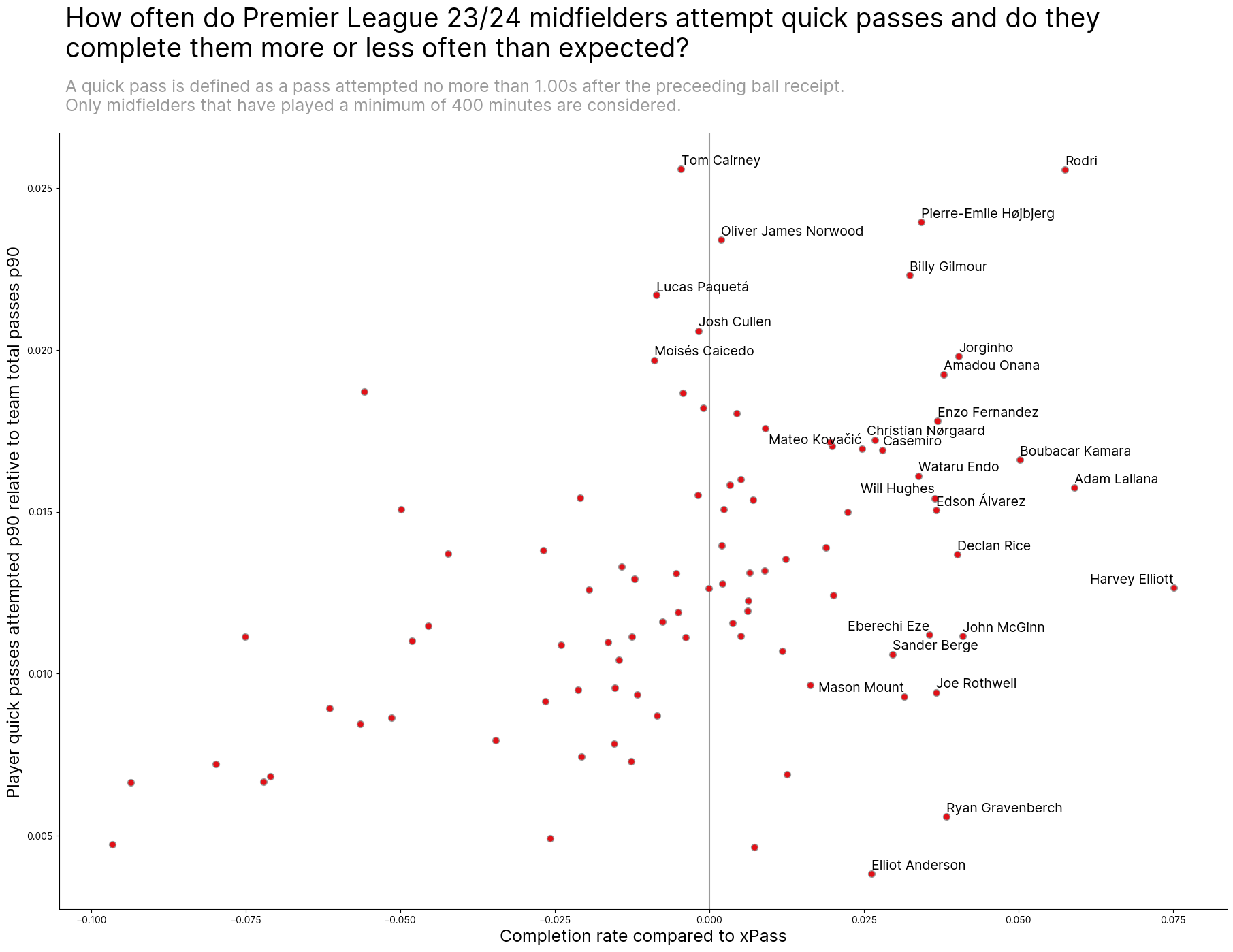
So with quick passes identified, we can now calculate the completion rate of these passes and compare them to xPass values. This will give us an idea of whether players are completing these types of passes more often than they are expected to do so on average.
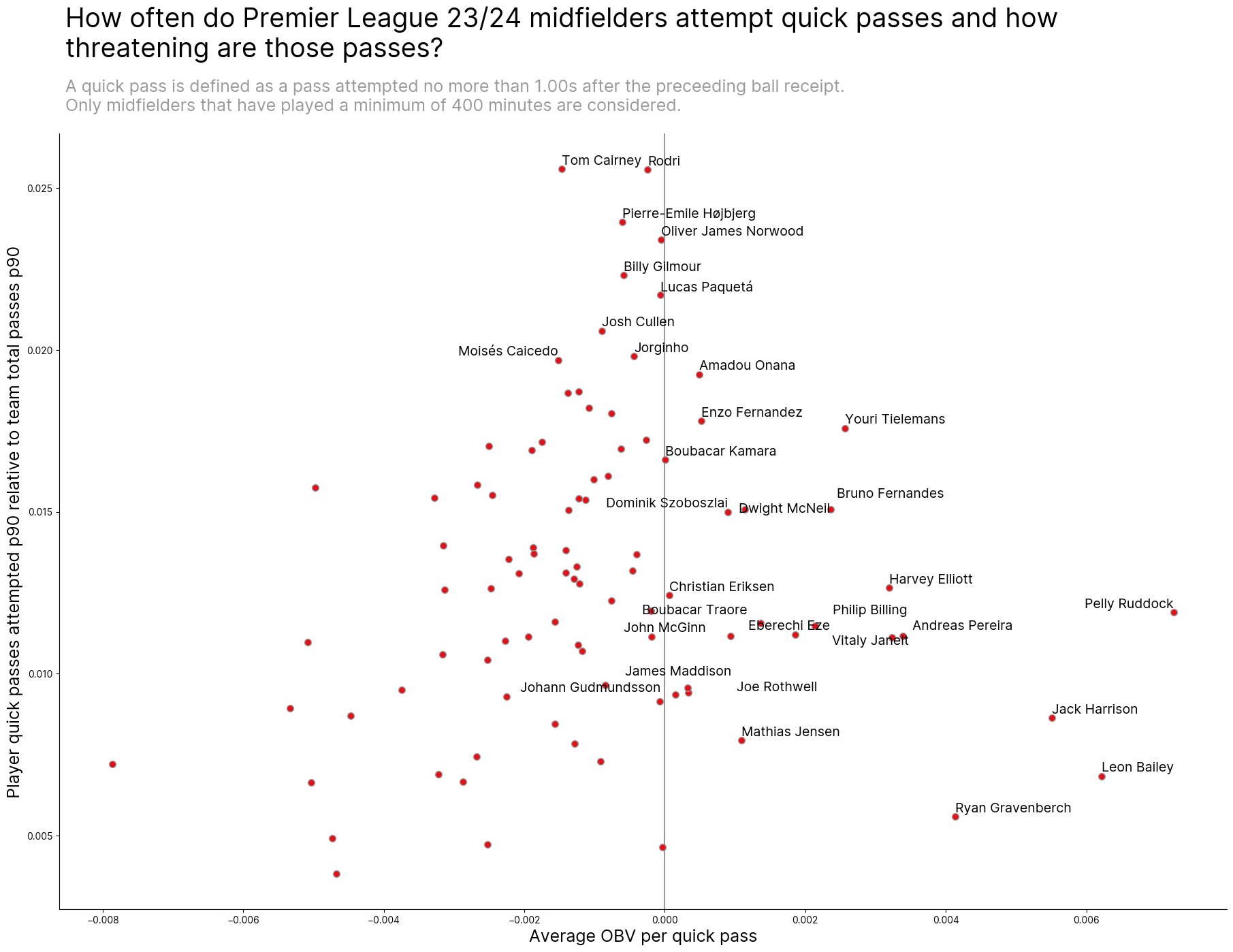
It’s quite clear that the players who are making more of these quick passes are doing so at a fairly neutral threat rate, on average. Rodri, Højberg, Oli Norwood, Gilmour, Lucas Paquetá are all hovering around the 0.00 line for OBV per pass, and there’s a general trend of gravitating towards that line as the volume of passes increases - perhaps a nod to this being a difficult skill to excel in.
Shout out to Pelly-Ruddock Mpanzu, Jack Harrison and Leon Bailey for being fairly potent when they do play quick passes. Harvey Elliott also stands out with a reasonably high rate of execution and a strong OBV per pass value - if Liverpool can get him involved more often then he could be a valuable resource for them this season.
Finds teammates in space
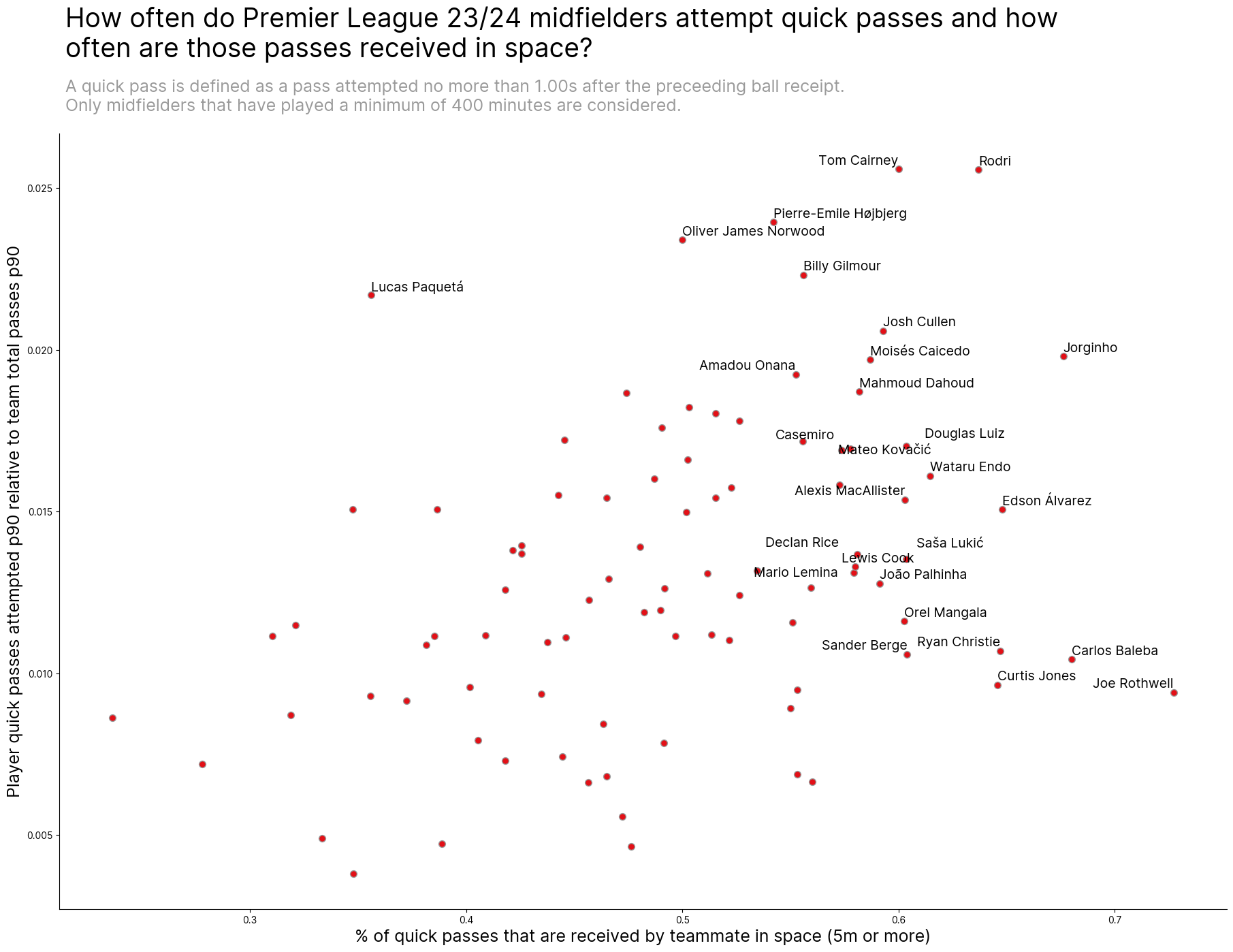
The final piece of my quick-passing-midfielder jigsaw is an ability to find teammates in space. For this we can dip into the 360 data set and look at which of the quick passes that we’ve identified land at a teammate in space.
Here I’ve chosen to look at passes received in a space of 5m or more – again, this is a fairly arbitrary amount and you can adjust as required. I should also point out that I’m not adjusting for opportunity here, this only looks at the frequency of which a player finds a teammate in space, there is no accounting for the number of times that option is available to them – if your teammates don’t find space, then you can’t be expected to deliver the ball to them in space.



Caveats
Of course the above is not exhaustive, there are plenty other factors you might want to throw into the mix. There’s a very good argument to be made for adding press resistance as a criteria - although that is baked into the xPass model somewhat. Game state is also a potential component that you’d want to consider – the way that a player passes the ball can differ notably when winning or losing. Pass length, pass direction, pass height and pass start/end location are all also things that you might want to, and can, assess.
Ultimately, you can shape this how you want, to fit the criterias that your team cares about. And whatever way you mould it, it’s not going to be a silver bullet to finding you the player that you want or need. But it absolutely can be another extremely useful data point that helps to build a clearer picture and point you towards a more curated shortlist of players to scout and assess in more detail.
One thing’s for sure, when the Dundee District Youth Football Association finally cave to my lobbying and bring in StatsBomb as their official data provider of the under-12s league, I know what metrics I’ll be looking at to find our next deep-lying playmaker.