Harry Potter, AI & the Redefined Role of the Sports Scientist
23 Sept 2026
9 min Read
By Dr. Carlos Martínez Rubio
Solution Consultant at Hudl & Performance Lead at Spanish Basketball National Women Team
Ron knew all the spells. Hermione knew which one to cast. Why AI has made judgment the sports scientist’s most valuable skill.
I was that classic kid obsessed with Harry Potter. My house was full of wands of every kind, I watched every film about 20 times, and I could recite the spells from memory without blinking. Yep, that level of obsession.
Precisely because of that, I got stuck on a question I couldn't shake: how can some wizards be better than others? Because let's be honest, learning the names of the spells didn't seem particularly complicated. Anyone could pick it up. Wingardium Leviosa, Expelliarmus, Expecto Patronum. Words and gestures. Nothing extraordinary.
Take Hermione and Ron, for example. Both have a wand, attend the same classes, and read the same books. And yet Hermione runs rings around him in every single situation.
My first theory was the most obvious one: Hermione studies more. And that part is true. But on its own it didn't explain much, because Ron studies too. He knows the same spells and he recites them correctly. The hours alone weren't the difference. It's not about the process.
So what is it?
Hermione does study and practise more, that's true. But what those hours really build isn't a longer list of spells. It's judgment. Handed the exact same spell Ron already knows, she knows when to use it, why, and what she wants it to achieve. Ron reacts. Hermione decides. The wand is just the tool.
And it turns out that artificial intelligence has done exactly something similar to data analysis in high-performance sport. For years, being good at this job meant mastering the tools, the R scripts, the Tableau dashboards, the Python pipelines. The process sat between the question and the answer. AI has removed that barrier and in doing so, has changed what being good at this job looks like.
The big shift: from process experts to outcome experts
Picture a sports scientist at a professional football club. Before AI, if they wanted to analyze the relationship between accumulated training load and muscular injury risk in the final stretch of the season, the workflow looked something like this:
Export GPS data > clean it in Excel > import it into R > write or adapt a script > generate visualizations > interpret them > and if something didn't add up, start again.
That entire process could take hours or days of work, and required a level of technical proficiency that not every sports professional has, or needs to have.
Now that same professional can ask the question directly: which players in my squad are showing load patterns that have historically been associated with a higher injury risk over the next two weeks? AI does the heavy lifting. The sports scientist does what they do best: interpret, contextualize, and make decisions.
That sounds like a subtle change. In reality, it completely transforms the job.
Before, the value was in knowing how to use the tools. Now, the value is in knowing what to ask them.
That requires something no software can give you: judgment. Knowing which metrics matter and why. Understanding the physiology behind an acceleration data point, or the biomechanics behind a movement pattern. Knowing the scientific literature well enough to recognize when an analysis doesn’t hold up.
AI has repositioned the value of the sports scientist, rather than reduce it. And for professionals who understand this, there’s a huge opportunity.
What this means for the sports scientist in 2026
There has never been more data available. More tools, more sensors, more video, more information arriving in real-time. And yet many professionals feel busier than ever without necessarily getting any closer to the answers they need.
The reason? More data brings more noise, more time spent managing information, and more risk of getting lost in the details before reaching the decision that actually matters.
The new professional profile
For the past decade, the most valued profile in sports science was the "technical hybrid": someone who knew physiology but could also code, who understood biomechanics but could also handle databases.
That profile still has plenty of value, but it's stopped being the only path to analytical excellence.
What gains value now is something different: the ability to ask good questions. And a good question is a specific one. Not 'is this player at risk', but 'how does his accumulated load compare to his four-week average?’, and ‘is his acute:chronic ratio outside his usual range?'. Knowing exactly what you want to know, why you want to know it, and what you would do with that information once you have it. Take these examples:
Vague: How is the squad's fitness? Specific:Which players have dropped more than 5% in Heart Rate Average in consecutive sessions in submaximal fitness tests over the last week?
Vague:Show me the GPS data. Specific:Rank the squad by maximum speed exposure over the last seven days and flag anyone who hasn't reached 90% of their season best in fourteen days.
Vague:Are they ready to return? Specific:How does their load progression in high-intensity speed running compare with their own pre-injury baseline?
This requires three things that no software can give you:
Clinical judgment. Understanding which metrics have real ecological validity in your sport, your team, with your athletes. Knowing when a number is a signal and when it's noise.
Context. AI can detect an anomalous load pattern in a player. Only the person who knows that player can tell whether that pattern is concerning or simply reflects a high-demand weekend. Data always needs human context.
Synthesis. Ultimately, the sports scientist's job is to turn information into decisions,not reports or dashboards. Decisions. And that final synthesis, turning analysis into a clear recommendation for a head coach or sporting director remains deeply human work.
What loses relevance
Some things that used to be differentiating skills now set people apart less. Building visualizations from scratch in Tableau is no longer a competitive advantage if an AI-powered platform generates them on request. Writing R scripts to clean data loses weight if that process is automated.
Those are hours back, hours that can be reinvested in what really matters: being closer to the athletes, understanding the game better, developing deeper judgment.
Hudl Signal and AI: from question to insight
All of this conceptual transformation needs to materialize in concrete tools.
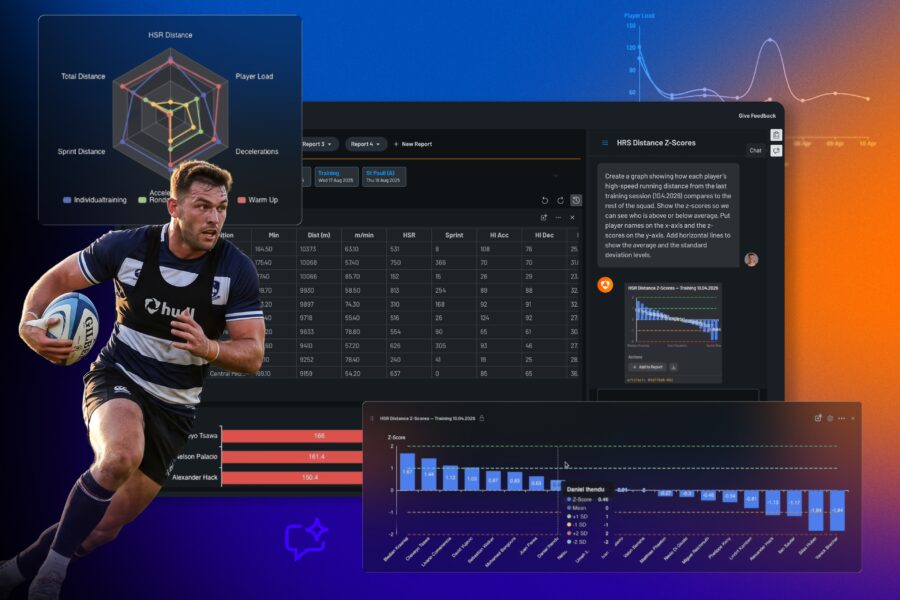
Hudl Signal is built around that idea. It's an environment where the sports scientist can ask real questions and get structured answers and visualization, without having to learn your way around the platform first. The goal isn't for you to become a power user of Signal. The goal is for you to become an expert in what you want to achieve, and for Signal to handle the rest.
Custom reports, no code required
Inside Hudl Signal, you can create any type of report you need. From something as straightforward as a maximum speed ranking across your entire squad for the last week, to more complex analyses like acute-chronic workload ratios, or the calculation of the smallest worthwhile change for a specific metric.
You shape the analyses around your question rather than taking a fixed output as it comes. AI acts as the layer that translates that need into visualizations, rankings, comparisons, and alerts that make sense for your specific context.
A sports scientist focused on load management can configure acute-chronic ratios, weekly load accumulated, and interindividual variability. One focused on match performance can orient their workflow toward maximum speeds, smallest worthwhile change values and positional effort profiles. One working on injury rehabilitation can track how a returning player's load progression compares to their pre-injury baseline, monitor whether their physical outputs are recovering at the expected rate, and set individualized thresholds that flag any deviation before it becomes a problem. Hudl Signal adapts to the question, not the other way around.
Connecting analysis with scientific literature
One of the most powerful aspects of AI in Hudl Signal is the ability to contextualize analysis with scientific evidence. The platform can surface relevant literature alongside what you're observing in your own data, closing one of the oldest gaps in the industry: the distance between published research and applied practice.
You don't need to spend hours searching PubMed to justify an intervention. Hudl Signal can help you find that evidence, connect it to your data, and give you a stronger foundation for the decisions you make every day.
Imagine you detect an accumulated load pattern that concerns you across several players at once. The useful question isn't only what the pattern is, but whether the evidence supports reading it as a risk at all. Acute-chronic workload ratio is the obvious example: a decade of enthusiasm, then a serious round of methodological criticism, and a good sports scientist carries both. Signal can help you find that material and hold it next to your own numbers, so the call you make rests on more than a threshold. All within the same platform where your data lives.
Start with the right question
If there's one takeaway from all of this, it's this: the value of AI in sport sits in what you bring to it: your judgment, your knowledge of your team, your sense of which question is worth asking at the right moment.
Hudl Signal gives you the tools to build any analysis you need - all connected to relevant scientific literature and presented in a clear, actionable way. Signal will build the analysis.
What it won't do is tell you which question was worth asking on a Thursday M-2/MD+1, with a squad three games into a congested block and a head coach who wants one sentence, not a dashboard. That part is still yours.
Ron had a wand and knew the spells. Hermione always knew exactly which one to cast.
The AI Assistant is available now for all Hudl Signal users. If you're already running curated sessions, there's nothing to set up. Open Signal and start asking.