FootballSignalPerformance AnalysisTraining and Drills
From Top Gun to Top Teams: Why G‑Forces Matter When Players Turn
16 Dec 2025
6 min Read
By Carlos Martínez Rubio, PhD
Implementation Consultant Human Performance
If Tom Cruise can nearly black out in a turn in Top Gun, your winger can definitely feel it too. We explain the science behind curvilinear metrics.
In Top Gun: Maverick, Tom Cruise pulls a vicious curvilinear manoeuvre. As his jet carves through the arc, G-forces surge with speed and turn radius. The cockpit gauge climbs, his vision narrows, and Hollywood briefly becomes a physics lecture: high-speed turning is not “just flying straight with style”, it is resisting massive curvilinear load.
Tom walks away with a grin.
Your athletes’ adductors? They aren’t always so lucky.
So, why am I telling you this? Is this just a fanboy speaking about one of their favourite actors? Yes… but mostly because the same physics that nearly sends Maverick grey applies directly to every tight cut, feint, or arcing sprint in team sports.
Change of Direction: Omnipresent, Decisive, and Often Mismeasured
Change of direction (COD) is everywhere and often decisive: feints, arcs, cutbacks, curved sprints to space. Coaches and sport scientists agree that it should be measured and trained. The real question is: are we measuring it properly?
GPS-derived acceleration and deceleration are familiar, helpful, and easy to interpret. Yet they are linear metrics. They quantify changes in forward speed, not the lateral forces athletes must generate to stay on a curve at speed. During curvilinear running, an athlete may apply substantial force to maintain or increase velocity, even when their “linear acceleration” appears modest. The load is high; the metric often underestimates it.
Aviation and motorsport engineers understood this decades ago: turning loads are not inferred from straight-line acceleration. They are quantified using angular velocity, angular acceleration, and the resulting G-forces. Because turning is physics, not vibes.
The same physics applies on the pitch:
Linear acceleration = how fast speed changes in a straight line
Curvilinear load = how much force the athlete must apply to stay on the curve
The faster the speed and the tighter the radius, the higher the G-load
High turning load is invisible if you only monitor ACC/DEC
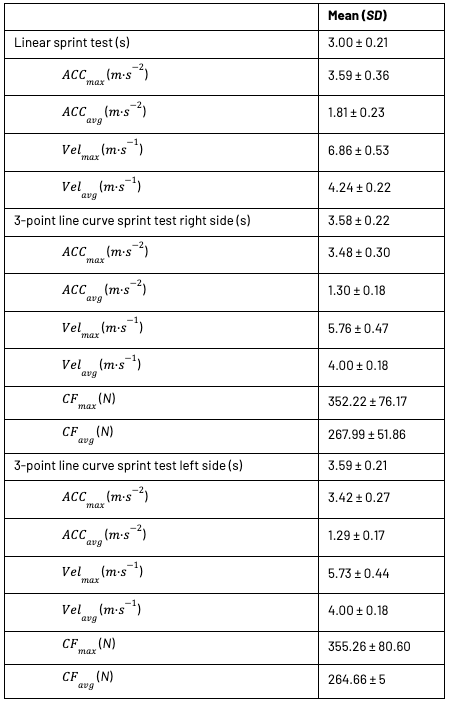
Our lab data backs this up: average linear acceleration is lower in curvilinear sprints than in straight-line sprints, yet the required centripetal force is substantially higher (1). COD makes athletes work harder than traditional metrics reveal. Their muscles notice. Your standard GPS report may not.
Why Turning Load Is Strategic, Not Just Scientific
Modern performance analysis is moving from “How much did the player run?” to “What did they run for—and what happened next?”.
Modern match actions—countermovements, cuts, curves, recoveries—require:
Rapid direction changes
Tight turning radii
Re-accelerations under lateral load
Control of the body’s centre of mass
Turning load becomes a crucial performance context because it reveals:
Hidden neuromuscular demand
Asymmetries under fatigue
Individual turning profiles
Differences between positions and playing styles
A winger creating separation uses curved sprinting. A guard attacking off a screen arcs to find passing space. A midfielder recovering after a turnover must turn under pressure.
It connects what the athlete is trying to achieve with the mechanical stress they must absorb to do it. These are decisive moments—yet we rarely quantify their true load.
From Physics to Practice: Bringing Curvilinear Load Into Monitoring
To address this gap, teams are beginning to integrate curvilinear metrics into their monitoring workflows.
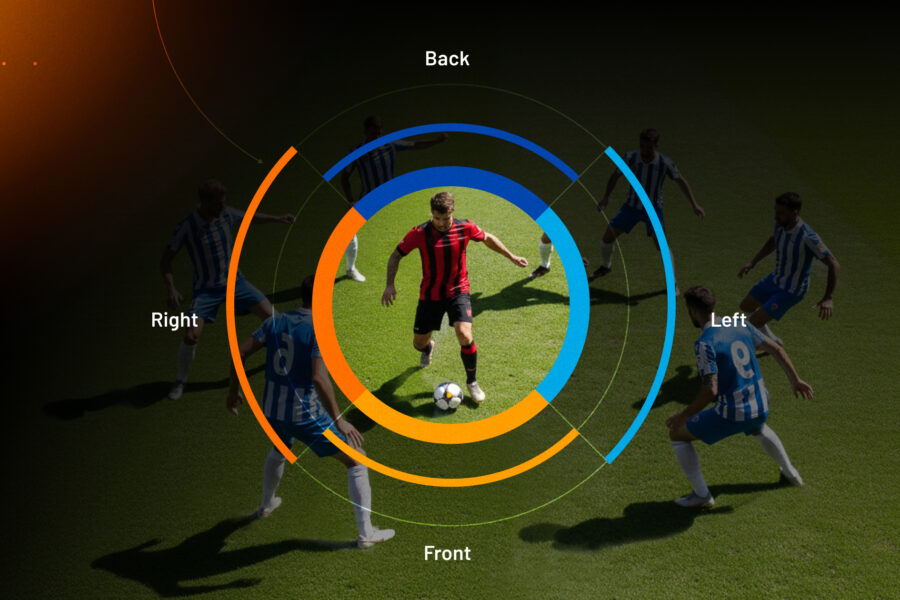
One example is Change of Inertia (COI), developed to quantify the magnitude and direction of high-intensity turning actions. It captures the lateral stress missing from GPS linear-only approaches. Independent studies have validated its reliability and precision (2,3).
Examples of practical questions COI helps answer:
Does a player accumulate more high-intensity turns to the left or right?
How does turning load evolve through a congested fixture cycle?
Which positions accumulate the most number of demanding COD?
Is the player maintaining turning intensity under fatigue?
Are the number and magnitude of turns increasing or decreasing after an injury?
What Practitioners Are Seeing
Marcos Cerveró, Head of S&C and Sports Scientist at Unicaja Málaga, integrates COI to monitor training and match load, manage injury risk, and build player profiles. Unicaja won just one title in the 15 years before he joined, then seven titles in the three years after. Is COI solely responsible? No. Does it help when your Head of S&C sees turning stress with fighter-pilot clarity? Absolutely. Being an early innovator and a big professional helps a lot to be fully prepared for competition. You can see a great example of this work in this webinar.
Recently, we published a paper (4), led by Javier Espasa (Assistant Director, FC Barcelona Performance Department) and with Franc García (Applied Sports Scientist, FC Barcelona First Team Basketball), where we found that more points and better efficiency ratings were associated with higher COI. Put simply: if you want to make an impact on the scoreboard, you need the ability to generate high curvilinear loads.
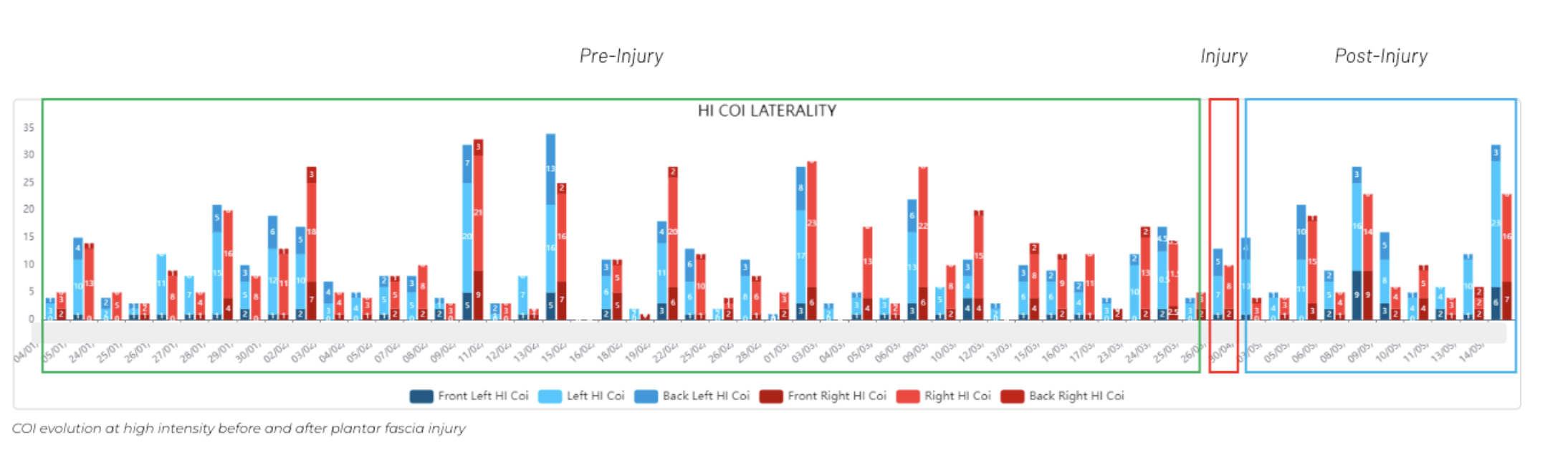
COI also helps in rehab and load monitoring. Here we see a real example from a EuroLeague football player:
Pre‑injury: directions of high‑intensity COD are chaotic and balanced across left and right, as you would expect from game context.
Post‑injury: after one month out, first sessions back show similar high‑intensity COD to the left but a clear reduction to the right.
Tactical change? Not fully recovered? Without context, impossible to know. With integrated video and physical metrics, much clearer (5).
With Hudl Signal, context is no longer a problem. Video, tactical events, and physical data live in one place, so you can understand the “problem” with the correct context. Want to see how tactical context plus physical data improves decisions? Explore a recent article here
Practical Takeaways for Coaches and Performance Staff
Don’t only rely on acceleration and deceleration to judge COD intensity. They miss the lateral story.
Add curvilinear variables to your monitoring to capture turning load
Use context plus metrics to coach the shape of the turn, not just the outcome.
Learn from Tom. He smiled at the end of his turn.
Make sure your players do the same – instead of flirting with a blackout or a muscle tear.
Victory isn’t linear. Your metrics shouldn’t be either.