A high school football coach’s honest take on AI to win back time, without losing the coaching.
If you're a high school football coach, you've probably heard plenty about AI by now.
Depending on who you're listening to, AI will either replace every job on the planet or turn a vacuum cleaner into a Terminator.
I don't buy either argument.
What I do know is this: coaching has never really been a football problem. It's always been a time problem.
Film study. Opponent breakdowns. Self-scouting. Game planning. Practice planning. Parent communication. Film uploads. Last-minute reports. All the stuff that somehow doesn't happen during the school day.
And if you're like most of us, most of that work gets done after dinner, after your kids go to bed, or while your significant other is giving you that look that says, "Are you watching film again?"
For our staff, we've been using Hudl AI Insights since the playoffs last season. When we first started, we'd do our own breakdown and then compare it to what AI found. I expected it to catch it making mistakes.
Instead, I found myself saying, "Well...that was annoyingly accurate."
The longer we used it, the more confidence we gained. Not because it was replacing our evaluation, but because it consistently helped us get to the answers faster.
Today, I trust it. Not blindly, but enough that it's become part of how we scout opponents and check our thinking. And once you start trusting an AI assistant, it's a little like opening Pandora's Box.
You stop asking, "Can this help me?"
And start asking, "What else can I make this thing do?"
Monday: Opponent Breakdown
This is where Hudl AI Assistant first grabbed my attention.
The reality is that coaches aren't short on film anymore. We're drowning in it.
The challenge isn't collecting information. It's finding the information you actually need.
Using AI to help identify tendencies or answer specific questions about an opponent can accelerate the process considerably. Instead of spending as much time digging through clips trying to confirm something you think you're seeing, you can start getting answers faster.
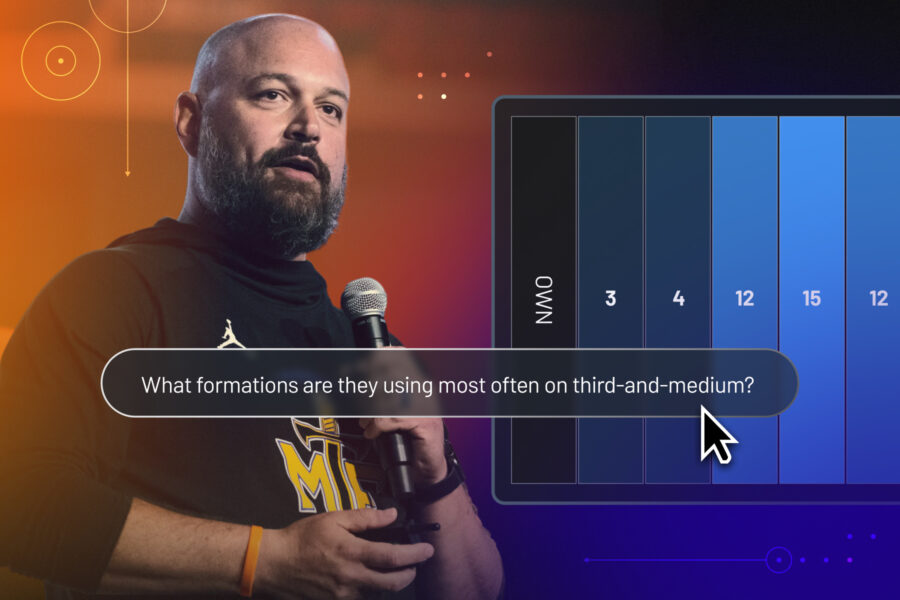
What formations are they using most often on third-and-medium?
What are they doing in the red zone?
How often are they running behind a particular player?
I'm still watching the film. I'm still making the coaching decisions. AI just helps surface information faster so I can spend more time evaluating it.
Think of it like having the world's most eager freshman assistant coach.
Except this one doesn't forget his notebook, miss curfew at camp, or eat all the sideline snacks.
Tuesday: Self-Scout
One of the biggest mistakes coaches make is believing we're unpredictable simply because we intended to be unpredictable.
AI has no feelings about your game plan. It doesn't care how clever you think that tendency breaker is.
One thing I've started using Hudl AI-Powered Reports for is seeing our offense the same way an opposing coach might see it. Sometimes it confirms what I already suspected. Other times it points out something I hadn't noticed.
And sometimes it points out you've become about as predictable as a Midwest dad slapping his knees and saying, "Welp, guess we'd better get going."
I've found it useful for identifying things like:
Personnel tendencies
- Formation tendencies
- Run/pass indicators
- Down-and-distance tendencies
- Situational play tendencies
Those are things opposing staffs are looking for anyway.
I'd rather know they're there before Friday night than discover them when someone else does.
Wednesday: The Stuff Nobody Wants To Do
Every staff has those tasks.
They're important. They matter. Nobody enjoys doing them.
Historically, those jobs have been assigned to whichever young coach drew the short straw.
This is where AI has the potential to make a huge difference.
Some of these are things I've already used it for. Others are things I've started experimenting with. And plenty more are things I think coaches will be using sooner rather than later.
Things like:
- Creating first drafts of scouting reports
- Summarizing film notes
- Organizing practice scripts
- Building meeting agendas
- Creating position-specific coaching points
- Searching large data sets for trends
- Building weekly communication for players and parents
- Compiling season statistics
- Turning raw observations into cleaner reports
Years ago we'd hand those projects to the new guy and tell him to figure it out.
Now I find myself wondering whether AI can handle the first 80 percent of that work so coaches can spend more time coaching.
Because if you've ever spent two hours staring at a spreadsheet instead of game film, you know exactly what I'm talking about.
Thursday: What Else Can This Thing Do?
This is honestly where my brain goes now.
When we first started using Hudl AI-Powered Reports during last year's playoffs, I viewed it mostly as a sanity check. We'd do our own assessment, compare notes, and see what it found.
The accuracy was surprising enough that eventually we stopped asking whether it was useful and started asking what else it might be useful for.
Now I catch myself thinking:
- Can it help break down our film faster?
- Can it help break down opponent film?
- Can it identify tendencies we're not seeing?
- Can it help us self-scout more effectively?
- Can it pull data together that would otherwise take hours to sort through?
- Can it help organize information that we already have but never seem to have enough time to analyze?
Most of those questions are still being explored. But once you start seeing the possibilities, it's hard not to keep asking what's next.
It's a little like giving a teenage offensive lineman access to an all-you-can-eat buffet. The first plate isn't the problem. It's what happens after he realizes there are unlimited trips.
What I Don't Use It For
There are still plenty of things AI doesn't do.
It doesn't motivate players. It doesn't build relationships. It doesn't make halftime adjustments. It doesn't know when a kid needs a hard coaching point versus a conversation. And it certainly doesn't know what your left guard means when he tells you, "Coach, I got him."
Every offensive line coach reading this knows that's either the most reassuring statement in football or the last thing you hear before disaster.
The coaching part remains coaching.
AI just helps us spend more time doing it.
Where This Is Going
I think we're still in the first quarter of what AI will become for football coaches.
A few years from now, I think we'll look back at manually searching through hours of film the same way we look back at carrying around giant binders full of scouting reports.
The coaches who benefit most won't be the ones who let AI coach for them. They'll be the ones who use it to eliminate the low-leverage work that steals their time.
For me, that's the biggest takeaway.
AI isn't coming for coaches. It's coming for the hours we spend doing things that don't actually make us better coaches.
And if it can give me more time to watch film, spend time with my family, grab a cheeseburger for a completely unnecessary food review, or convince my wife that another quote from a 1990s movie absolutely applies to whatever situation we're discussing, it’s a technology worth paying attention to.