Atalanta, Strikers and Shot Creation

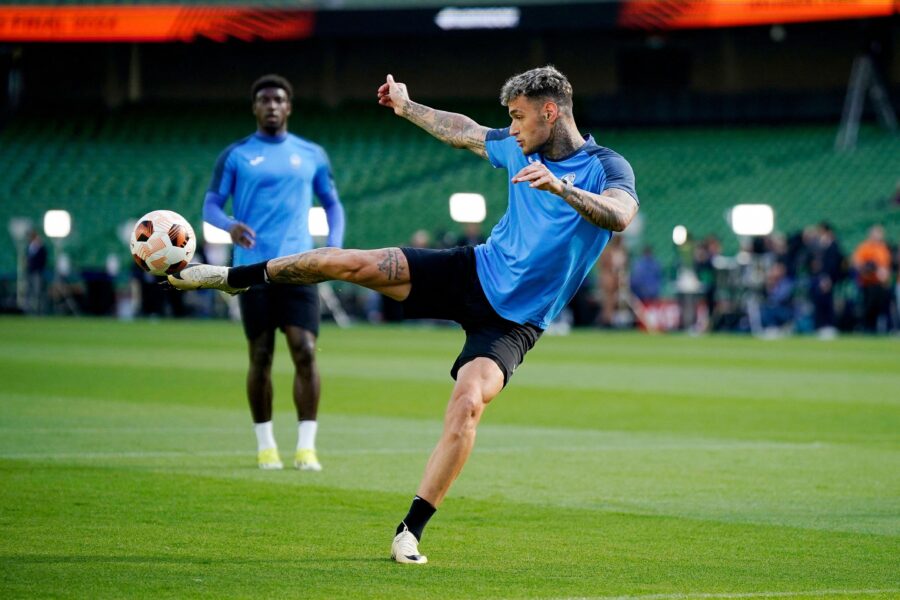
In this article, L’Ultimo Uomo uses Statsbomb data to look at the numbers behind Atalanta’s rich tradition of strikers – and whether that is likely to continue in a post-Gasperini era.
There aren’t many certainties in football, but one thing Serie A fans have grown accustomed to in recent years has been Atalanta strikers outperforming expectations.
They might not always be the league’s top scorers, but the likes of Duván Zapata, Luis Muriel and Rasmus Højlund always guaranteed a good number of goals without fail.
And in the case of Mateo Retegui, Atalanta converted the Argentine-born forward from a solid mid-table player into capocannoniere in the space of one season, before pocketing €65million from Saudi Arabian side Al-Qadisah
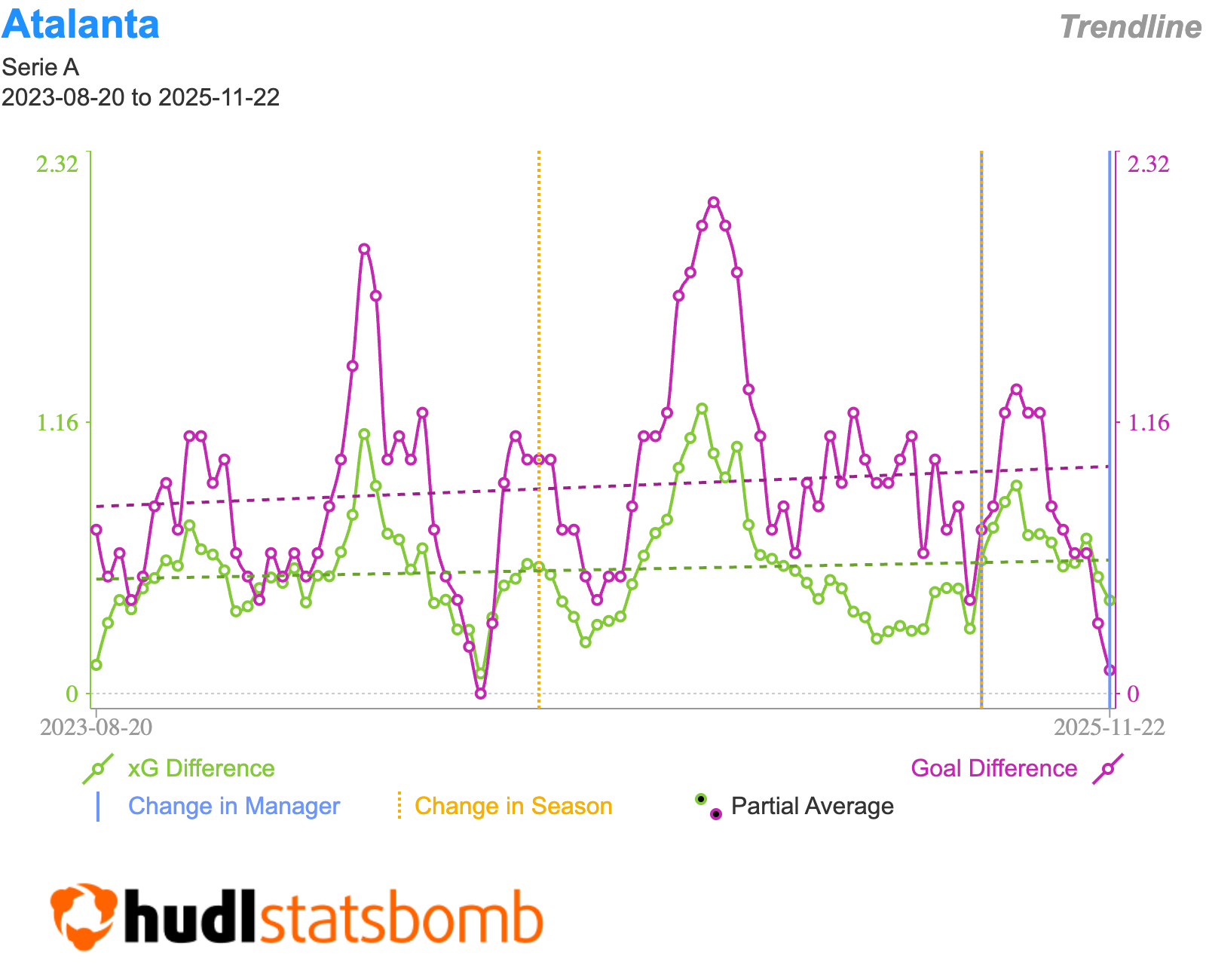
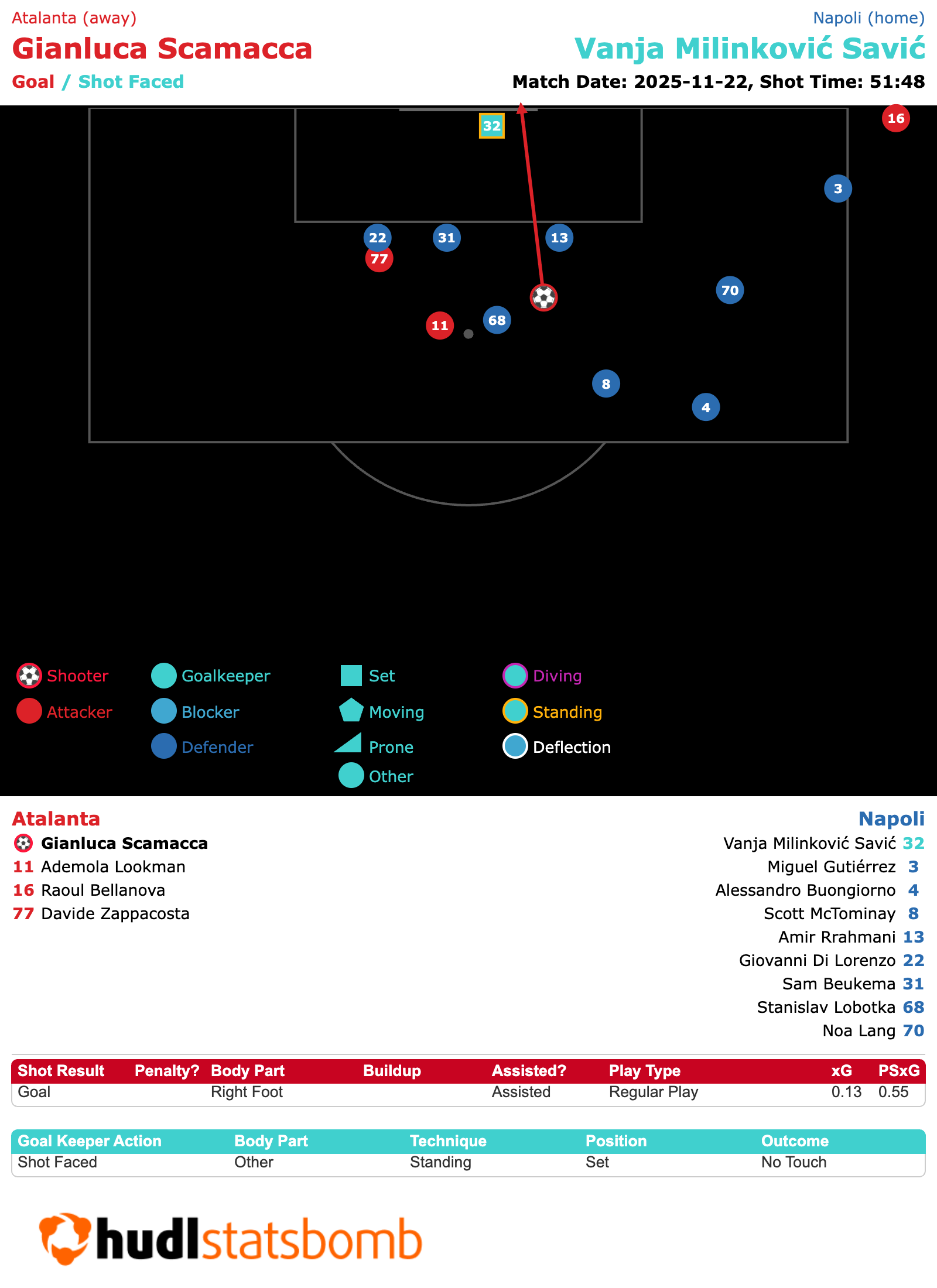
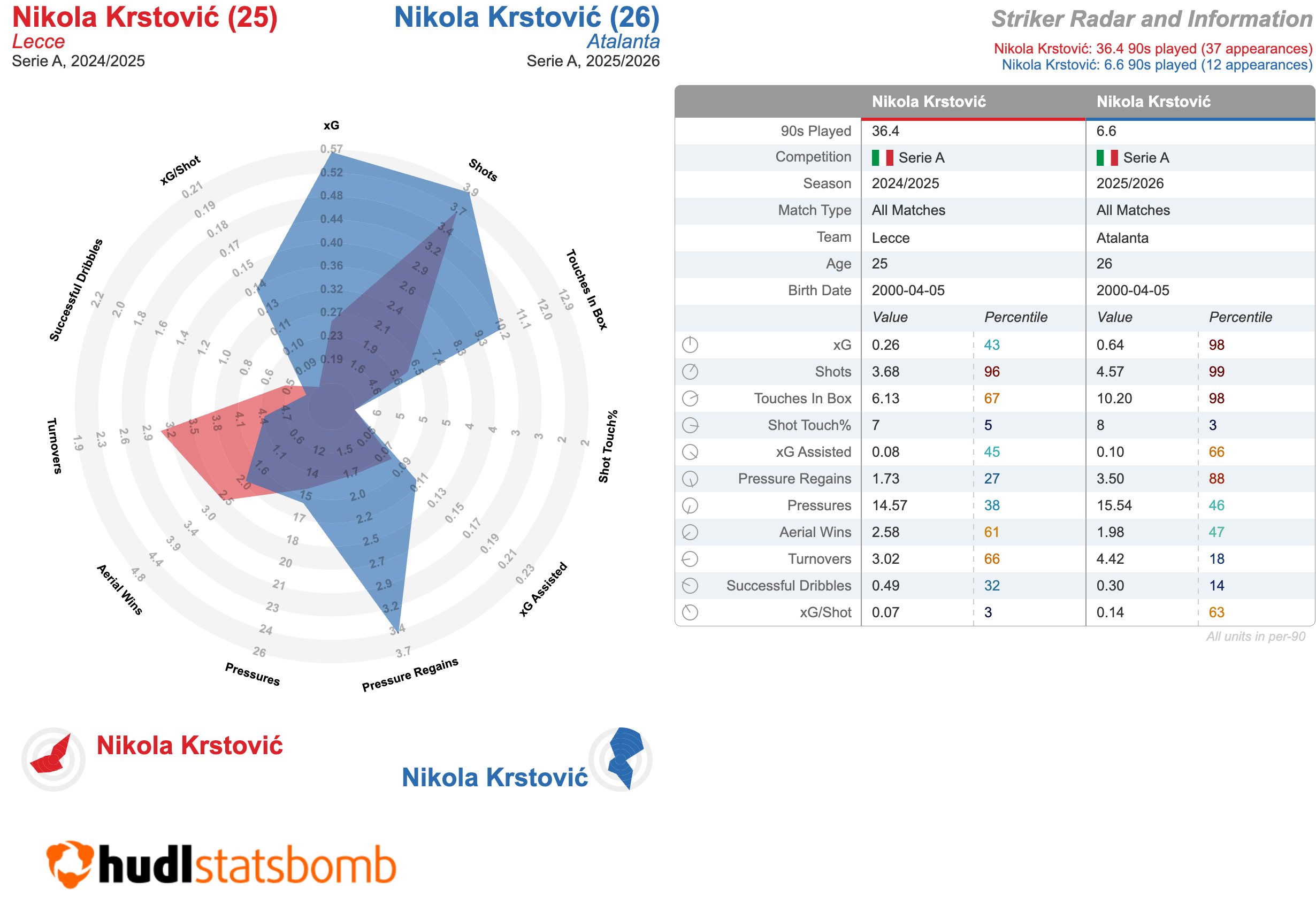
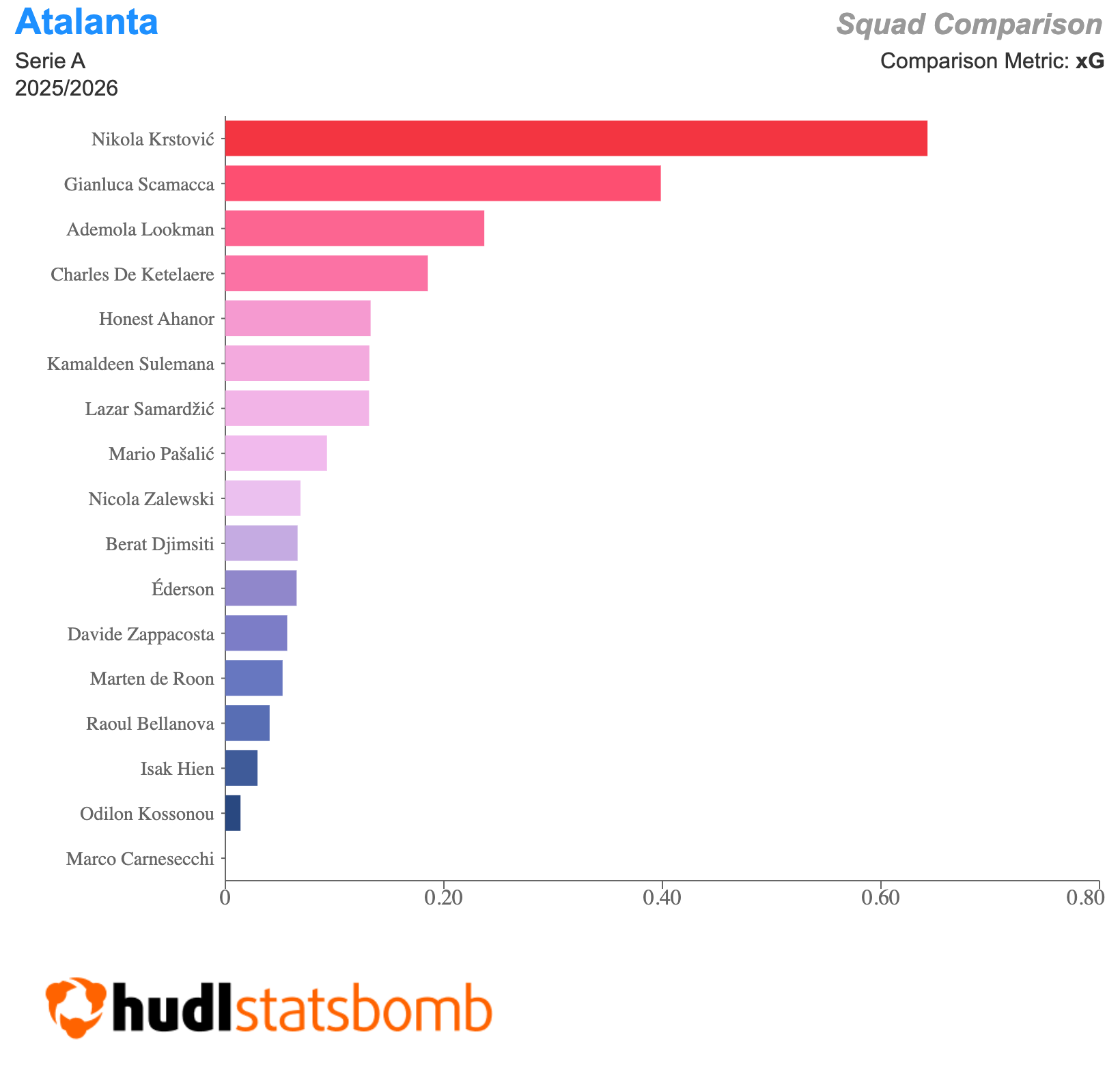
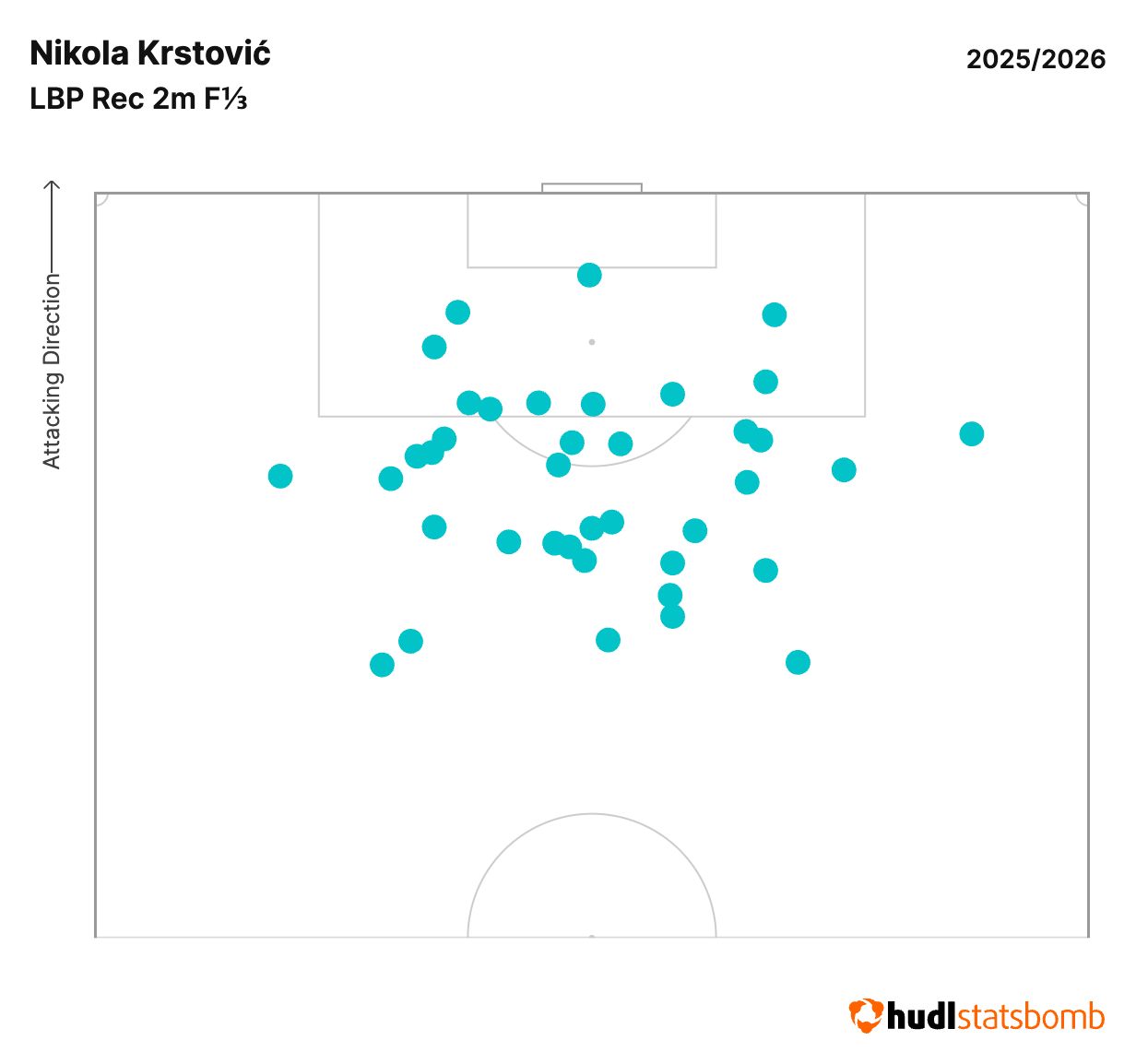
While it’s a fairly natural improvement when moving from a team in the lower part of the table to one that has been qualifying for the Champions League for years now, Krstović’s numbers are not an isolated case but represent the continuation of a phenomenon seen under Gasperini.
Shots Fired
As mentioned, in recent years Atalanta have had the magical ability to exponentially raise the performances of their number nines: not only the starters, but also those coming off the bench. The statistics prove it.
Let’s take the cases of Scamacca and Retegui, who both enjoyed genuine breakthroughs in 2023/24 and 2024/25 in the nerazzurro shirt respectively.
Both players had the best seasons of their careers in Bergamo in terms of scoring average in Serie A: 0.69 non-penalty goals per 90 minutes for Scamacca, and an impressive 0.75 for Retegui.
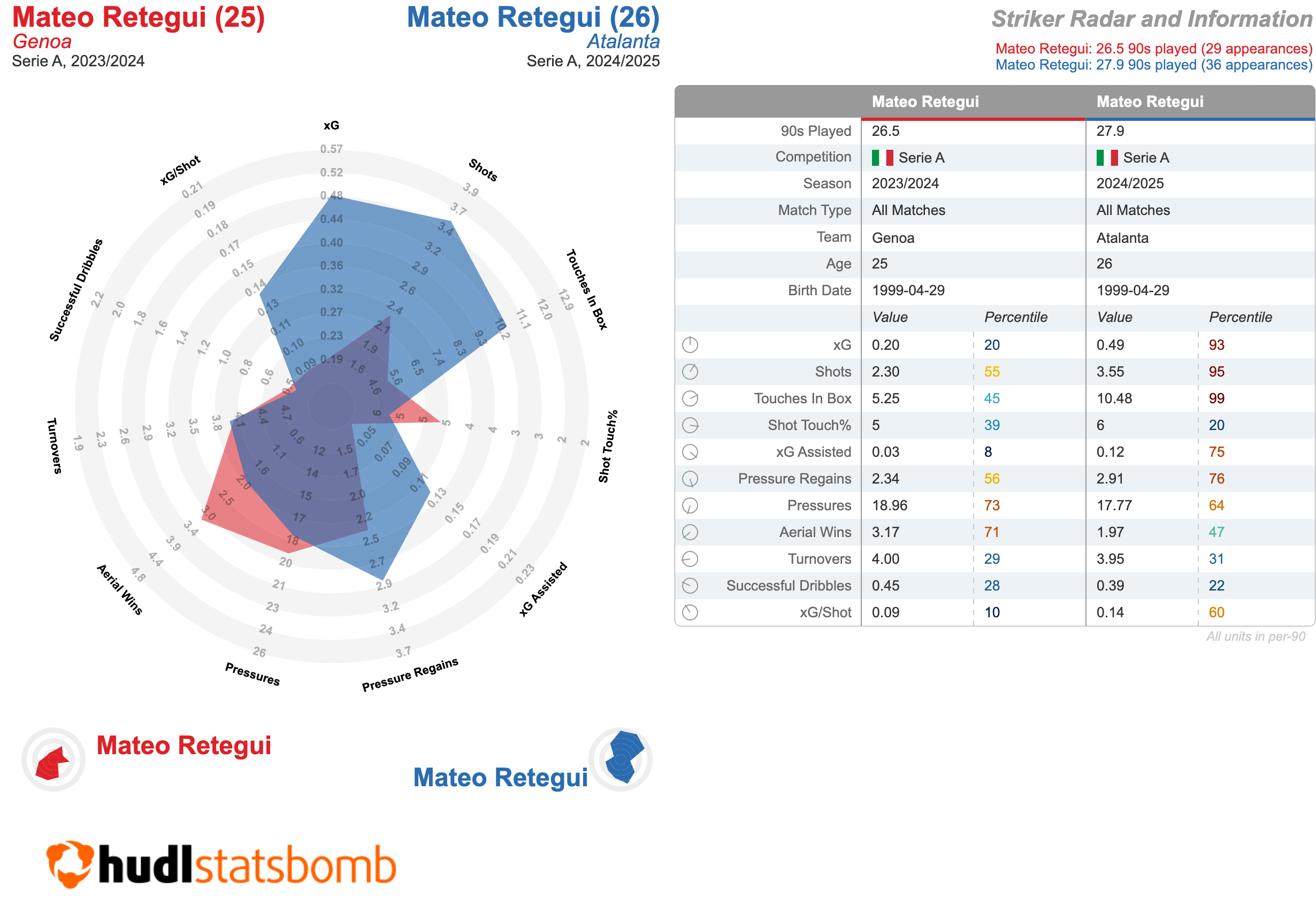
Part of this goalscoring increase is directly related to the increase in shot volume that strikers experienced when moving to Gasperini’s Atalanta. For example, Retegui arrived in Europe at Gilardino’s Genoa. For him, moving from the rossoblù to Atalanta meant going from 2.3 shots per 90 in 2023/24 to 3.55 per 90 in 2024/25.
Going further back, Duván Zapata showed a huge jump from around 2.2 shots per 90 at Udinese and Sampdoria to four consecutive seasons of 3.4+ – reaching a high of 3.89 – per 90 output at Atalanta.
Compatriot Luis Muriel went from around 2.6 shots per 90 at both Sevilla and Fiorentina in 2018/19, before registering a massive 4.73 per 90 in 2019/20 and 4.85 in 2020/21.
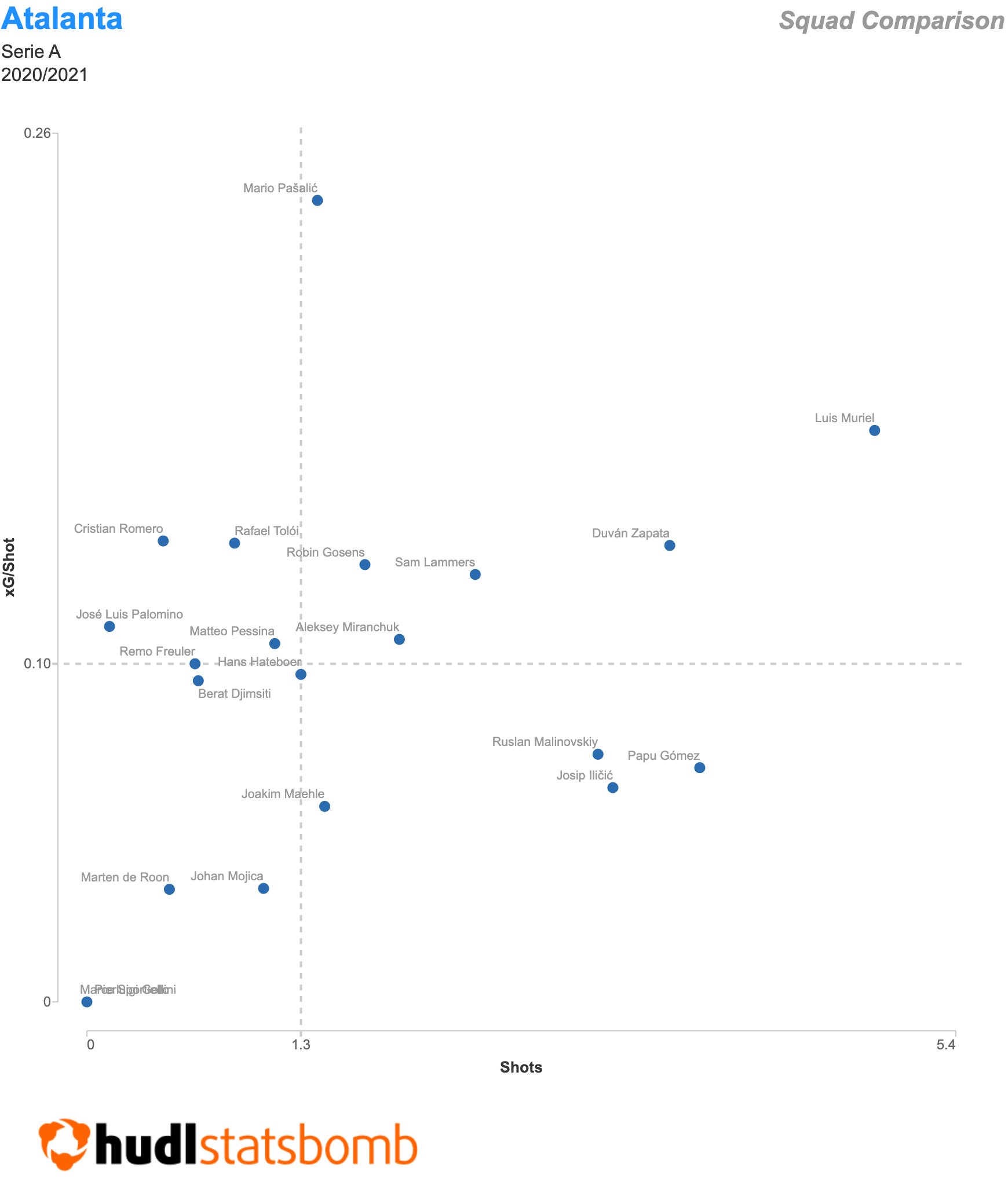
While not at the same level as the two Colombians, Rasmus Højlund saw his 1.90 shots per 90 at Sturm Graz in 2021/22 rise to 2.41 when he joined Atalanta, before dropping back down to 1.44 and 1.36 at Manchester United.
The situation is more nuanced for the other Atalanta striker of recent years, Scamacca, who, before arriving in Bergamo, had already found success at a small but strongly attack-minded club: Alessio Dionisi’s Sassuolo in 2021/22.
In moving from the Emilia-Romagna side to the nerazzurri (with the disappointing spell at West Ham in between), Scamacca has seen an uplift in shot volume, albeit not as pronounced, going from roughly 3 per 90 at Sassuolo to 3.45 in his first season at the Stadio di Bergamo.
Scamacca, then, has performed broadly in line with his past. However, production — the chances he had — represents only the output, the final result of what Atalanta created.
What has truly changed in the move from teams like Sassuolo, Lecce and Genoa to Atalanta, and what shows just how special la Dea has been and continues to be, is the way the ball reaches them and the positions they receive it in. In other words, moving to Atalanta has meant receiving the ball in more dangerous areas.
Quality, not just Quantity
Under Gasperini, Atalanta had a unique ability in Italy to combine technical quality with off-the-ball movement, always geared towards attacking vertically and creating space for whoever received the ball.
Moreover, the nerazzurri were — and still are — among the few Serie A sides boasting attacking players capable of keeping the ball in tight spaces, right on the edge of the box, where it’s easiest to create danger.
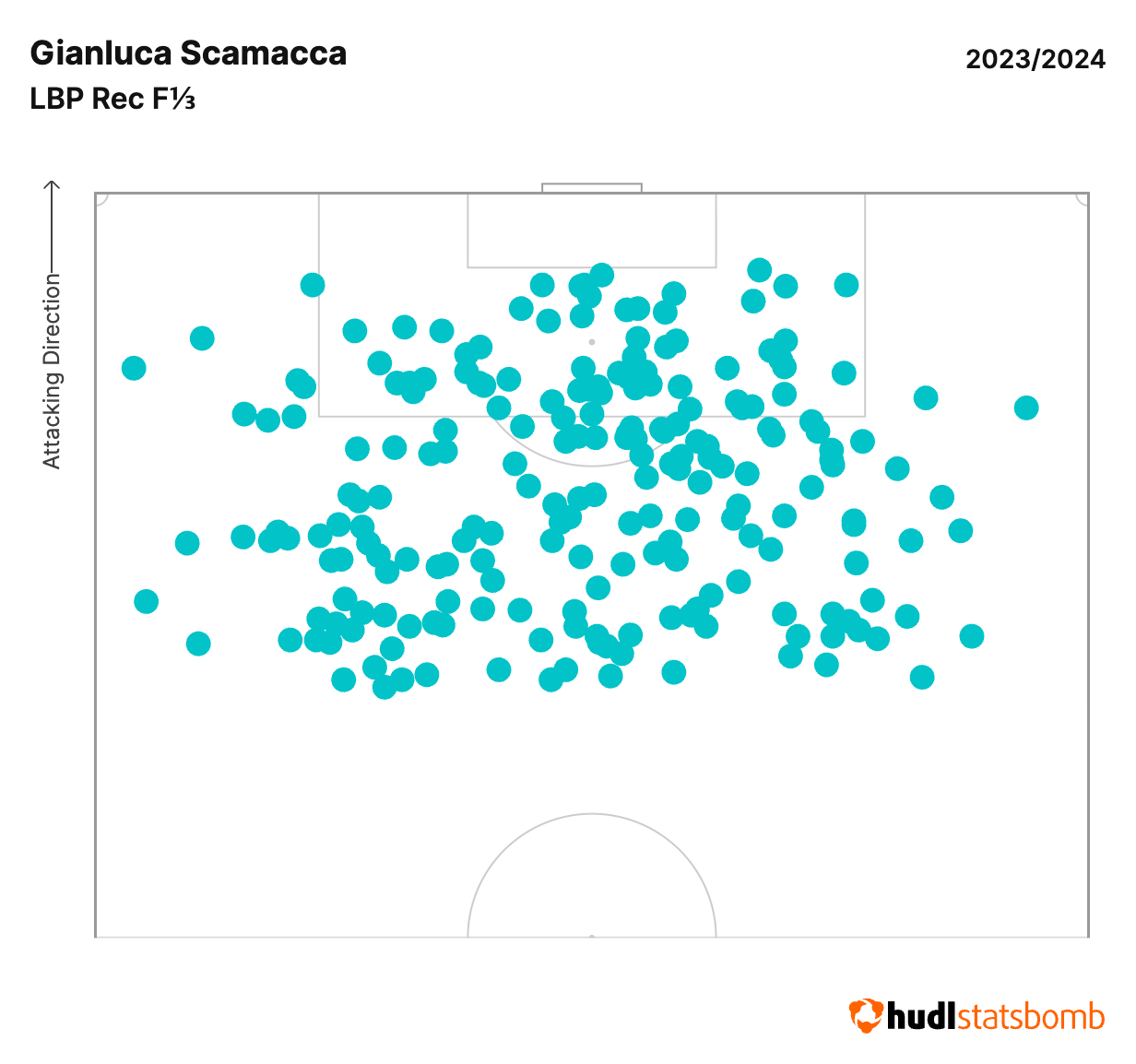
Scamacca, then, just like Retegui, owes part of his breakthrough to the fact that he received the ball in better conditions. Both improved their numbers in metrics that indicate more dangerous types of receptions, as per Statsbomb data.
Both Scamacca and Retegui increased their touches inside the penalty area. For the former, from 6.35 in his season at Sassuolo to 10.08 in 2023/24 at Bergamo. For Retegui, he went from 6.24 with Genoa to 11.81 with Atalanta.

The number of line-breaking passes they received in the final third also rose significantly. Through balls should, in theory, make it easier to play a striker into dangerous situations.
At Sassuolo, Scamacca received 5.6 line-breaking passes per 90 minutes in the final 30 metres, of which only 3.11 came with at least two metres of space — a significant margin for freedom. In 2023/24 at Atalanta, however, he received 9.74, of which 5.42 came with two metres of space available.
Learn how Hudl Statsbomb’s industry-leading data can power your analysis and recruitment.
Visit L’Ultimo Uomo website.